
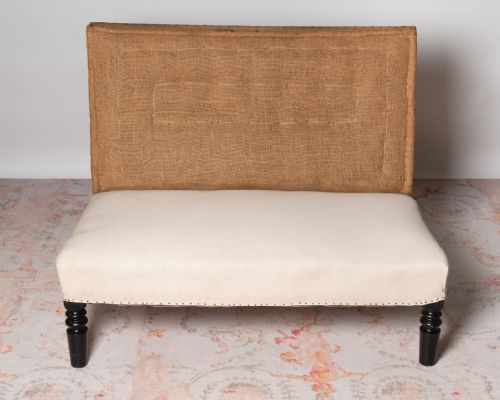


Vintage Hall Settee
A vintage hall settee offers compact seating for an entryway, combining period timber and upholstery to welcome visitors with character.
Vintage Hall Settee
When buyers search for a vintage hall settee, they encounter a compact seating form designed for narrow spaces like corridors, landings, and entranceways. The selection spans pieces from the 19th Century, Edwardian era, and the 1920s, reflecting diverse domestic needs over decades.
The objects listed here appear as settees, benches, banquette sofas, and window seats rather than large living room suites. Origins range across English, French, Italian, Viennese, and Chinese traditions, bringing distinct regional silhouettes to the hallway.
Edwardian mahogany and inlaid satinwood items sit alongside painted couches, French leather banquettes, and bentwood designs. Buyers find pieces matching specific historic aesthetics, from Art Nouveau curves to Neoclassical restraint.
Materials and construction methods
Makers utilised solid timbers such as mahogany, beech, blonde wood, and satinwood to build these frames, often applying paint finishes or decorative inlay. The structural integrity relies on traditional joinery suitable for compact seating.
Upholstery forms a key component of many pieces, utilising leather, velvet, fabric, and linen trims. Bentwood techniques appear in Austrian work, employing steam-bent timber to create lightweight yet durable frames.
The selection includes Edwardian pieces, 1920s designs, and 19th Century items spanning French, Italian, and Chinese origins.
Judging the standard of a settee
Quality rests in the harmony of the timber grain, the precision of any wood inlay, and the retention of original surface finishes like paint or polish. Refined proportions separate simple utility benches from sophisticated reception seating.
The integrity of the frame construction and the quality of the covering materials - whether supple leather, woven fabric, or plush velvet - dictate the enduring appeal of the piece.
Thonet
The Vintage Hall Settee Glossary
- Banquette
- An upholstered bench or settee, often featuring back support and decorative trim. These pieces originated in French domestic spaces.
- Bentwood
- Timber shaped by steam application to form curved structural elements. This technique defines lightweight production from the early twentieth century.
- Inlay
- A decorative technique where contrasting woods or materials are set into the surface of the primary timber. Satinwood and mahogany frequently display this detail.
- Satinwood
- A durable timber with a characteristic golden sheen, prized for fine furniture decoration. It appears in polished and inlaid surfaces.
Vintage Hall Settee: Frequently Asked Questions
Where should I place a vintage hall settee?
These compact seats suit narrow hallways, entryways, landings, and bedroom ends where full-sized sofas prove too large. Their shallow depth allows passage in transitional spaces.
Positioning one near a door provides a convenient spot for removing shoes while adding period character to the threshold of a home.
How do I identify an Edwardian settee?
Edwardian examples often feature light mahogany timbers, delicate inlay work, and influences from Art Nouveau or Neoclassical styles. They tend to look lighter and more refined than heavy Victorian alternatives.
Construction methods from this period balance decorative appeal with practical domestic utility for entrance halls.
What is a bentwood hall seat?
A bentwood seat utilises steam-bent timber components to form curved, resilient frames without heavy joints. Makers like Thonet pioneered this approach for public and domestic seating.
These pieces offer an airy profile that works well in confined entryways where solid wood might appear too bulky.
Can I use a banquette in a hallway?
French banquettes and similar upholstered forms fit well in wide hallways or reception areas as statement seating. Their padded backs and seats provide comfort for guests.
Ensure the dimensions leave sufficient walking space for everyday traffic before placing an upholstered bench in a narrow corridor.