


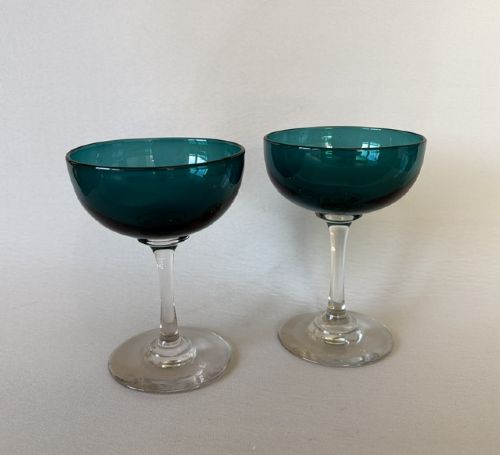






Vintage Green Stemware
Vintage green stemware brings striking colour and historical character to a table, spanning Georgian, Victorian and twentieth-century eras.
Vintage Green Stemware
Vintage green stemware encompasses wine glasses, hock glasses, champagne coupes and cordial glasses produced across the eighteenth, nineteenth and twentieth centuries. These vessels appear in shades ranging from deep emerald and Bristol green to aqua, turquoise and cased glass.
The selection on this page relies heavily on Victorian productions alongside Georgian examples, Edwardian designs and pieces from the nineteen-thirties. Wine glasses and hock glasses form the majority of the objects found here.
Continental workshops and English makers dominate the origins, presenting everything from simple coloured glass to elaborate enamelling and cut crystal. Collectors encounter pairs and larger sets, such as sets of six, which suit modern dining tables just as well as display cabinets.
What varies in quality
Quality in these drinking vessels rests upon the clarity of the glass, the precision of the cutting and the fineness of any enamel work. Heavier lead glass and deeply saturated cased glass demonstrate superior material substance.
The artistry involved in hand-enamelling and the crisp execution of wheel-cut facets separate standard production items from workshop pieces created by notable glasshouses.
Vintage Green Stemware Retail Price Guide 2026
Typical asking prices for vintage green stemware among the pieces listed under this phrase on Sellingantiques today, from the lower quarter to the upper quarter. They describe what is for sale here now, not the wider market.
Listings span the Georgian, Victorian, Edwardian, and Art Deco periods, featuring materials such as lead glass, cased glass, and enamel.
Baccarat·Theresienthal·James Powell·St Louis Massenet
The Vintage Green Stemware Glossary
- Hock glass
- A tall-stemmed wine glass traditionally used for German white wines. These often feature coloured bowls and intricate cutting.
- Cased glass
- Glass formed of two or more distinct layers of different colours. Cutting through the outer layer reveals the contrasting colour beneath.
- Vaseline glass
- Glass containing uranium dioxide that produces a distinctive yellow-green colour. It glows under ultraviolet light.
- Champagne coupe
- A shallow, broad-bowled stemmed glass designed for sparkling wine. Vintage examples frequently utilise coloured glass or over-crystal techniques.
- Enamel decoration
- Applied coloured glass pigments fused to the surface through firing. This technique adds floral or abstract motifs to the body.
Vintage Green Stemware: Frequently Asked Questions
How do I date vintage green stemware?
Dating relies on stylistic clues, pontil marks on the base, and the weight of the glass. Georgian and early Victorian pieces often display heavier proportions and hand-finished pontils.
Later twentieth-century examples from the nineteen-thirties tend to show more stylised forms, reflecting Art Deco or Arts and Crafts movements.
Can I use these glasses for daily dining?
Many buyers choose to use their vintage stemware for special occasions or everyday dining. Hand-washing is essential to preserve fragile enamel decoration and delicate gold leaf.
Sudden temperature changes should be avoided to protect antique glass from thermal shock.
What is Bristol green glass?
Bristol green refers to a deep, rich shade of dark green traditionally associated with English glass production in the eighteenth and nineteenth centuries. The colour results from specific mineral content in the glass batch.
This hue became a standard descriptor for wine glasses originating from that period.
Are these glasses sold in matching sets?
Listings frequently include pairs of glasses alongside larger sets of six. Matched sets of six wine glasses or cordial glasses are particularly sought after for entertaining.
Individual pieces and pairs also appear for those looking to mix colours and styles on a table.