


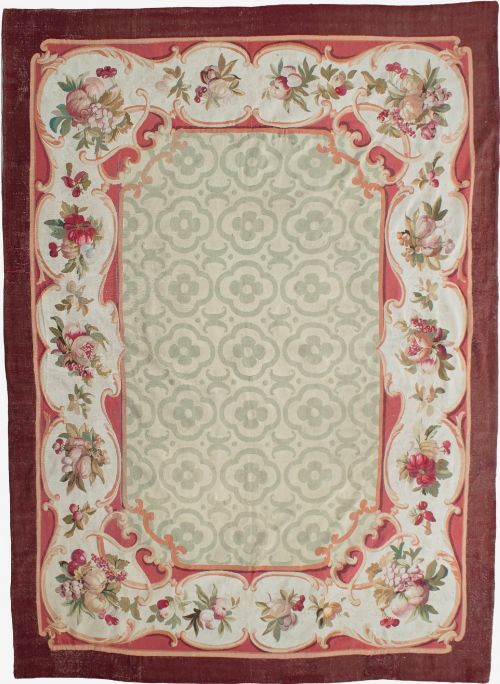


Vintage French Rug
A vintage french rug brings centuries of European design into a room, offering warmth and classical elegance underfoot.
Vintage French Rug
When you search for a vintage french rug, you encounter woven floor coverings and tapestries that reflect historic European craftsmanship. The selection centres on Aubusson weaves and nineteenth-century tapestry carpets, alongside related needlepoint and chain stitch interpretations from various periods.
Most examples originate from the mid-nineteenth century, spanning the eighteen-fifties to the eighteen-seventies, with occasional twentieth-century interpretations. Forms range from large carpets to square area rugs, often displaying classical floral and architectural motifs derived from French chateau and rococo traditions.
How they were made
These textiles rely primarily on wool and cotton foundations, combined in flatweave, needlepoint, or tapestry techniques. Artisans worked these natural fibres by hand to build dense, durable surfaces capable of holding intricate botanical and scrollwork patterns.
The construction methods focus on creating a flat, resilient textile rather than a deep pile. This allows the detailed neoclassical and rococo designs to remain crisp and legible across the expanse of the rug.
Vintage French Rug Retail Price Guide 2026
Typical asking prices for vintage french rug among the pieces listed under this phrase on Sellingantiques today, from the lower quarter to the upper quarter. They describe what is for sale here now, not the wider market.
Listings for this phrase span from eighteen-fifty through to nineteen-fifty, incorporating wool, cotton, and occasional canvas supports.
What varies in quality
Quality in these textiles rests upon the precision of the weave and the complexity of the design layout. Finer examples display tightly packed stitches that render floral borders and central medallions with sharp clarity.
The sophistication of the palette and the fidelity of the historical style also distinguish superior pieces. Earlier nineteenth-century specimens generally exhibit a more harmonious integration of traditional motifs than later adaptations.
The Vintage French Rug Glossary
- Aubusson
- A style of tapestry weave and carpet originating from the French town of Aubusson. These pieces typically feature classical floral and architectural medallions without a raised pile.
- Tapestry rug
- A flat-woven textile produced on a loom using coloured weft threads to form pictorial or ornamental patterns. It offers a smooth surface suited to detailed classical designs.
- Needlepoint
- A type of embroidery stitched onto a canvas mesh ground by hand. It provides a dense and durable texture often utilised in traditional European floor coverings.
- Flatweave rug
- A carpet constructed without knots or pile by interlacing warp and weft threads together. This technique results in a lightweight textile that lies flat upon the floor.
Vintage French Rug: Frequently Asked Questions
Where should I place a vintage french rug?
These rugs suit low-traffic living areas, studies, or bedrooms where their delicate weaves face minimal heavy wear. Placing them away from direct, harsh sunlight helps preserve the natural wool and cotton fibres.
Pairing the rug with a quality underlay provides necessary cushioning and prevents slipping on smooth wooden or tiled floors.
How do I clean a vintage french rug?
Gentle surface cleaning and occasional professional specialist attention keep these antique textiles in stable condition. Avoid vigorous scrubbing or soaking, which damages the historic wool and cotton construction.
Regular careful vacuuming using a suction-only attachment removes surface dust without pulling at the flatweave or needlepoint stitches.
How do I identify an Aubusson rug?
Aubusson rugs are distinguished by their flat-woven tapestry structure rather than a knotted pile. They frequently display classical French floral sprays, scrolling acanthus leaves, and central architectural medallions.
Many examples date from the nineteenth century and reflect neoclassical or rococo design vocabularies popular in historic French interiors.
Can I use a flatweave rug in a hallway?
Flatweave rugs provide a slim profile that works well in areas requiring doors to pass easily overhead. Their sturdy construction handles moderate foot traffic when supported by a proper underlay.
Evaluating the specific condition and density of the weave helps determine if a nineteenth-century textile is robust enough for a busy corridor.