

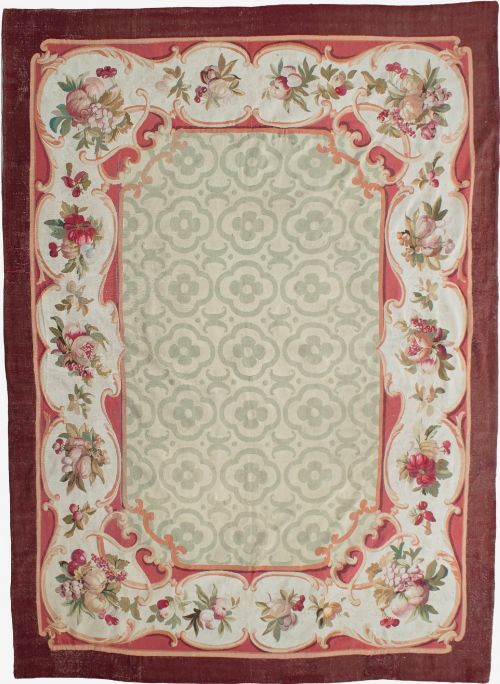


Rose Tapestry Carpet
A rose tapestry carpet brings botanical warmth to a floor, offering distinctive floral motifs woven in wool and cotton across various periods.
Rose Tapestry Carpet
A rose tapestry carpet is a floor covering defined by woven floral patterns, most commonly encountered here as French Aubusson rugs or Bessarabian kilims. These pieces range in origin from the mid-nineteenth century up to the early twentieth century, spanning periods such as 1850, 1870, 1890 and 1920.
The forms available include standard area rugs, larger rectangular carpets, square rugs and flatweave kilims. Buyers searching for a rose tapestry carpet will frequently discover either French Rococo and Chateau styling or flatweave kilim constructions.
Materials and construction
These carpets are constructed primarily from wool and cotton, utilising traditional weaving techniques suited to flatweave kilims and tapestry-woven floor coverings. The interplay of these natural fibres gives the textiles their characteristic weight and drape on the floor.
The production methods vary between the tapestry weave of French Aubusson pieces and the flatweave construction of Bessarabian kilims. Both techniques allow for crisp floral depictions and detailed borders executed in dyed wool.
Rose Tapestry Carpet Retail Price Guide 2026
Typical asking prices for rose tapestry carpet among the pieces listed under this phrase on Sellingantiques today, from the lower quarter to the upper quarter. They describe what is for sale here now, not the wider market.
Sheep supplied the wool for these carpets centuries ago, quite unaware their coats would end up immortalised as French roses on nineteenth-century floors.
Assessing quality
Quality in these textiles rests upon the precision of the floral drawing and the complexity of the colour palette within the wool and cotton weave. Pieces designed in the French Rococo or Chateau styles often display intricate shading in the rose motifs.
The fineness of the weave distinguishes the standard examples from the finer productions recorded in the inventory. A tighter structural tension in the flatweave or tapestry construction yields a firmer handle and sharper pictorial definition.
The Rose Tapestry Carpet Glossary
- Aubusson
- A tapestry-woven carpet or rug originating from France, known for floral designs and architectural borders without a knotted pile. These pieces often reflect French Rococo and Chateau influences.
- Kilim
- A flatweave carpet or rug made without a pile, traditionally produced in regions such as Bessarabia. The technique creates a smooth surface where the pattern is created by tightly interweaving warp and weft threads.
- Flatweave
- A textile construction method where rugs are woven on a loom without knotting yarn into a foundation. This results in a thinner, lighter floor covering compared to piled carpets.
- Bessarabian
- A regional style of kilim characterised by deep backgrounds and realistic floral arrangements. These nineteenth and early twentieth-century pieces often feature large roses set against dark wool.
Rose Tapestry Carpet: Frequently Asked Questions
How do I clean a flatweave rug?
Flatweave rugs benefit from gentle surface cleaning and regular cautious vacuuming without a rotating brush.
Professional specialist cleaning is recommended for antique wool and cotton textiles to preserve the natural fibres.
Where should I place an Aubusson rug?
Aubusson rugs suit low-traffic drawing rooms or bedrooms where the flat tapestry weave is protected from heavy wear.
Placing them away from direct sunlight helps prevent fading in the dyed wool and cotton.
What is the difference between a kilim and an Aubusson?
A kilim is a flatweave textile traditionally associated with Bessarabian workshops and bolder geometric or floral layouts.
An Aubusson is a French tapestry weave typically featuring formal floral bouquets and classical architectural borders.
How do I date a nineteenth-century carpet?
Dating relies on stylistic clues, such as French Rococo revival motifs or Bessarabian colour palettes, alongside material analysis.
Comparing structural details of the wool and cotton weave with documented examples from periods like 1850 or 1890 assists verification.