



Vintage French Bureau Plat
A vintage French bureau plat offers a sophisticated writing surface, bringing refined continental elegance to any room.
Vintage French Bureau Plat
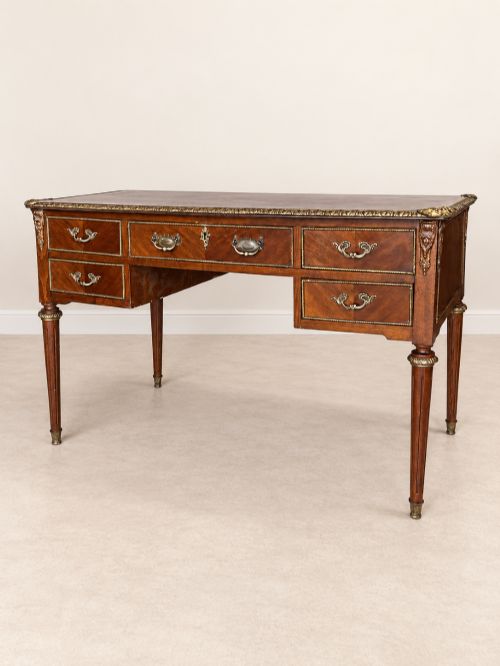
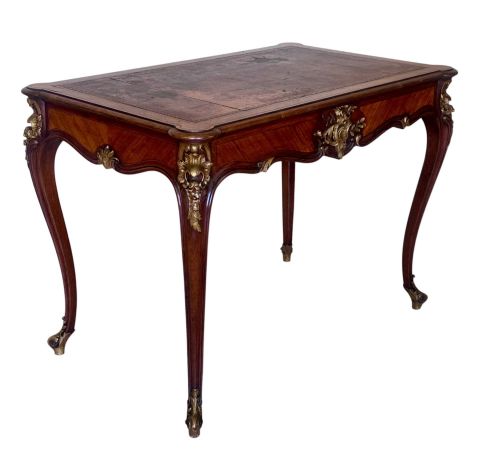
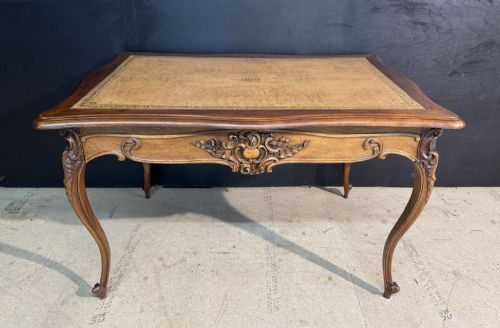
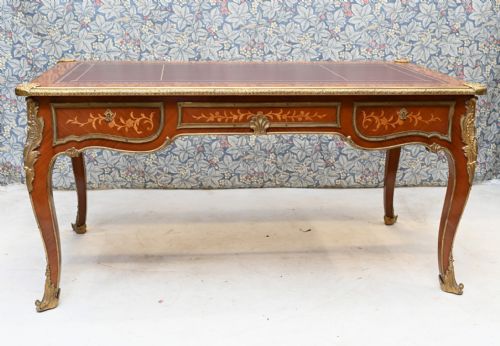
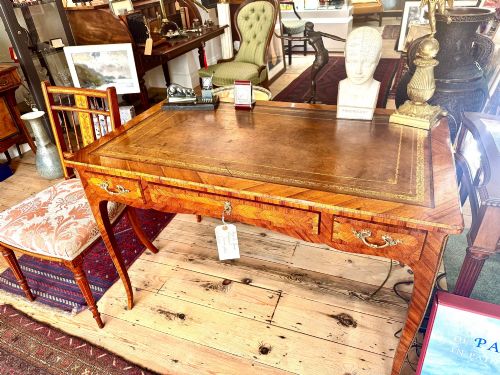
A vintage French bureau plat is a freestanding writing table designed to sit away from the wall, featuring a dedicated writing surface often inset with leather. These pieces emerge from periods spanning the nineteenth century and into the early twentieth century, drawing heavily on classical French design idioms.
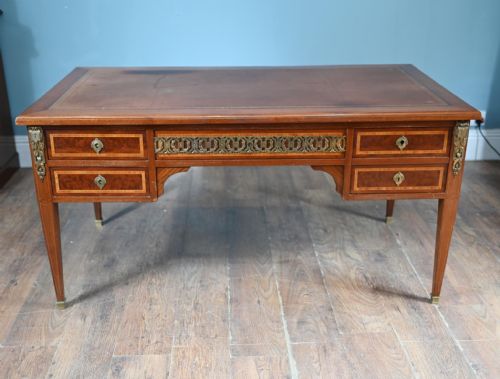
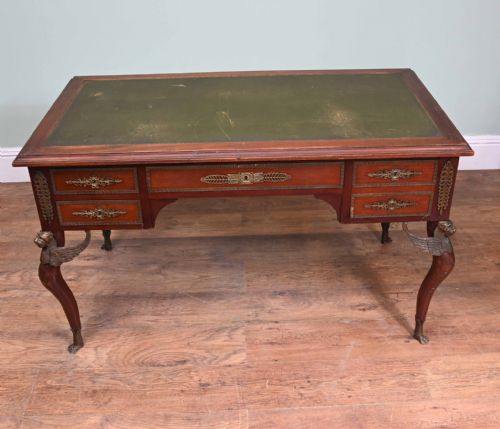
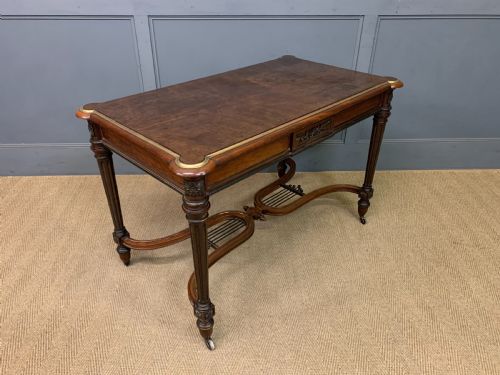
The most common iterations encountered here adhere to Louis XV and Louis XVI revival styles, alongside Empire and Directoire interpretations. Makers constructed these desks primarily in forms categorised as writing tables, centre tables, and specific writing desks.
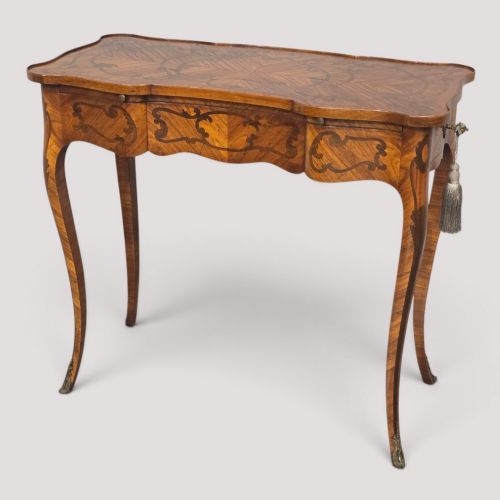
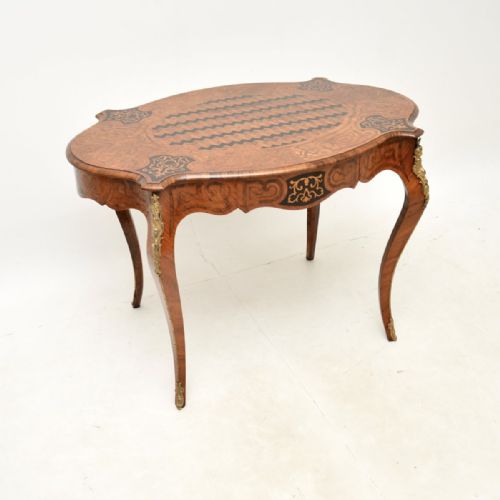
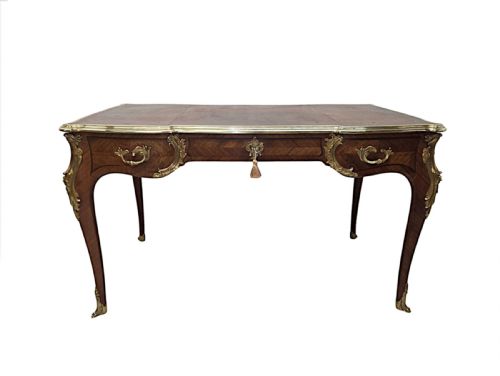
Materials vary widely across the selection, featuring timbers such as mahogany, kingwood, walnut, and rosewood, frequently accented with marquetry and parquetry. Many examples incorporate gilt bronze or ormolu mounts that highlight the structural contours of the legs and apron.
How they were made
Craftsmen built these tables using robust carcases of mahogany, walnut, or exotic hardwoods like kingwood and rosewood, often enhanced with intricate veneer patterns. Marquetry designs and parquetry geometric arrangements required high precision from cabinetmakers working in specialised workshops.
Metalwork played a defining role in the construction, utilising cast ormolu and brass to mount corners, drawer pulls, and sabots. These gilt bronze elements were chased and finished by hand to complement the polished wood surfaces.
Writing surfaces were typically finished with inset leather panels, sometimes decorated with blind tooling or gilt borders. This leather top provided a durable, tactile writing medium that contrasted with the polished timber frames.
Red lacquered finishes occasionally break the sea of traditional timber, bringing an unexpected flash of pigment to the writing table.
What varies in quality
Quality in a vintage French bureau plat rests upon the precision of the cabinetwork and the crispness of the gilt bronze mounts. Finer pieces display seamless veneer matching, delicate marquetry, and mounts that fit the timber contours with exactness.
The choice of secondary timbers and the complexity of the internal drawer construction distinguish standard production from exceptional examples. Superior tables exhibit hand-cut dovetails and substantial gauge ormolu rather than lighter stamped brass plating.
CH. Jeanselme & Co
The Vintage French Bureau Plat Glossary
- Bureau plat
- A flat-topped freestanding writing table, typically fitted with one or more drawers in the frieze. This form developed in France and remains a centrepiece of refined study interiors.
- Ormolu
- Gilded bronze used extensively for decorative mounts on furniture. The technique involves applying a mercury and gold amalgam to cast bronze before heating.
- Marquetry
- The art of applying pieces of veneer to a structure to form decorative patterns and pictures. Craftsmen select contrasting timbers to achieve tonal depth.
- Parquetry
- Geometric mosaic woodwork used for flooring and furniture surfaces. It relies on regular shapes like squares, triangles, and lozenges.
- Directoire style
- A transitional design phase preceding the French Empire style, marked by neoclassical restraint and simpler geometric lines. It reflects the political shift of the late eighteenth century.
Vintage French Bureau Plat: Frequently Asked Questions
What is a bureau plat?
A bureau plat is a traditional French writing table designed to be viewed from all sides, featuring a flat top and frieze drawers.
Unlike standard desks meant to face a wall, these tables traditionally sat in the middle of a room for administrative work.
What woods were used?
Cabinetmakers utilised a range of domestic and exotic timbers including mahogany, walnut, rosewood, and kingwood.
These woods were often selected for their rich grain patterns and suitability for detailed veneer work.
How do I identify the style?
Styles are determined by leg curvature, mount designs, and overall silhouette, ranging from curved Rococo forms to straight neoclassical lines.
Louis XV pieces show flowing cabriole legs, whereas Louis XVI examples favour fluted straight legs and symmetrical mounts.