



Vintage French Brass Bedstead
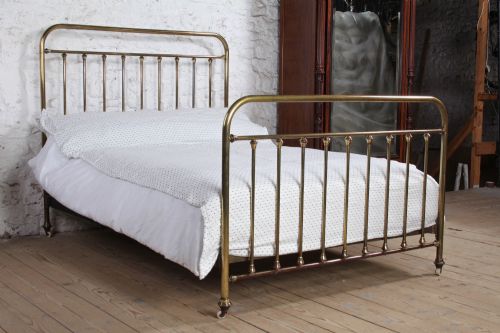
These vintage french brass bedstead pieces combine striking metalwork with continental proportions, offering a dramatic centrepiece for a bedroom.
Vintage French Brass Bedstead
A vintage french brass bedstead represents a distinct category of continental sleeping furniture, emerging primarily across the late nineteenth and early twentieth centuries. These pieces encompass various sizes from single and double frames up to king and super king dimensions, often displaying characteristic French styling.
The versions most commonly encountered on this page date from around eighteen eighty to nineteen twenty, reflecting the aesthetic movements of the period. Buyers frequently find examples that blend bright metal tubing or castings with contrasting iron frames or wooden components.
Makers of the era produced numerous formats, including hospital style designs with no foot end, square tube constructions, and frames featuring hoop details. Such variety ensures that these beds suit both traditional interiors and more eclectic modern room schemes.
Materials and construction
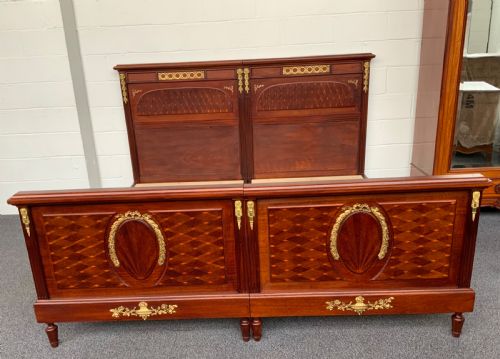
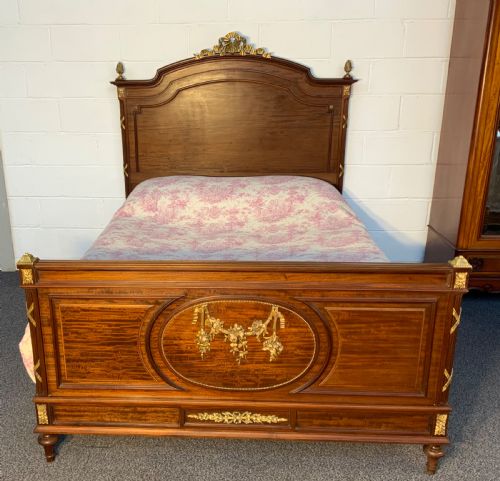
Construction relies heavily on a combination of brass and iron, utilising cast iron for structural stability alongside polished brass tubing and decorative detailing. Many pieces incorporate wrought iron components or painted wooden elements such as mahogany and veneer to achieve their distinctive appearance.
Makers applied specific surface treatments, ranging from gilt finishes and brass embellishments to original paint effects and polished metal surfaces. This mixed media approach allowed workshops to produce robust bed frames that combined industrial metalworking techniques with refined decorative arts.
Listings demonstrate a strong presence of nineteen hundred production dates, alongside examples from eighteen eighty and nineteen twenty.
Assessing quality in construction
Quality in a vintage french brass bedstead is determined by the substance of the metalwork and the precision of the cast brass detailing. Finer examples display crisp casting work on mounts and embellishments, whereas simpler items rely on plain tubing and minimal decoration.
The integrity of the underlying iron frame and the proportion of the woodwork, such as plum pudding mahogany or painted panels, distinguish superior workshops from standard commercial production. Preservation of original paint effects and genuine period components further elevates the standing of an individual bed frame.
The Vintage French Brass Bedstead Glossary
- Brass
- An alloy of copper and zinc widely used for decorative tubing, finials, and mounts on nineteenth and twentieth century bed frames. It provides a bright, golden appearance that can be polished or left with a mellow patina.
- Cast Iron
- A sturdy material poured into moulds to create robust structural rails and decorative ends. It forms the unseen backbone of many mixed metal French beds.
- Neoclassical
- A revival style drawing inspiration from classical antiquity, characterised by symmetry, restrained ornamentation, and architectural lines. It appears frequently in nineteenth century French furniture design.
- Veneer
- A thin layer of choice wood applied over a secondary timber base to create decorative surfaces on bed frames and matching cabinets. Plum pudding mahogany is a notable example seen in this tradition.
- Hospital Style
- A specific bed configuration featuring a headboard but no corresponding foot end, designed originally for ease of access and space efficiency. These frames remain popular for modern domestic settings.
Vintage French Brass Bedstead: Frequently Asked Questions
How do I measure for a French bed?
Continental sizing often differs from standard modern dimensions, meaning older frames may require custom mattress solutions. Checking the internal rail lengths and widths before purchase ensures a proper fit for daily use.
Taking precise measurements of your bedroom space also accounts for the generous proportions of decorative headboards and footboards.
Are these beds structurally sound?
Most antique metal frames utilise robust iron and brass components that easily support modern sleeping arrangements. Standard iron side rails and brackets are built to handle regular dismantling and reassembly.
Inspecting the joint fixings and ensuring all original bolts are present will guarantee long term stability in the home.
How do I care for brass and iron?
Routine maintenance involves gentle dusting with a dry microfibre cloth to prevent the buildup of grime on polished metal surfaces. Avoid harsh chemical cleaners that can strip original lacquers or antique platings.
For painted wooden sections, a soft cloth slightly dampened with water is sufficient to preserve the finish without damaging the material.
Can I use standard mattresses?
Many vintage frames accommodate standard modern mattress widths, though length variations can occur due to French sizing conventions. Checking the exact internal span between the side rails clarifies whether a standard or bespoke mattress is required.
Using supportive slatted bases inside the antique frame protects the mattress and maintains proper alignment.
How do I identify the period?
Dating relies on stylistic clues such as the presence of Belle Epoque flourishes, Neoclassical symmetry, or simpler early twentieth century tubular construction. The combination of brass embellishments and painted wood also points towards specific decades between eighteen eighty and nineteen twenty.
Examining construction techniques on the joints and fixings helps narrow down the manufacturing era.