





Vintage Floor Screen
A vintage floor screen divides a room or shields a hearth, bringing texture, structure and history to an interior.
Vintage Floor Screen
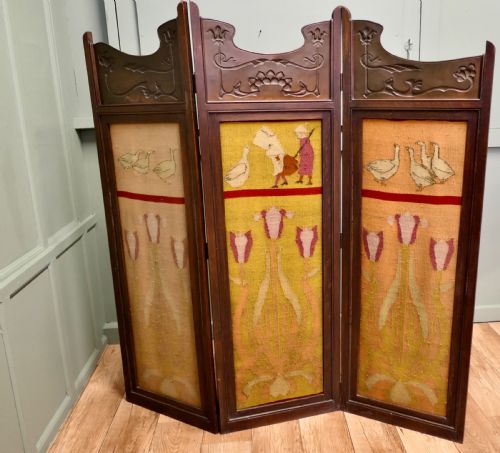
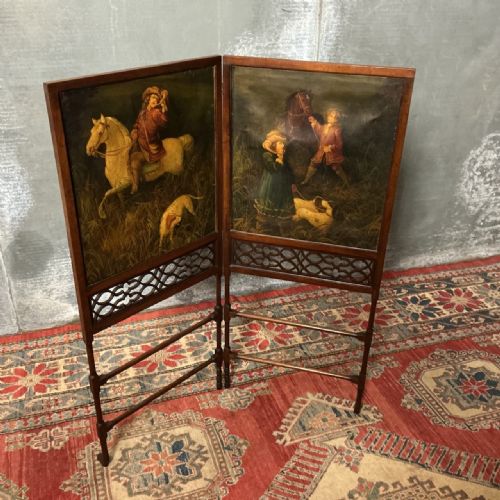
A vintage floor screen provides architectural division and decorative focal points across domestic interiors through hinged panels or single vertical frames. The selection on this page ranges from multi-fold Chinese lacquer pieces and Chinoiserie panels to Arts and Crafts oak designs and Edwardian painted screens.
Makers utilised various formats, including tall room dividers, three and four-fold dressing screens, and smaller pole screens designed for hearthside use. These objects span periods from the eighteenth century through the Victorian era, Edwardian years, and mid-twentieth century.
Origins stretch across Britain, France, Burma, China, and Japan, uniting diverse cultural craft traditions within a single functional category of folding and standing furniture.
How they were made
Construction relies primarily on timbers such as mahogany, walnut, oak, and ebonised wood to form sturdy structural frames and folding panels. Brass and copper provide structural hardware, hinges, and decorative mounts.
Surfaces receive intricate treatment through lacquer, paint, gilt, and carved detailing, alongside textile insertions of silk, canvas, and wool panels. Artisans also incorporated hardstone mounts, decoupage, and oil paintings to decorate the surfaces.
Materials across this selection include mahogany, brass, lacquer, silk, canvas, and hand-carved wood spanning multiple centuries.
What varies in quality
The sophistication of the surface decoration and the integrity of the woodwork determine the distinction between standard examples and finer works. Hand-carved details, applied hardstone, and well-preserved lacquer demonstrate superior craftsmanship compared to simpler painted finishes.
The original condition of hinges, framing joints, and integrated textiles or oil paintings dictates the overall structural and aesthetic merit of each piece.
William Morris
The Vintage Floor Screen Glossary
- Pole screen
- A vertical screen panel mounted on a slender central pole with a weighted base, traditionally placed near a fireplace to shield the face from radiant heat. These items often feature adjustable heights.
- Chinoiserie
- European artistic styles reflecting Chinese decorative motifs, widely applied to lacquered furniture and room dividers. This style employs gilt ornamentation on dark backgrounds.
- Lacquer
- A durable resin finish applied in multiple layers to wood surfaces, often polished to a smooth sheen. It frequently forms the base for elaborate Asian screen decoration.
- Decoupage
- The art of decorating a surface by applying paper cutouts and sealing them with varnish or lacquer. Country house examples often utilise this technique for whimsical panel scenes.
- Hardstone
- Semi-precious stones such as jade or quartz carved and applied in relief to wooden panels. This technique adds tactile dimension to oriental screens.
Vintage Floor Screen: Frequently Asked Questions
How do I choose the right size screen?
Consider the height and width of the space you want to divide or accent. Multi-fold panels offer flexible arrangement, while pole screens occupy minimal floor space.
Measure your room clearances carefully before selecting tall room dividers or expansive multi-panel screens.
Were these screens used in bedrooms?
Many folding screens functioned as dressing screens in bedrooms and boudoirs to provide privacy. They were easily repositioned as domestic layouts required.
Their decorative sides also served to enrich plain walls.
How do I care for lacquered wood?
Dust surfaces gently with a soft, dry cloth and avoid harsh chemical cleaners that might damage delicate lacquer. Keep pieces away from direct sunlight and excessive moisture.
Stable indoor humidity prevents timber frames and panels from warping over time.
What is the difference between a pole screen and a room divider?
A pole screen consists of a single small panel on a pedestal designed to block heat from a fireplace. A room divider uses multiple hinged panels to partition larger spaces.
Both serve distinct functional roles within historic interiors.