


Vintage Envelope Table
These vintage envelope tables fold clever rotating tops to reveal baize-lined playing surfaces, offering period charm and folding utility for modern homes.
Vintage Envelope Table
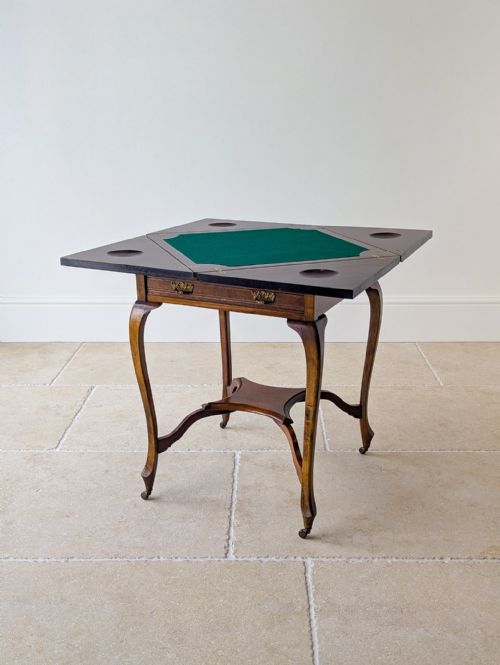
A vintage envelope table is a clever multi-functional occasional furniture piece designed primarily for card games and tea, folding closed into a compact square when not in use. When you search for a vintage envelope table, you are looking at items primarily originating from the Edwardian period, alongside examples dated around eighteen-ninety and nineteen-hundred. These pieces function as card tables, games tables, and tea tables, adapting easily to different rooms.
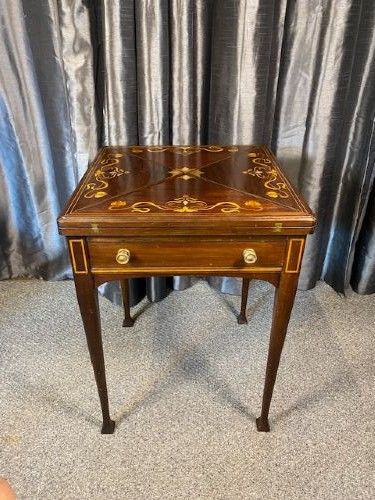
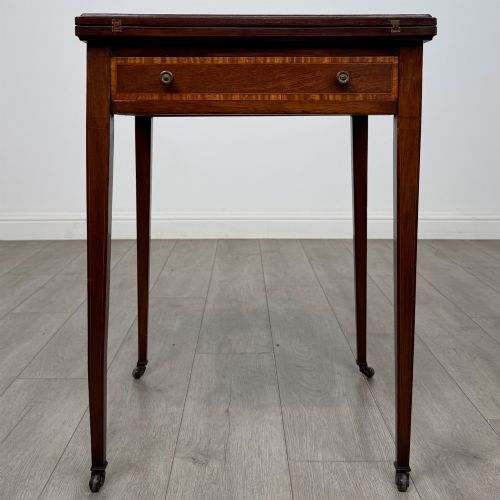
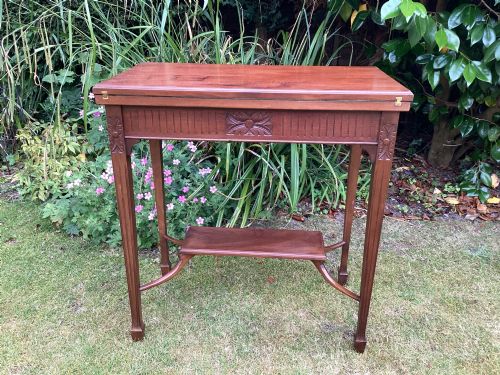
The most common version you will meet on this page is the Edwardian mahogany card table, often detailed with intricate inlay work. Alongside mahogany, variations include rosewood, satinwood, and oak pieces representing Edwardian, Edwardian Chippendale Revival, and Arts and Crafts styles. They sit comfortably as occasional tables or freestanding side tables while retaining their original fold-out mechanics.
How they were made
Cabinet makers utilised dense hardwoods such as mahogany and rosewood to construct the structural frames of these tables. Contrasting timbers like satinwood and boxwood provided decorative stringing and intricate panel inlays, frequently paired with brass hardware and hinges that allowed the four flaps to pivot smoothly.
The interior surfaces of the playing compartments were typically lined with baize to provide a soft, durable surface for card games. Joinery techniques relied on sturdy framing to support the pivoting leaf mechanism without sagging when the flaps opened outwards.
The clever rotating top mechanism acts like a polite mechanical butler, instantly transforming a modest side table into a card arena.
What varies in quality
Quality in these tables rests heavily on the crispness of the timber inlays and the selection of figured veneers like mahogany or rosewood. Superior examples display precise boxwood and satinwood stringing that integrates seamlessly into the primary wood without gaps.
The mechanical action of the rotating top distinguishes finer pieces from ordinary ones, as top-tier tables operate with smooth, synchronized movement across all four flaps. The condition of the original baize lining and the solidity of the freestanding frame also dictate the overall standard of the piece.
The Vintage Envelope Table Glossary
- Envelope table
- A square occasional table with a four-flap folding top that rotates to open like an envelope. It conceals a baize-lined surface for card playing.
- Baize
- A coarse woollen fabric, typically green, used to line the playing surface of card and games tables. It provides a durable texture that prevents cards from sliding.
- Inlay
- A decorative technique where pieces of contrasting timber, such as satinwood or boxwood, are inserted into recessed portions of the primary wood.
- Edwardian Chippendale Revival
- A decorative style popular in the early twentieth century that reinterpreted eighteenth-century designs by Thomas Chippendale. It appears frequently in mahogany card tables from this era.
- Stringing
- A thin strip of contrasting wood inlaid into the surface of a furniture piece to create delicate borders and geometric outlines.
Vintage Envelope Table: Frequently Asked Questions
How do envelope tables work?
The top of the table consists of four triangular wooden flaps that fold inward to form a flat square surface. When the top is rotated diagonally, the flaps unfold automatically to reveal the baize-lined interior.
Underneath the moving top, small swing-out brackets automatically extend from the frame to support each opened flap securely.
What were envelope tables used for?
These tables served primarily as compact card and games tables for drawing rooms and parlours during the late Victorian and Edwardian periods. Their folding design allowed households to save space when entertainment was finished.
Certain variations also functioned as tea tables or occasional side tables for everyday domestic use.
How do I date an envelope table?
Dating relies on stylistic markers such as Edwardian construction methods, specific wood selections like satinwood or rosewood, and characteristic inlay patterns. Pieces from this era often feature lighter timbers and refined Edwardian proportions.
Examining the internal hinges and secondary woods helps confirm the period of manufacture around nineteen-hundred.
Where should I place an envelope table?
They make versatile freestanding side tables in living rooms, studies, or hallways due to their finished appearance on all sides. Their compact closed footprint suits tight corners while offering a larger surface when opened.
Keep them away from direct heat sources and strong sunlight to protect the polished mahogany or rosewood veneers.