



Vintage Envelope Card Table
A vintage envelope card table unfolds from a compact square into a spacious gaming surface with clever pivoting leaves.
Vintage Envelope Card Table
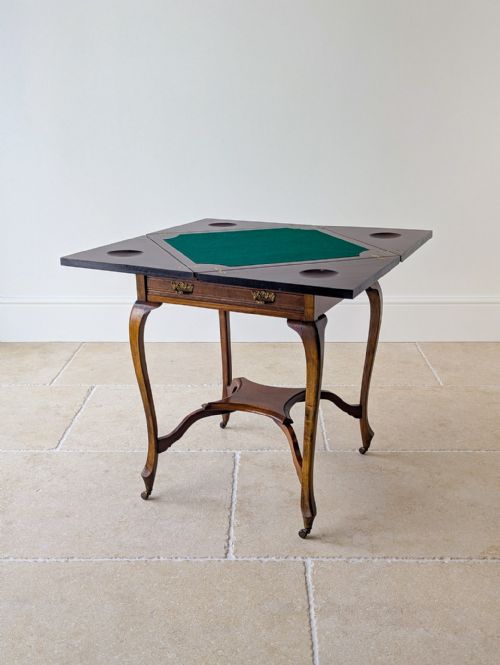
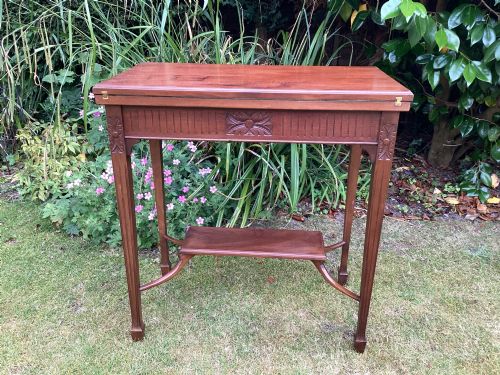
A vintage envelope card table is a clever multi-functional piece designed to serve as both a side table and a card table. When you search for a vintage envelope card table, you encounter Edwardian and late nineteenth-century forms that pivot and unfold to reveal a baize-lined playing surface.
Most pieces display the characteristic four triangular flaps that fold over the centre like an envelope. Beneath these folding leaves, small corner wells often hold counters or cards during play.
Materials and Construction
Cabinet makers utilised dense hardwoods such as mahogany and rosewood for the structural frames and primary surfaces. Oak also appears in specific Arts and Crafts examples, demonstrating alternative regional joinery methods.
Decorative surfaces frequently incorporate satinwood inlay and boxwood stringing to create geometric or floral motifs. Brass elements appear in hardware fittings and specific inlay details across the Edwardian pieces.
The folding mechanism relies on a pivoting tabletop action where turning the top causes the four triangular flaps to open in unison. The interior playing surface is typically lined with coloured baize to provide a soft counter for card games.
Vintage Envelope Card Table Retail Price Guide 2026
Typical asking prices for vintage envelope card table among the pieces listed under this phrase on Sellingantiques today, from the lower quarter to the upper quarter. They describe what is for sale here now, not the wider market.
Current listings feature Edwardian examples alongside pieces dated eighteen-ninety, constructed primarily in mahogany, rosewood, and oak with brass and satinwood inlay.
Judging Quality
Quality rests heavily on the precision of the pivoting mechanism and the crispness of the inlaid decoration. Superior tables ensure the four triangular flaps meet precisely at the centre when closed without uneven gaps.
Timber selection dictates the overall visual weight, with finely figured mahogany and rich rosewood commanding greater visual presence than plain utility woods. The intricacy and hand-cut nature of satinwood and boxwood inlay further separate standard production from finer cabinet work.
The Vintage Envelope Card Table Glossary
- Envelope table
- A square table with a hinged top that opens via a rotating mechanism into four triangular flaps. This clever design doubles the surface area.
- Baize
- A coarse woollen material resembling felt, traditionally used to line the playing surfaces of gaming tables. It protects cards and dampens the sound of play.
- Satinwood inlay
- A contrasting light yellowish wood inserted into darker timbers to form decorative patterns. Cabinet makers employed this technique extensively during the Edwardian era.
- Boxwood stringing
- Thin lines of pale boxwood inlaid around the edges of tabletops and drawer fronts. This subtle detail defines panel boundaries.
Vintage Envelope Card Table: Frequently Asked Questions
How does the envelope mechanism work?
The tabletop rotates diagonally on its central pivot. As the top turns, the four triangular flaps automatically open outwards to form a square gaming surface.
Underneath, internal wooden arms rise to support each flap as it locks into its open horizontal position.
What were these tables originally used for?
They served as compact decorative side tables when closed in a drawing room or parlour. When guests arrived, the top unfolded to accommodate card games and board pastimes.
Corner wells recessed into the baize surface held small gaming counters, coins, or scoring pegs during play.
How do I care for the baize top?
Keep the woollen baize away from direct sunlight to prevent the original green or coloured dye from fading unevenly. Gentle brushing removes dust from the fibres.
Avoid liquid cleaners or moisture, which can warp the wooden substrate beneath the fabric lining.
How do I distinguish Edwardian pieces from later copies?
Examine the timber shrinkage, hand-cut joinery, and the patination on the brass hardware. Edwardian pieces display period-appropriate secondary timbers and traditional hand-applied polish.
Satinwood inlay on genuine Edwardian examples shows slight natural ageing rather than modern synthetic bonding.