

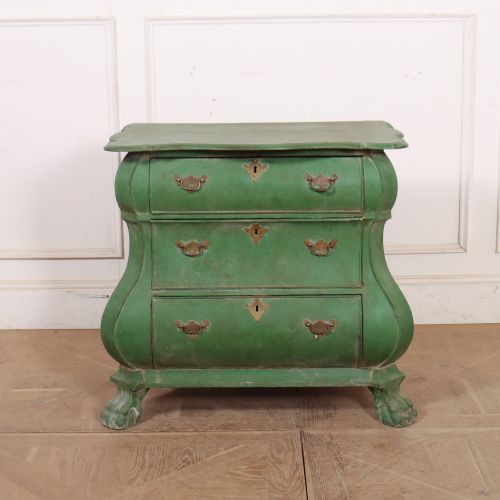


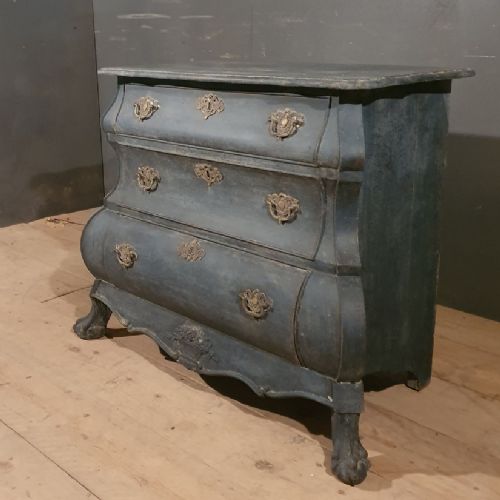


Vintage Dutch Commode Drawers
These vintage dutch commode drawers offer profound character and generous storage, formed in rounded bombe profiles or straight fronts.
Vintage Dutch Commode Drawers
When you search for vintage dutch commode drawers, you encounter sturdy timber storage pieces originating primarily from the eighteenth and nineteenth centuries. These low chests serve as prominent statement items in a room, offering wide drawer configurations and distinctive silhouettes.
The most common examples on this page display the characteristic bombe shape, swelling outwards towards the base, alongside restrained straight-front chests. These pieces span Dutch Baroque, Rococo, and Neoclassical styles, reflecting the shifting tastes of European cabinetmakers across multiple centuries.
Makers utilised regional timbers and decorative veneers to create substantial furniture that balances utility with artistic flair. They appear in variations of oak, walnut, burr elm, and fruitwood, often finished with intricate floral marquetry or painted surfaces.
How they were made
Cabinetmakers constructed these carcases using robust domestic timbers like oak and walnut, often applying richly grained veneers of fruitwood, mahogany, or burr elm over top. The curved bombe forms required exceptional skill in shaping solid wood and bending veneers to follow the undulating contours.
Surface decoration frequently involved meticulous marquetry, embedding delicate floral patterns of boxwood and lighter woods into darker backgrounds. Workshops also employed hand-applied paint finishes and fitted the drawers with substantial cast brass hardware.
Vintage Dutch Commode Drawers Retail Price Guide 2026
Typical asking prices for vintage dutch commode drawers among the pieces listed under this phrase on Sellingantiques today, from the lower quarter to the upper quarter. They describe what is for sale here now, not the wider market.
Makers occasionally hid tiny secret compartments behind elaborate floral marquetry, rewarding future owners who thoroughly explore the depths of their drawers.
What varies in quality
The distinction between ordinary and exceptional pieces rests upon the ambition of the design and the precision of the cabinetwork. Finer examples display fluid, perfectly proportioned bombe curves that maintain structural integrity without sagging or distortion over centuries.
Surface artistry creates the primary divergence in value among these chests. Pieces adorned with intricate, tightly fitted marquetry or sophisticated painted decoration demand greater respect than plain timber versions, showcasing the pinnacle of historical craftsmanship.
The Vintage Dutch Commode Drawers Glossary
- Bombe
- A bulging, convex shape that swells outward towards the base of a chest of drawers. This undulating profile requires advanced woodworking techniques to achieve successfully.
- Marquetry
- The art of applying decorative pieces of veneer to a structure to form intricate floral or geometric patterns. Craftsmen use contrasting woods like boxwood and fruitwood to create depth.
- Veneer
- A thin layer of finely figured wood applied to a secondary timber base. This technique allows makers to display striking grain patterns economically.
- Oak
- A hard, durable timber frequently utilised for the structural carcases and drawer linings of early European furniture. It provides enduring strength and stability.
Vintage Dutch Commode Drawers: Frequently Asked Questions
What is a bombe commode?
A bombe commode is a chest of drawers characterised by its distinctively curved, bulging sides and front. This dramatic silhouette became immensely popular in continental furniture design during the eighteenth century.
Craftsmen achieved this swelling shape through specialised joinery and thick wooden carcases that could be carved or bent. These pieces function as dramatic focal points in contemporary interiors.
How do I date these chests?
Dating relies on observing the timber species, construction methods, and stylistic decorative elements present on the piece. Eighteenth-century examples often feature hand-cut dovetails and distinct regional marquetry patterns.
Later nineteenth-century interpretations frequently adopt simpler painted finishes or softer wood selections. Comparing the secondary woods inside the drawers provides further clues to the manufacturing era.
Are these chests practical for modern storage?
These pieces offer deep, wide drawers that accommodate modern clothing and household linens with ease. Their low profile also provides a convenient surface for lamps or display items.
Because historical drawer mechanisms lack modern metal runners, they operate best when maintained with traditional beeswax. The robust timber construction ensures they remain entirely functional for daily use.
What woods were commonly used?
Cabinetmakers primarily relied on oak and walnut for the structural foundations of these substantial chests. Decorative surfaces often incorporated fruitwood, mahogany, and burr elm veneers.
Inlayers additionally utilised lighter woods such as boxwood to create sharp contrasts in floral marquetry scenes. Painted variants utilised softer regional timbers beneath their pigments.