


Vintage Cranberry Glassware
Vintage cranberry glassware brings rich, warm hues to your table through Victorian and Edwardian drinking vessels, decanters, and preserve dishes.
Vintage Cranberry Glassware
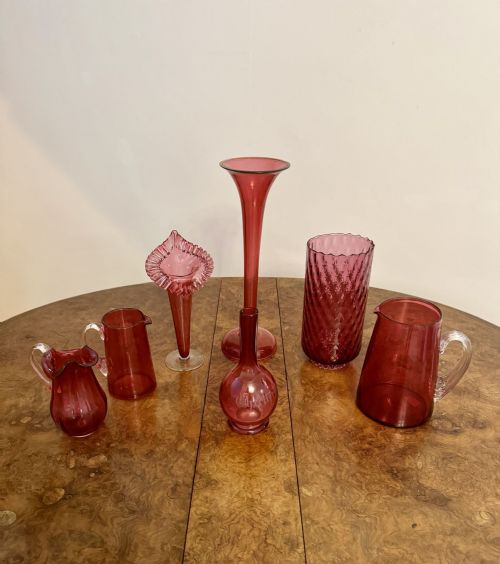
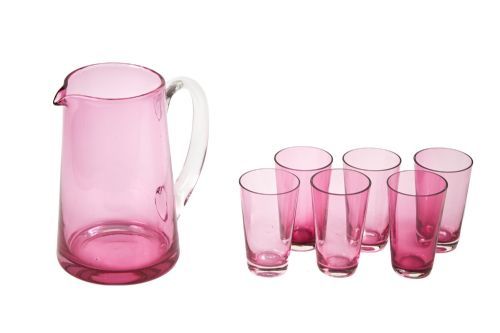
Vintage cranberry glassware encompasses an array of decorative and functional vessels produced primarily during the Victorian and Edwardian eras, spanning from the mid-nineteenth century to the early twentieth century. When exploring vintage cranberry glassware, you frequently encounter matching sets of wine glasses, champagne coupes, and carafes alongside larger jugs, preserve bowls, and lidded biscuit jars.
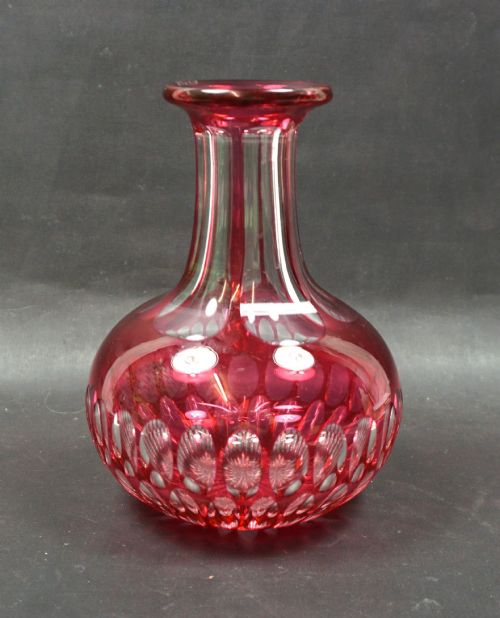
The objects originate from English and Bohemian workshops, reflecting the prevailing styles of the period through blown and cut formations. Drinking sets and individual decanters dominate the selection, often complemented by hand-painted enamel decoration or finely engraved floral motifs.
Materials and production techniques
These pieces rely on glass infused with gold chloride to achieve the characteristic rich pinkish-red tone, sometimes layered over clear crystal before cutting. Artisans shaped the molten material through hand-blowing techniques, producing delicate stemware, pitchers, and jars.
Post-blowing decoration involved skilled engraving to expose the underlying clear glass, or the application of white enamel figures in styles associated with Mary Gregory. Lead crystal and silver plate mounts occasionally appear to add structural contrast and refinement to the glassware.
Some Victorian pieces depict small children painted in white enamel amidst foliage, capturing a whimsical pastime frozen in glass.
Assessing quality and craftsmanship
The depth and uniformity of the red colouration indicate the skill applied during the initial glass-melting process, distinguishing superior pieces from paler examples. Hand-engraved details, such as convolvulus or fruiting vines, display varying degrees of precision and depth that elevate the artistry of individual items.
Consistency across larger sets of wine glasses or champagne coupes denotes careful workshop production rather than hurried output. The integration of overlay techniques, where clear crystal and cranberry glass meet cleanly, marks the work of accomplished makers.
The Vintage Cranberry Glassware Glossary
- Cranberry glass
- A type of transparent glass coloured with gold chloride during production, yielding shades from pale pink to deep ruby. It gained immense popularity across Victorian dining tables.
- Champagne coupe
- A shallow, broad-bowled stemmed glass designed for sparkling wine, frequently found in matched pairs or sets with engraved decoration.
- Overlay
- A technique where a layer of coloured glass is fused over a base of clear crystal, then partially cut away to reveal the contrasting layer underneath.
- Mary Gregory
- A style of decorative glassware featuring white enamel painting, typically depicting children at play amidst foliage.
- Decanter
- A stoppered glass vessel used for holding and serving wine, often paired with matching carafes or jugs in the listings.
Vintage Cranberry Glassware: Frequently Asked Questions
How do I clean antique cranberry glass?
Wash these pieces by hand using warm water and a mild detergent, avoiding abrasive sponges that might scratch the surface. Dry them promptly with a soft cloth to prevent water spots.
Keep them away from modern dishwashers, as the extreme heat and harsh chemicals can damage the glass and any delicate enamel work or silver plate mounts.
Can I use these wine glasses daily?
Victorian and Edwardian wine glasses remain functional, but their delicate hand-blown construction requires careful handling during use and storage. Treat them with respect to preserve their thin rims and stems.
Many collectors prefer to reserve them for special occasions or display them in cabinets to protect them from accidental knocks and everyday wear.
What period are most pieces from?
The majority of items originate from the Victorian era, spanning the mid-to-late nineteenth century, with some later examples reaching into the Edwardian period around nineteen hundred.
Styles from this timeframe often feature rich colour saturation, hand-engraving, and robust forms such as jugs, decanters, and sets of wine stemware.
Are all cranberry glasses mouth-blown?
Traditional pieces from the nineteenth and early twentieth centuries were shaped by hand using traditional blowing and forming techniques at the furnace. This method produces subtle variations in wall thickness and weight.
Such individual traits help distinguish genuine period items from later machine-pressed reproductions.