



Engraved Ruby Glass
These engraved ruby glass pieces are richly coloured Victorian and Edwardian drinking vessels and vanity bottles that bring deep crimson warmth to a room.
Engraved Ruby Glass
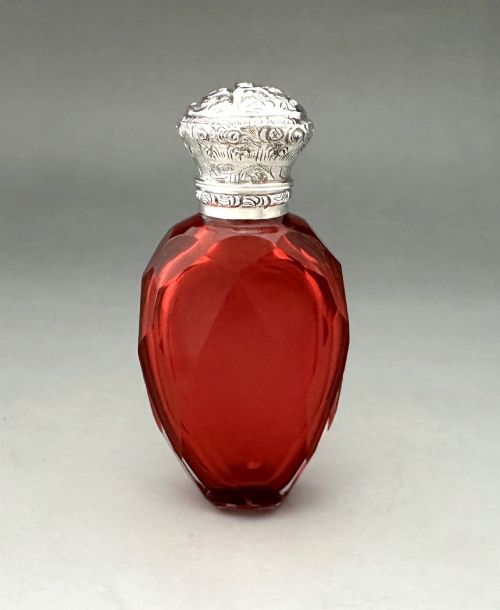
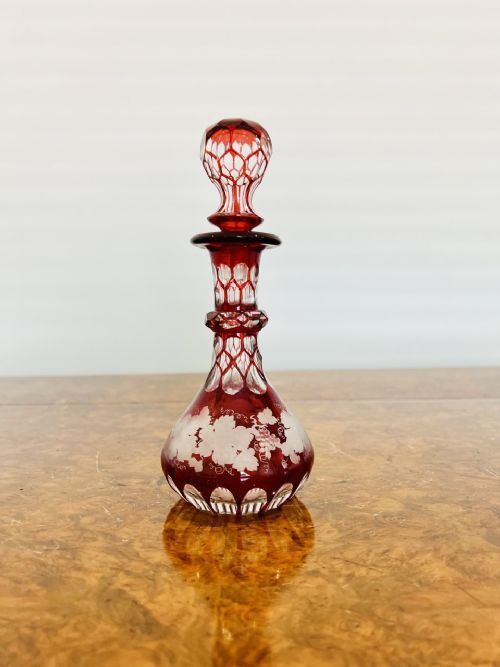
When you search for engraved ruby glass, you are looking at deeply tinted crimson vessels that catch the light through clear cut-away windows or delicate surface work. These pieces span decanters, perfume bottles, wine jugs, roemers, tumblers, champagne coupes, flagon decanters, covered jars, and goblets.
You are most likely to meet Victorian and Edwardian examples on this page, alongside specific Bohemian and English pieces. The forms range from modest pocket scent bottles with silver caps to large wine decanters and tall flagons.
The aesthetic relies on the contrast between the saturated red skin and the clear or white glass beneath, often worked into elaborate botanical motifs. Every piece carries the weight and texture of nineteenth-century tablewares and dressing table accessories.
How they were made
The makers achieved this deep crimson tone through ruby glass, cranberry glass, and ruby flash glass methods, sometimes building up a ruby overlay on top of clear crystal. The glassblower gathered molten metal before casing or flashing the red layer over a clear core.
Surface decoration relied on skilled wheel engraving to cut through the coloured layer down to the clear glass beneath. Craftsmen incised birds among vines, fruiting vines, and personalised motifs directly into the surface.
Makers finished many items with additional structural elements, mounting glass scent bottles in silver or pairing red crystal bodies with clear stems and faceted cuts.
Engraved Ruby Glass Retail Price Guide 2026
Typical asking prices for engraved ruby glass among the pieces listed under this phrase on Sellingantiques today, from the lower quarter to the upper quarter. They describe what is for sale here now, not the wider market.
Listings feature ruby glass, cranberry glass, and ruby flash glass alongside clear glass, cut crystal, and silver mounts across decanters, scent bottles, and tumblers.
What varies in quality
Quality rests primarily on the depth and precision of the wheel engraving, where crisp, detailed birds and vines distinguish finer works from simpler linear patterns. The clarity of the cut windows through the ruby layer dictates how sharply the design stands out against the crimson ground.
The weight and purity of the underlying crystal also separate standard vessels from superior ones, especially when light passes through clear stems or facet-cut panels. Furthermore, the inclusion of hallmarked silver caps or custom structural forms elevates an ordinary scent bottle or decanter into a more ambitious piece.
The Engraved Ruby Glass Glossary
- Ruby flash glass
- A thin layer of red glass applied over a clear glass base before being engraved to expose the clear layer underneath. This technique created sharp contrast without requiring solid coloured glass throughout.
- Roemer
- A traditional Germanic wine glass featuring a large bowl set on a stem decorated with applied prunts. These glasses frequently appeared in ruby colourways with engraved foliage.
- Cranberry glass
- A transparent pinkish-red glass coloured with gold chloride during production. It differs from deeper ruby glass by offering a lighter, translucent tone.
- Facet cut
- A geometric surface treatment consisting of multiple flat polished planes meeting at sharp angles. This cut catches light from various directions on decanters and scent bottles.
- Overlay glass
- A vessel made from two or more distinct layers of glass fused together while hot. The outer coloured layer is selectively cut away to reveal the contrasting layer beneath.
Engraved Ruby Glass: Frequently Asked Questions
What is engraved ruby glass?
Engraved ruby glass consists of nineteenth-century vessels made from red or cranberry-tinted glass that have been carved with wheel-engraved patterns. These objects reveal clear glass beneath the coloured surface through detailed botanical motifs.
Most examples date from the Victorian and Edwardian periods, originating from English or Bohemian workshops. They combine practical utility with deep crimson decoration.
Are these decanters safe for wine?
Many Victorian decanters and jugs were built to hold wine and spirits during nineteenth-century dining. You can use them for serving today provided the interior is clean and free from old residue.
Check the inside for stubborn staining before filling, and avoid subjecting antique glass to sudden temperature changes. Hand washing remains essential after any use.
How do I date a piece?
Dating relies on examining the object type, engraving style, and associated materials such as silver hallmarks. Victorian and Edwardian examples often feature naturalistic vine motifs and characteristic nineteenth-century silhouettes.
Look at the base for pontil marks and wear patterns that indicate age. Comparing the weight of the crystal and the method of overlay helps narrow the production era.