



Vintage Cornwall Artwork
Vintage cornwall artwork captures the rugged coastlines and maritime light of the West Country through nineteenth and twentieth century paintings.
Vintage Cornwall Artwork
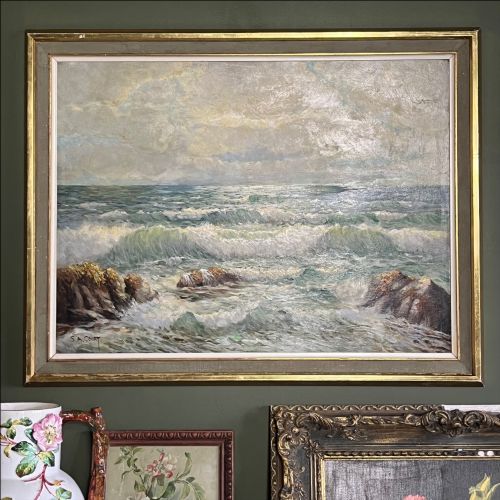
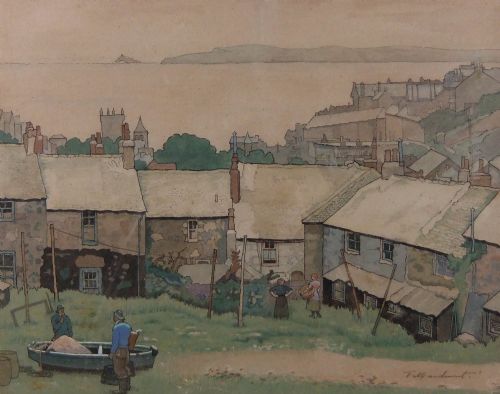
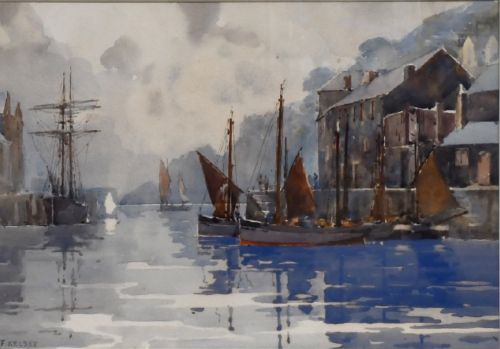
Vintage cornwall artwork encompasses oil paintings, watercolours and pastels depicting local harbours, fishing fleets and coastal villages. These pieces document maritime life and rural scenes across the nineteenth and twentieth centuries.
Collectors encounter traditional watercolours and impressionist oil paintings created by artists working in coastal settlements. St Ives and Newlyn form the primary geographical and artistic focus of these regional works.
Materials and Techniques
Artists painted primarily in oil on canvas or wood panels, and in watercolour on paper, often working en plein air to capture immediate light conditions. Gilt wood frames frequently house these paintings, preserving the paper and canvas supports.
Maritime subjects required careful handling of pigment to convey the specific qualities of sea, sky and harbour rocks. Pastels also appear on paper, offering softer tonal transitions for village scenes.
Several artists braved howling Cornish gales with pocket-sized sketchbooks just to catch a rogue wave.
Evaluating Quality
Quality rests upon the handling of light and atmospheric depth, distinguishing accomplished plein air observation from formulaic topography. The vigour of brushwork and the accuracy of maritime detail separate exceptional works from standard regional examples.
Provenance and association with established artistic communities elevate individual pieces. Signatures and documented exhibition histories further differentiate the finest paintings.
William Banks Fortescue·Thomas Maidment·Frank Kelsey·Denis Mitchell·Edward Matthew Elliott·Charles Napier Hemy·Richard Harry Carter·Gyrth Russell·George Turland Goosey·William Pitt·Joseph Farquharson·Ernest F. Hill·Frederick Stuart Richardson·William Lambert Bell·Jack R Mould·William Lee Hankey·Walter Sweet·Hendrik Yan Wolter·S. J. Lamorna Birch·Herbert James·Cuthbert Crossley·John Baragwanath King·Henry Scott Tuke·Sidney A. Court·George F Pennington
The Vintage Cornwall Artwork Glossary
- Newlyn School
- An art colony based in West Cornwall that focused on plein air realism and depictions of local fishing communities.
- St Ives School
- A group of artists associated with the Cornish port, known for evolving styles from traditional marine painting to mid-century modernism.
- Plein air
- Painting outdoors to capture direct observations of natural light and weather conditions.
- Lugger
- A traditional two-masted fishing boat frequently depicted in West Country maritime paintings.
- Watercolour
- A paint consisting of water-soluble pigments on paper, valued for transparency and luminous washes.
Vintage Cornwall Artwork: Frequently Asked Questions
What subjects appear most often?
Harbours, fishing luggers and coastal cliffs dominate the regional paintings. Scenes focus heavily on ports like St Ives, Polperro and Mevagissey.
Artists also recorded local village streets and tidal inlets across the West Country.
How do I identify a Newlyn or St Ives piece?
Signatures, exhibition labels and stylistic traits connect pieces to these specific colonies. Naturalistic portrayals of fisherfolk point toward the earlier Newlyn output.
Later modernist developments and harbour views frequently link to the St Ives circle.
Were these painted outdoors?
Many coastal works relied on en plein air methods to record immediate weather and light. Artists set up easels directly on harbour walls and cliffs.
Larger studio compositions often developed from these initial outdoor watercolour and oil sketches.
How should I frame and display them?
Original gilt wood frames complement the period aesthetic of nineteenth and early twentieth century oils. Period watercolours require conservation glass to protect paper supports from UV damage.
Keep pieces away from direct sunlight and damp conditions to preserve the paint layers.