



Framed Cornish Watercolour
Framed cornish watercolour works capture the coastal light and harbour life of the West Country through enduring nineteenth and twentieth century British movements.
Framed Cornish Watercolour
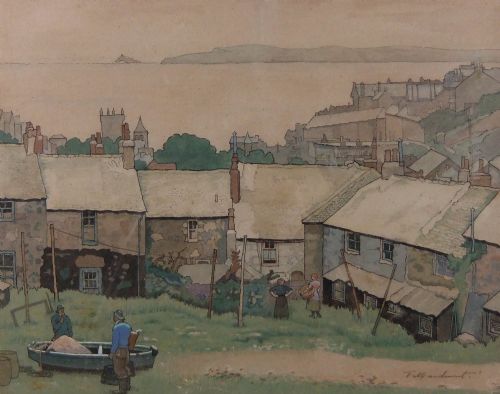
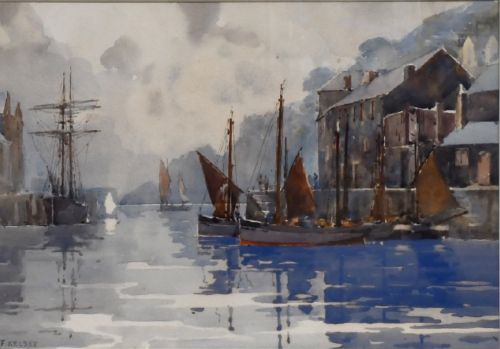
When you search for framed cornish watercolour pieces, you encounter works executed on paper by artists associated with the Newlyn School, St Ives School and broader British Impressionism. These paintings record fishing vessels, rugged coastlines and harbour scenes from locations such as St Ives, Mousehole, Polperro and Looe.
The selections available here span from the late nineteenth century through to the 1940s, capturing the shift from Victorian fine art sensibilities towards early twentieth century British modernism. Most examples arrive protected behind glass within wooden or gilt wood frames that complement their maritime and landscape subjects.
How they were made
These works rely on watercolour pigment applied to paper, occasionally combined with ink to define the linear elements of boats, rigging and stone harbour walls. The artists worked en plein air to capture the changeable coastal atmosphere of Cornwall directly from life.
Framing typically involves wood or gilt wood enclosures fitted with glass to protect the delicate water-soluble pigments from moisture and light damage over the decades.
The periods represented in these listings span from the nineteenth century through to 1940, focusing heavily on Edwardian and early twentieth century British art.
What varies in quality
Quality in these watercolours rests upon the artist's ability to render light and movement swiftly, capturing the particular atmosphere of West Country harbours rather than merely recording topographical details. Works by established figures associated with recognised regional groupings demonstrate a surer handling of tone and composition.
The distinction also lies in the preservation of the paper support and the clarity of the pigment, alongside the appropriateness of the period frame in complementing the artwork.
William Banks Fortescue·Thomas Maidment·Frank Kelsey·Richard Harry Carter·Ernest F. Hill·Frederick Stuart Richardson·Walter Sweet·S. J. Lamorna Birch·Cuthbert Crossley
The Framed Cornish Watercolour Glossary
- Watercolour
- A painting method in which the paints are made of pigments suspended in a water-based solution. It relies on the white of the paper to provide luminosity.
- Newlyn School
- An art colony of painters based in Cornwall during the late nineteenth and early twentieth centuries. They favoured naturalistic scenes painted in the open air.
- St Ives School
- A term describing artists who lived and worked in the Cornish coastal town, encompassing both traditional marine painters and later twentieth century modernists.
- Gilt Wood
- Wood that has been coated with a thin layer of gold leaf or metallic gilt paint. It is frequently found on traditional picture frames from the nineteenth and early twentieth centuries.
Framed Cornish Watercolour: Frequently Asked Questions
How do I hang a watercolour?
Hang these watercolours away from direct sunlight to prevent the pigments from fading over time. Indirect natural light or controlled gallery lighting works best to reveal the fine details of the paper.
Ensure the wall space remains stable in temperature and humidity, as excessive moisture can damage both the paper support and the wooden frame.
What is the St Ives School?
The St Ives School refers to the community of artists who based themselves in the Cornish fishing port, drawn by the exceptional coastal light and maritime subject matter. This grouping includes traditional marine artists alongside those who embraced early twentieth century British modernism.
Works associated with this movement often focus on harbours, fishing luggers and the rugged West Country coastline.
How do I date a watercolour?
Dating typically relies on the artist's working period, stylistic markers of the frame, and sometimes inscriptions or signatures left on the paper. Late nineteenth century examples often feature heavier Victorian framing and detailed maritime realism.
Pieces from the 1920s to the 1940s tend to show freer brushwork aligned with British Impressionism and early twentieth century regional schools.
Are these paintings original?
The works recorded here are original hand-painted watercolours on paper, created directly by the artists rather than being mechanical reproductions or prints. Each piece represents an individual artistic interpretation of a Cornish subject.
Signatures from period artists frequently appear within the composition or along the margin of the sheet.