


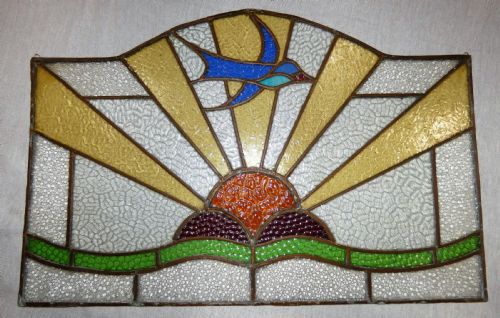
Vintage Coloured Glass Panel
These vintage coloured glass panel pieces bring rich period character and colour into a room, offering the exact decorative warmth a buyer wants.
Vintage Coloured Glass Panel
A vintage coloured glass panel search brings up architectural salvage and window panels dating from the Victorian era through the 1930s. These pieces include leaded glass windows with hand painted scenes alongside simpler decorative panels.
The selection ranges from church windows with square panes to domestic panels featuring countryside scenes, birds, and Dutch folk art designs. Most examples combine traditional leaded techniques with coloured or hand painted glass.
Buyers will also find architectural pieces in styles such as Edwardian, Arts and Crafts, Gothic Revival, and Art Nouveau. While the majority are windows, the selections occasionally include related items like wine glasses from the nineteenth century.
How they were made
The construction of these pieces relies on glass and lead to create structured window panels and architectural salvage. Artisans joined individual pieces of coloured and painted glass using lead cames.
Many panels incorporate hand painted details depicting countryside scenes, farmhouses, and figures directly onto the glass. Supporting wooden frames, often made of pine or timber, surround the leaded and stained glass compositions.
Vintage Coloured Glass Panel Retail Price Guide 2026
Typical asking prices for vintage coloured glass panel among the pieces listed under this phrase on Sellingantiques today, from the lower quarter to the upper quarter. They describe what is for sale here now, not the wider market.
Listings span multiple decades from the Victorian period through to the 1930s, utilising lead, timber, and hand painted glass.
What varies in quality
Quality in these panels depends upon the complexity of the hand painted artwork and the intricacy of the leaded design. Detailed pictorial scenes involving castles, birds, or human figures represent a higher level of craftsmanship than plain geometric arrangements.
The material composition also distinguishes pieces, particularly the presence of specialist elements like amber bullseyes or rich coloured glass. The structural integrity of the timber frame and the condition of the leadwork further differentiate the examples.
The Vintage Coloured Glass Panel Glossary
- Leaded glass
- Glass pieces held together with lead cames to form a window or panel. This technique allows for complex patterns and pictorial designs.
- Stained glass
- Glass coloured by the addition of metallic salts during its manufacture. It forms the vibrant panels seen in Victorian and Edwardian architectural salvage.
- Bullseye
- A round centre piece of blown glass showing a concentric ripple pattern. These appear as decorative accents within leaded windows.
- Architectural salvage
- Building materials rescued from older structures for reuse or display. This category includes church windows and domestic door panels.
- Came
- A slender strip of lead with a channel profile used to hold pieces of glass together. Cames form the structural grid of leaded windows.
Vintage Coloured Glass Panel: Frequently Asked Questions
How do I install an antique glass panel?
These architectural pieces typically fit into existing window openings or hang against a light source as decorative art.
Careful consideration of the timber frame and lead stability ensures the panel remains secure during mounting.
What periods do these glass panels come from?
The listings span from Victorian and Edwardian eras into the 1920s and 1930s.
Design characteristics such as Art Nouveau motifs or Dutch folk art help indicate the specific decade of manufacture.
How should I clean my stained glass?
Gentle dusting with a soft cloth preserves the delicate hand painted surfaces and lead cames.
Moisture should be kept away from the lead and painted areas to prevent deterioration over time.
Are all these panels meant for windows?
While the majority function as architectural windows and door panels, some items serve primarily as decorative wall art.
Larger Art Nouveau examples may span multiple sections, requiring specific display spaces.