




Vintage Castle Landscape Painting
When you search for vintage castle landscape painting, you find works capturing historic fortresses set within British scenery.
Vintage Castle Landscape Painting
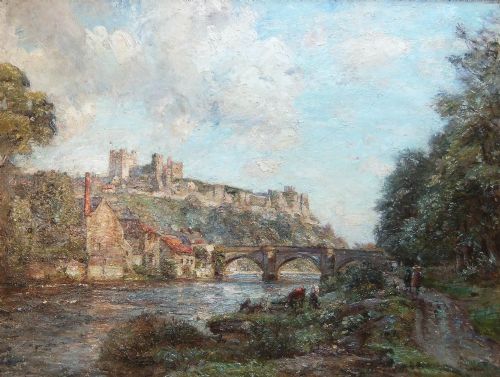
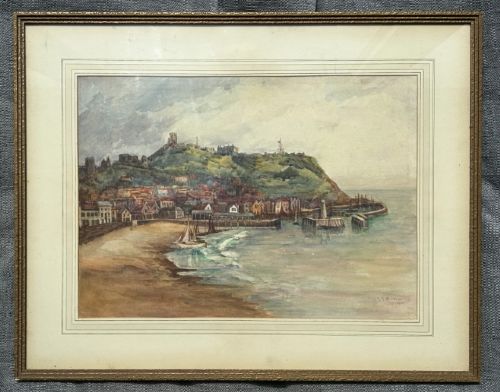
A vintage castle landscape painting presents historic fortresses and ruined strongholds positioned within pastoral settings, coastal views, or river valleys across Britain. These works record identifiable sites such as Bolton Castle, Richmond Castle, and Bamburgh Castle through the eyes of artists working from the nineteenth century into the mid-twentieth century.
You are most likely to meet watercolours on paper and oil paintings on canvas depicting these rural and coastal scenes. The selection spans Victorian topographical watercolours, Edwardian impressions, and mid-century interpretations of ancient stone walls rising above rivers and hills.
The subjects range from grand royal residences to weathered medieval ruins framed by surrounding trees, bridges, and local wildlife. Each piece captures a specific topography, often tied to regional British landscapes in Yorkshire, Northumberland, and Shropshire.
Materials and methods
Artists deployed watercolour pigment on paper or applied oil paint directly onto canvas, sometimes working on board or incorporating pen and ink. Many nineteenth-century and Edwardian watercolours rely on delicate washes to build atmospheric skies and river reflections around stone masonry.
Oil paintings utilise heavier brushwork to render the texture of ancient fortress walls and rolling terrain, frequently framed in wood with gilt detailing. Leaded glass windows also appear, featuring hand-painted countryside and castle scenes executed with vitrified enamels.
Support materials vary from stretched canvas and heavy watercolour paper to vintage wooden glazed frames that preserve the original presentation of the artwork. Pastels on paper also emerge in mid-century depictions of castle approaches.
Fred Lawson walked so extensively around Wensleydale with his sketchbook that the local sheep practically posed for him.
Distinctions in quality
Quality rests upon the artist's ability to render the structural weight of historic masonry while maintaining atmospheric depth in the surrounding landscape. The strongest works balance architectural precision with confident brushwork or fluid watercolour washes that convey light and weather.
Lower quality pieces often present stiff, formulaic representations of ruins without sensitivity to scale, light, or local topography. Superior examples display assured handling of pigments, effective tonal contrast between stone and foliage, and a coherent sense of place.
Alfred Young Nutt·Herbert Royle·George Graham·George Gregory·Frank Wood·James Bell Anderson·William Wyld·Alfred Robert Quinton·Fred Lawson·James L Brooke·Sonia Lawson·Rowland Henry Hill·George Willis Pryce·Reginald Mills·Angus Rands
The Vintage Castle Landscape Painting Glossary
- Watercolour
- A painting method where fine pigment is suspended in water-soluble binders and applied to paper. This medium allows for translucent washes that capture changing light across castle stonework and rivers.
- Oil on Canvas
- Pigments bound in drying oil applied to a woven fabric stretched across a wooden frame. This technique provides rich colour saturation and textured impasto for depicting rugged castle terrain.
- Gilt
- A thin layer of gold leaf or gold paint applied to wooden frames. It enhances the visual presentation of nineteenth-century and Edwardian landscape paintings.
- Topographical
- Representing specific real-world locations with accuracy. These views document actual British castles and their surrounding landscapes rather than imagined scenes.
- Impressionist
- A style focusing on the visual impression of the moment, particularly shifting light and colour. Mid-century and later works often adopt these looser handling methods.
Vintage Castle Landscape Painting: Frequently Asked Questions
What periods do these castle paintings date from?
The works span from the nineteenth century through the Edwardian era and into the mid-twentieth century. You will find Victorian topographical studies alongside 1930s watercolours and mid-century oils.
Earlier examples often lean towards detailed architectural recording, while later decades introduce looser impressionistic interpretations of the same historic sites.
Where are the depicted castles located?
Most of the featured fortresses and ruins sit within British landscapes, particularly in Yorkshire, Northumberland, and Shropshire. Locations include Bolton Castle, Bamburgh Castle, and Richmond Castle.
Artists frequently positioned themselves along nearby rivers, coastlines, and valleys to capture the relationship between the historic stone structures and their natural surroundings.
How should I frame and display a watercolour?
Watercolours require conservation mounting behind glass to protect the paper and pigments from ultraviolet light and ambient moisture. Keeping them out of direct sunlight prevents fading of the delicate washes.
Original vintage wooden and glazed frames often accompany these pieces, preserving the historic presentation when structurally sound.
Are these paintings signed by the artists?
Many of the works carry the artist's signature, monogram, or attribution, recorded directly on the canvas, paper, or within accompanying archival books. Signed pieces connect the viewer to known regional painters and illustrators of the period.
Unsigned works rely on stylistic evidence, period framing, and subject matter to indicate their origins in the nineteenth or twentieth century.