



Vintage Bridge Landscape
These vintage bridge landscape paintings capture rivers, canals and spans across Britain and the continent through a century of changing artistic styles.
Vintage Bridge Landscape
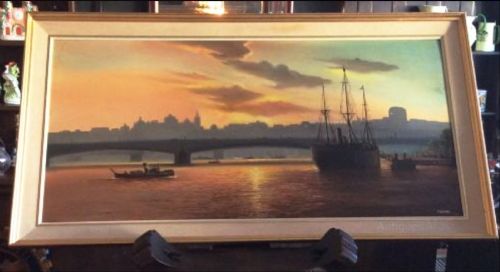
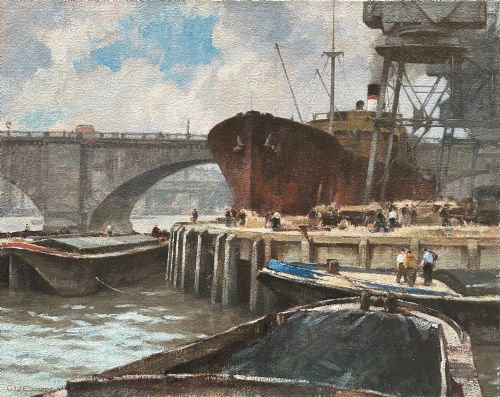
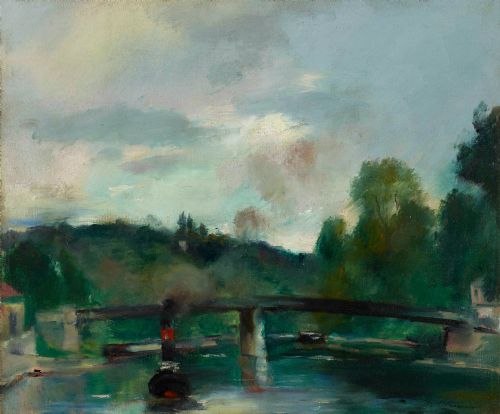
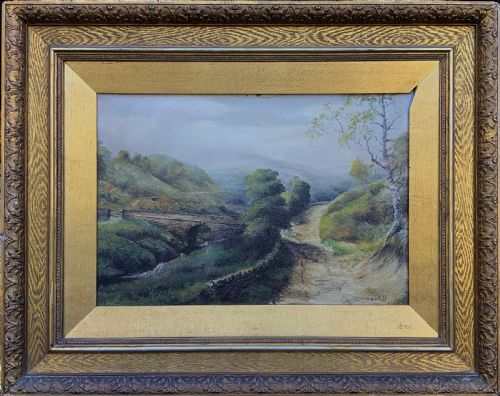
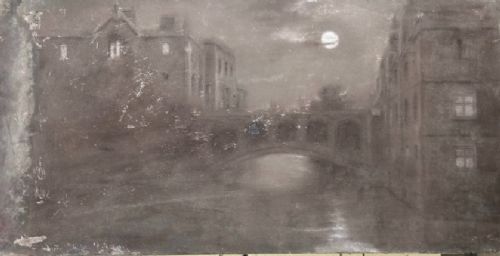
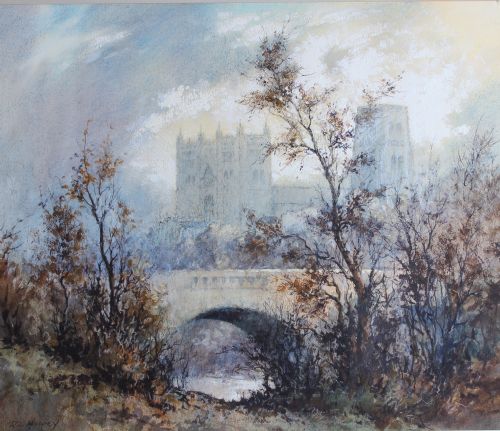
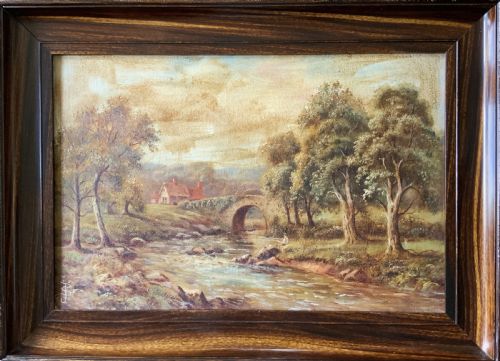
A vintage bridge landscape focuses on architectural crossings set within natural or urban surroundings, ranging from rural stone arches to bustling city spans over the Thames. The selections here draw heavily upon nineteenth-century traditions and early twentieth-century British watercolours and oils.
Compositions often feature rivers, streams or canals with figures, boats or drovers near the structure, anchoring the scenery in a specific topographical context. Examples span domestic scenes in Yorkshire, Shropshire and London alongside continental views in Venice and Paris.
The materials reflect traditional fine art practices, pairing paper and canvas supports with liquid mediums. Watercolour and oil paint dominate the selection, applied across varied decades from the Victorian era through the mid-twentieth century.
How they were made
Artists built these works using oil paint and watercolour applied to canvas, paper, wood panels or board. Oil formulations offer rich, layered pigments suitable for heavy textures, while watercolours rely on fluid washes across textured paper to capture light and atmosphere.
Support materials dictate the preservation and presentation of each piece, with stretchers and panels providing rigid foundations for oils, and paper supports frequently preserved under glass. Brushwork ranges from precise topographical detail in nineteenth-century watercolours to looser, impressionistic strokes in later canvases.
Listings feature works executed on paper, canvas, wood and glass across the Victorian, Edwardian and mid-twentieth-century periods.
What varies in quality
The strength of a vintage bridge landscape rests on the artist's handling of perspective, spatial depth and natural light upon water and stone. Masterful handling creates a convincing atmosphere, whereas weaker examples rely on rigid, formulaic rendering of architectural lines.
Provenance and signature clarity elevate certain works, particularly when associated with documented regional painters or established British schools. The integrity of the original medium - whether vibrant watercolour pigments or stable oil layers - defines the enduring visual impact.
Cyril Walduck Edwards·Henri Ottmann·Sydney Yates Johnson·William Traies·Noel Harry Leaver·George Willis Pryce
The Vintage Bridge Landscape Glossary
- Topographical
- Depicting a specific, recognizable real-world location rather than an imaginary scene. These works often record historical bridges and surrounding townscapes accurately.
- Watercolour
- A paint consisting of pigment suspended in a water-soluble vehicle, traditionally applied to paper. It allows for translucent washes and delicate atmospheric effects.
- Oil on canvas
- Pigments bound in a drying oil applied to a stretched woven fabric support. This medium permits thick impasto application as well as subtle glazing.
- Stretcher
- The wooden frame upon which an artist's canvas is secured and tensioned before painting. In older works, inscriptions on this frame often provide clues to provenance.
- Impressionism
- An art movement characterised by relatively small, thin yet visible brush strokes and an emphasis on accurate depiction of light. British variations often apply these techniques to domestic rivers and coastal scenes.
Vintage Bridge Landscape: Frequently Asked Questions
What periods do these bridge paintings cover?
The works span from the nineteenth century through the mid-twentieth century, capturing shifting artistic movements across decades.
Victorian and Edwardian pieces sit alongside interwar watercolours and later twentieth-century interpretations.
Are these paintings signed by the artists?
Many examples carry signatures, monograms or inscriptions left by the painter, occasionally detailing the specific bridge and location on the reverse.
Unsigned works are frequently attributed to regional British schools or specific artistic circles based on style and technique.
What mediums were used for these artworks?
Artists worked primarily in oil paint and watercolour, utilising canvas, paper, wood panels and boards as supports.
Watercolours capture light and fluid river atmospheres, while oils provide heavier texture and depth.
Where do the landscape locations come from?
The subjects range widely across British towns and waterways, including London, Yorkshire, Shropshire and Devon.
Continental views from locations such as Venice and Paris also feature prominently in the selection.