

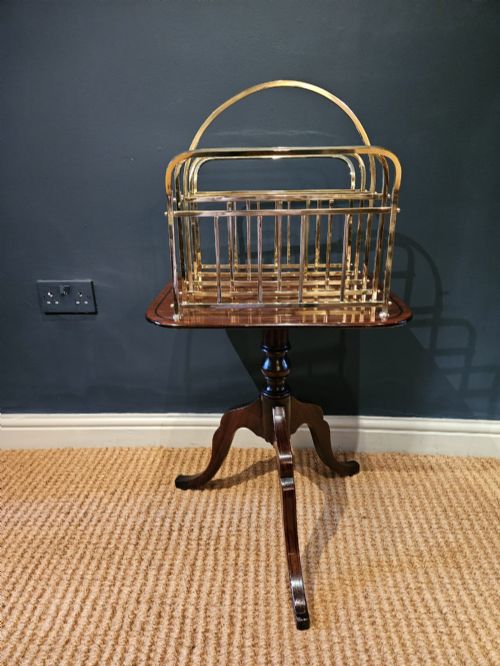
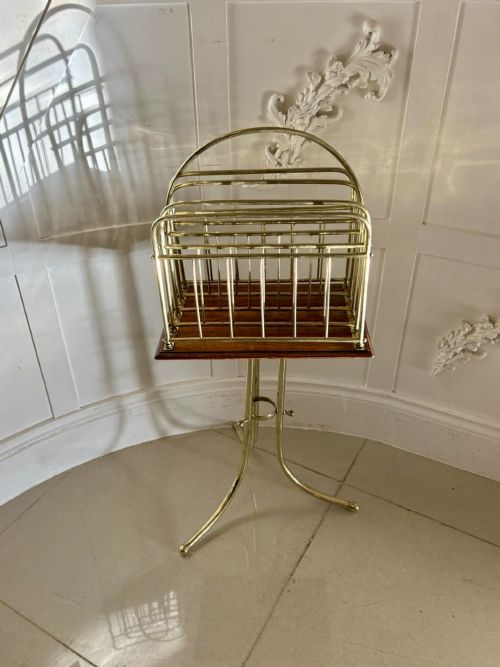


Vintage Brass Newspaper Rack
A vintage brass newspaper rack combines practical daily storage with bright metallic presence, offering an organised place for journals and sheets.
Vintage Brass Newspaper Rack
A vintage brass newspaper rack serves as a dedicated holder for periodicals, journals, and daily papers in sitting rooms and studies. When searching for a vintage brass newspaper rack, buyers encounter a variety of forms ranging from revolving stands to floor-standing compartments.
The pieces on this page span several periods, featuring early developments like the traditional wooden canterbury alongside later metallic magazine stands. Edwardian and Victorian examples appear frequently, often combining bright brass frameworks with polished timber bases.
Makers historically adapted these stands to suit changing reading habits, resulting in designs with multiple divisions, carrying handles, or integrated tables. Tubular brass construction emerges prominently among the selection, providing a lighter silhouette than earlier solid metal designs.
Materials and construction methods
Makers constructed these racks using structural timbers such as mahogany, oak, walnut, and rosewood to form the main bodies or compartment dividers. These woods were often polished, turned, or inlaid to provide a stable base for the metallic elements.
Brass and copper components were worked into tubular frames, cast feet, decorative handles, and riveted panels. The combination of warm timber and polished metal defines the physical makeup of these pieces across the nineteenth and twentieth centuries.
Vintage Brass Newspaper Rack Retail Price Guide 2026
Typical asking prices for vintage brass newspaper rack among the pieces listed under this phrase on Sellingantiques today, from the lower quarter to the upper quarter. They describe what is for sale here now, not the wider market.
Materials recorded in the inventory include mahogany, oak, walnut, rosewood, copper, and brass.
Evaluating standard and craftsmanship
The distinction between standard pieces and finer examples often lies in the precision of the joinery and the weight of the metal components. Heavier cast brass frames and carefully turned wooden supports indicate a higher grade of manufacture.
Superior items display thoughtful detailing such as integrated carrying bars, multi-division partitions, and secure fixings that withstand regular use. The harmony between the selected timber and the metallic elements determines the overall refinement of the piece.
The Vintage Brass Newspaper Rack Glossary
- Canterbury
- A low, multi-division stand originally designed for holding sheet music and newspapers. These pieces often feature slatted sides and low legs.
- Tubular brass
- Hollow metal tubing used in furniture frames to reduce weight while maintaining structural strength. This technique became common in later Victorian and Edwardian manufacturing.
- Division
- An individual compartment within a rack designed to keep papers or magazines upright and separated. Multiple divisions help organise different publications.
- Revolving stand
- A piece mounted on a central pivot that allows the entire book or magazine holder to turn for easy access. This form appears in both table and floor models.
Vintage Brass Newspaper Rack: Frequently Asked Questions
What is a canterbury?
A canterbury is a traditional low stand fitted with vertical partitions, originally created to hold sheet music or books.
Over time, these pieces evolved to serve as convenient holders for daily newspapers and periodicals beside seating areas.
How do I date a rack?
Dating relies on observing the combination of materials, construction methods, and prevailing decorative styles present in the piece.
For instance, tubular brass combined with oak often points toward Edwardian production, while heavier turned mahogany indicates earlier Regency or Victorian work.
Where should I place it?
These racks sit comfortably beside armchairs, sofas, or desks where reading materials accumulate throughout the day.
Freestanding models work well near living room seating, while table-top versions fit neatly onto occasional furniture.
Are they sturdy enough for daily use?
Most examples are built with robust timber bases and metal frames intended to support heavy loads of paper.
Checking the joints and fixings ensures the structure remains stable under the weight of modern magazines and broadsheet newspapers.