


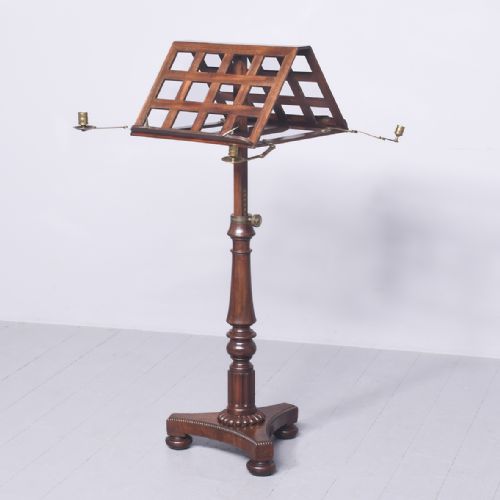


Vintage Brass Music Rack
A vintage brass music rack brings functional elegance to a room, holding scores or periodicals with distinct period character.
Vintage Brass Music Rack
When you search for a vintage brass music rack, you encounter a mix of dedicated sheet music holders, adjustable stands, and multi-functional canterburys spanning the nineteenth century through the interwar period. The forms range from lyre-shaped stands and revolving magazine racks to large country house folio stands.
The most frequent examples combine rich timbers like mahogany, rosewood, and burr walnut with polished brass fittings, accents, or adjustable mechanisms. These pieces serve equally well today for organising contemporary journals or displaying open volumes.
Materials and construction
Joinery methods reflect the periods spanning from the George III era to the nineteen-thirties, utilising turned columns, slatted dividers, and precise framework to support heavy folios and bound volumes without sagging.
Assessing quality and craftsmanship
Quality rests in the crispness of the brass casting, the articulation of adjustable mechanisms, and the depth of the timber grain. Superior examples exhibit finely turned pillars, substantial gauge brass work, and thoughtful proportions that balance heavy books.
Lesser pieces show simpler joinery or replacement hardware, whereas finer specimens retain original castors, intact division slats, and uncompromised structural integrity across their framework.
The Vintage Brass Music Rack Glossary
- Canterbury
- A low, multi-divided stand originally designed for holding sheet music or folios, later adapted for newspapers and magazines. These typically feature slatted vertical partitions and low legs often fitted with castors.
- Folio Stand
- A large stand built to hold oversized books, prints, or music sheets flat or at a slanted angle. They appear frequently in grand proportions suitable for country houses.
- Lyre Motif
- A decorative element shaped like an ancient Greek lyre, frequently incorporated into the brass or wooden framework of music stands and racks. It serves both structural support and aesthetic ornamentation.
- Revolving Stand
- A rack mounted upon a pivoting base that allows the user to rotate the tiers for easy access from multiple seating positions. This mechanism appears on Victorian magazine and book holders.
Vintage Brass Music Rack: Frequently Asked Questions
What is a Canterbury?
A Canterbury is a low partitioned stand traditionally used to store sheet music and folios. Over time, these versatile pieces also became popular for holding newspapers and magazines.
They typically feature wooden or brass uprights creating distinct compartments, and many sit on small castors for easy movement across a room.
How do I date a music stand?
Dating relies on examining the timber species, construction techniques, and brass hardware styling. Pieces from the Georgian and Regency periods often display clean mahogany lines, whereas Victorian examples introduce heavier rosewood or burr walnut and more elaborate turning.
Looking closely at the joinery and any metal mechanisms helps place the object within the nineteenth or early twentieth century.
Can these hold modern magazines?
Yes, many of these stands accommodate contemporary periodicals and large softcover books without difficulty. The divided compartments and open racks work well for sorting daily reading material.
Checking the width and depth of individual divisions ensures your specific publications fit comfortably between the uprights.
Are brass music stands adjustable?
Certain examples, particularly duet music stands from the Regency period, feature adjustable stems or tilting desks. These mechanical elements allowed musicians to alter height and angle during practice.
Revolving stands offer a different type of adjustment, allowing the entire tier of compartments to spin freely.