

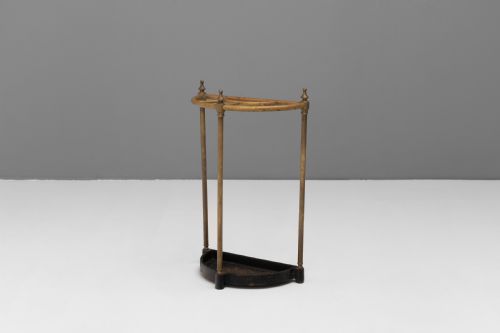


Vintage Brass Circular Tray
A vintage brass circular tray brings warmth and rich engraved detail to a room, functioning as a striking table top or decorative charger.
Vintage Brass Circular Tray
A vintage brass circular tray forms part of a varied group of round metal vessels and table tops appearing across Victorian, Edwardian, and early twentieth-century periods. These items range from simple domestic trays to engraved mixed metal chargers and decorative table tops.
Buyers seeking a vintage brass circular tray will encounter pieces reflecting diverse global styles, including Persian, Anglo-Indian, and Mamluk Revival designs alongside British Victorian and Edwardian work. The most common form on this page is the large engraved circular tray, often adapted as a coffee table top or occasional table.
Alongside the round trays and tables, the broader selection includes umbrella stands, stick stands, and demi-lune hall pieces incorporating brass and cast iron. These functional items share the same period metalwork traditions found in the flat circular trays.
Materials and construction
The objects are constructed primarily from brass, frequently paired with copper, cast iron, wood, or hardwood to form stable stands and table bases. Metalwork techniques rely heavily on hand engraving and mixed metal inlay to create complex surface patterns.
Trays and table tops display detailed surface ornamentation, utilising contrasting metals to highlight motifs from zodiac signs to intricate Islamic and Persian revival designs. Heavier items such as umbrella stands combine cast iron components with sheet brass to ensure durability.
Current listings feature Victorian, Edwardian, and early twentieth-century pieces, spanning periods from 1860 to the 1930s.
Distinguishing quality
Quality in these metalwork pieces rests upon the depth, crispness, and complexity of the engraving rather than mere age. Pieces featuring mixed metal inlay and deeply chased surfaces demonstrate superior craftsmanship compared to simpler stamped or lightly etched examples.
The integration of brass tops with their structural elements, whether solid hardwood occasional tables or cast iron stick stands, dictates the overall integrity of the piece. Finer examples maintain crisp detailing across the entire circular surface without excessive wear to the engraved lines.
The Vintage Brass Circular Tray Glossary
- Mixed Metal
- The combination of different metallic elements, such as brass, copper, and silver, used together in a single object to create contrasting visual tones. This technique is frequently seen on Victorian engraved trays.
- Demi-Lune
- A half-moon or semicircular shape applied to furniture and umbrella stands designed to sit flush against a hallway wall. It saves floor space while retaining decorative presence.
- Anglo-Indian
- A style describing decorative items made in India during the British colonial period, often combining traditional eastern motifs with forms suited to Western homes.
Vintage Brass Circular Tray: Frequently Asked Questions
How were brass trays originally used?
These round metal vessels served both practical domestic purposes and decorative display functions within nineteenth and early twentieth-century homes. Larger engraved examples often functioned as serving trays or centrepieces before later being mounted onto folding wooden stands to create occasional tables.
Many pieces were also imported from the Middle East and India during the Victorian and Edwardian eras as decorative works of art. Their rich surface ornamentation made them focal points in reception rooms and parlours.
How do I care for a vintage brass tray?
Maintenance requires minimal intervention to preserve the natural aged patina that develops over decades of handling. Gentle dusting with a soft cloth is generally sufficient for everyday upkeep.
Avoid harsh chemical metal polishes that strip away historical patination and soften the engraved details. If cleaning is necessary, use a mild, non-abrasive soap solution and dry thoroughly.
How do I distinguish revival styles from original period pieces?
Revival styles such as Mamluk or Egyptian Revival date from the nineteenth century and reflect Victorian and Edwardian interpretations of earlier historic aesthetics. They are identified by specific manufacturing techniques, tool marks, and alloy compositions typical of that era rather than medieval craftsmanship.
Examining the underside, fixing methods, and edge finishing helps establish the manufacturing period. The presence of mixed metal inlay and specific engraving styles aligns these pieces with late Victorian workshop practices.
Can these circular trays be used as coffee tables?
Many circular trays and engraved table tops are paired with wooden or metal folding bases to function effectively as coffee tables or occasional tables. This adaptation respects the original decorative nature of the tray while providing practical modern utility.
When using a tray as a table top, ensure it rests securely on a stable support sized appropriately to the diameter of the metal piece. This prevents tipping and protects the edges from accidental damage.