





Vintage Black Powder Pistol
A vintage black powder pistol carries the weight of centuries, offering a tangible connection to early firearm mechanics and military history.
Vintage Black Powder Pistol
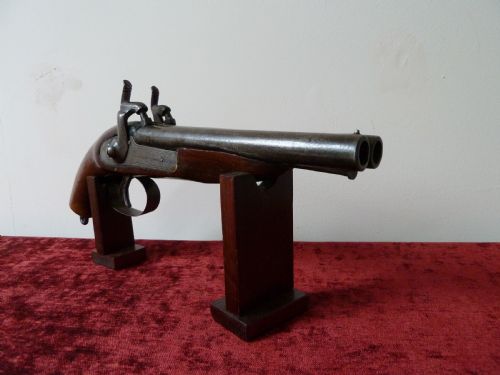
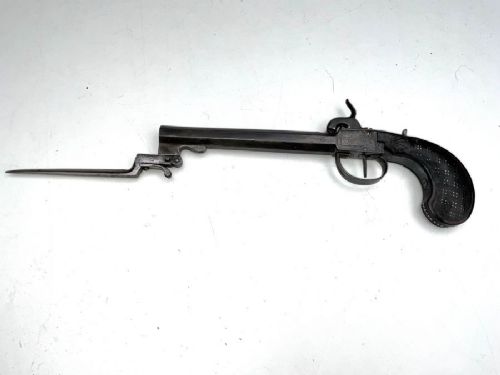
When you search for a vintage black powder pistol, you encounter muzzle-loading firearms spanning the eighteenth and nineteenth centuries. These pieces encompass military service arms, officers' sidearms, and compact pocket pistols designed for personal defence.
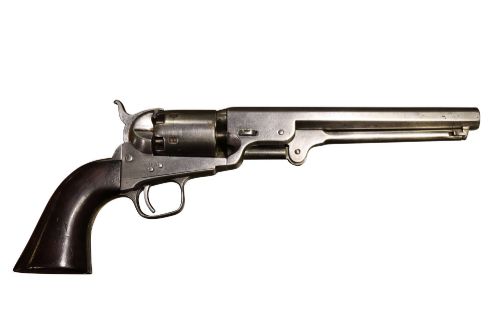
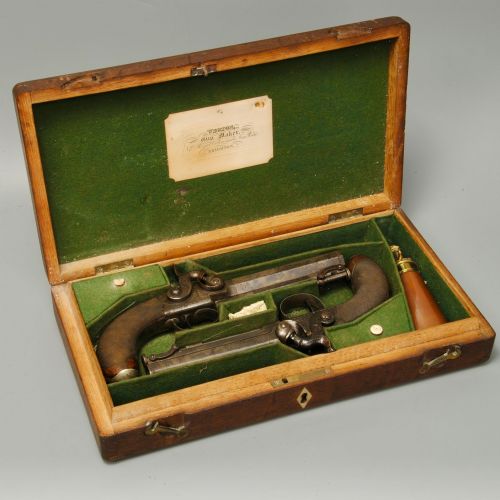
The selections available here range from flintlock mechanisms of the Georgian era to mid-nineteenth-century percussion revolvers and belt pistols. Many items appear alongside fitted boxes and accessories such as powder flasks.
Makers from London, provincial towns, and continental workshops produced these arms for civilian carriage and military campaigns alike. Buyers frequently encounter British and American service issues alongside European holster pistols.
How they were made
Gunsmiths utilised forged steel and iron for barrels and lock mechanisms, pairing them with stocks shaped from dense hardwoods like walnut, mahogany, and oak. Brass frequently formed trigger guards, butt caps, and barrel furniture on both flintlock and percussion models.
Internal components required precise hand-fitting to ensure reliable spark generation in flintlocks or smooth cylinder rotation in percussion revolvers. Fitted presentation cases often lined their interiors with velvet to cushion the pistol and its accompanying tools.
Some pocket pistols incorporate hidden triggers that spring into position only when the hammer is cocked.
What varies in quality
The calibre of engraving on lock plates and trigger guards often distinguishes standard service issue from bespoke civilian pieces. Crisp maker signatures on the barrel or lock denote workshop pedigree.
Matching serial numbers across frames, cylinders, and barrels elevate the standing of nineteenth-century revolvers. The integrity of the wood stock and the preservation of original metal finishes dictate overall desirability.
Thomas Anelli·Barber of Newark
The Vintage Black Powder Pistol Glossary
- Percussion lock
- An ignition system developed in the nineteenth century that used a hammer to strike a percussion cap containing fulminate of mercury, producing a flame to ignite the black powder charge.
- Flintlock
- A firearm ignition mechanism where a flint held in a cock strikes a steel frizzen to create sparks that ignite priming powder in the pan.
- Smoothbore
- A barrel lacking internal rifling, designed to fire lead balls without imparting spin.
- Calibre
- The internal diameter of the firearm barrel, determining the size of the ammunition used.
- Muzzle-loading
- The method of loading gunpowder and projectile down the forward end of the barrel rather than via a breech.
Vintage Black Powder Pistol: Frequently Asked Questions
How do flintlock and percussion pistols differ?
Flintlocks rely on a flint striking steel to create a spark for ignition, whereas percussion models use a hammer hitting a cap.
Percussion systems emerged later in the nineteenth century and offered greater reliability in damp weather.
Were these pistols used in the Civil War?
Several listed revolvers, notably Colt models from eighteen sixty onwards, saw active service during the American Civil War.
Martial issue markings indicate military procurement for troop deployment.
What accessories normally accompany these pistols?
Complete sets frequently include wooden transit boxes lined with velvet, housing lead ball moulds, cleaning rods, and copper powder flasks.
Compartments kept percussion caps and spare components organised.
How do I identify the period of a pistol?
Inspect the lock mechanism, barrel shape, and any stamped maker details or dates inscribed on the metal components.
Georgian examples typically feature flintlocks, while Victorian pieces favour percussion caps and steel frames.