





19th Century Percussion Handgun
These 19th century percussion handgun examples span military service and civilian defence, offering solid mechanics and period materials for collectors.
19th Century Percussion Handgun
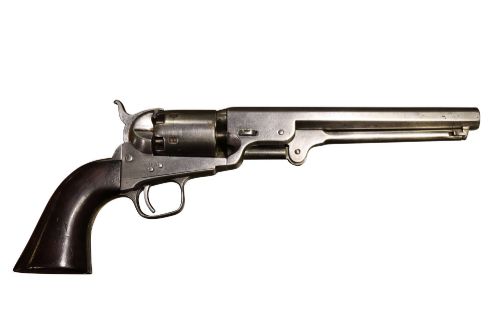
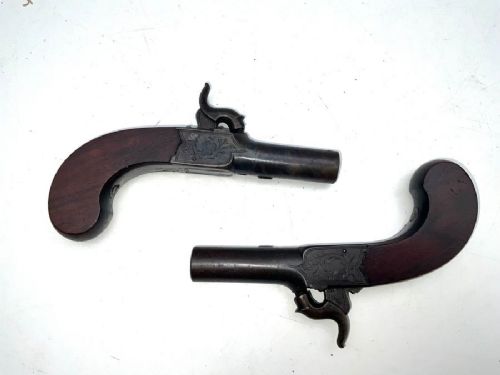
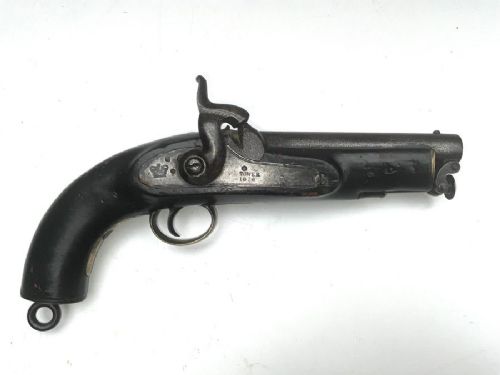
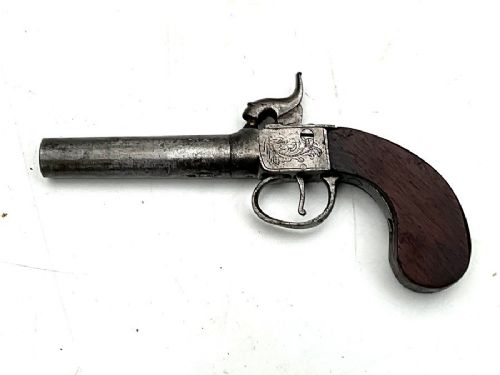
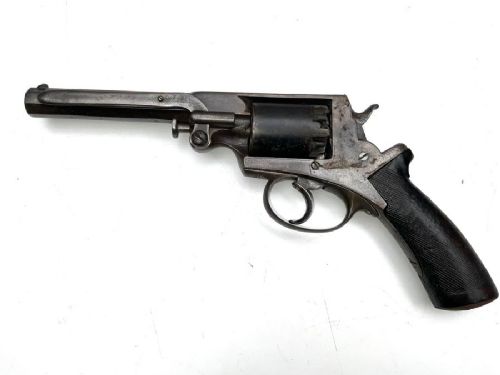
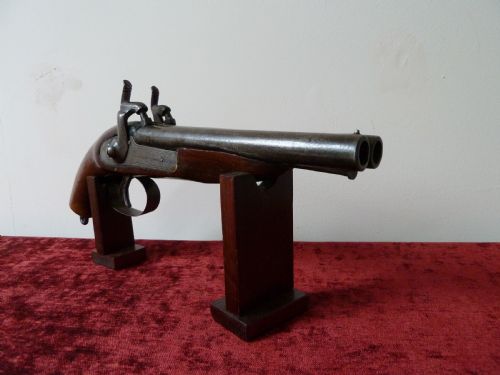
A 19th century percussion handgun represents the technological shift from flintlock mechanisms to the percussion cap system, which used a detonating compound struck by a hammer to ignite the gunpowder charge. The pieces gathered here cover pocket pistols, heavy revolvers, and military belt models dating from the 1850s and 1860s.
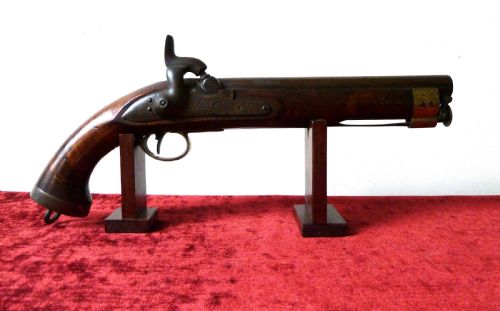
Buyers most frequently encounter Victorian military issues, pocket pistols, and revolvers bearing maker stamps or government marks. These firearms served officers, cavalry units, and civilians across British, American, and European contexts during a period of rapid arms development.
Materials and construction methods
Makers utilised forged steel and iron for barrels, frames, and lock mechanisms to withstand repeated powder charges. Wood stocks, predominantly walnut, mahogany, and oak, were shaped and fitted to the metal components, sometimes accompanied by brass trigger guards and mountings.
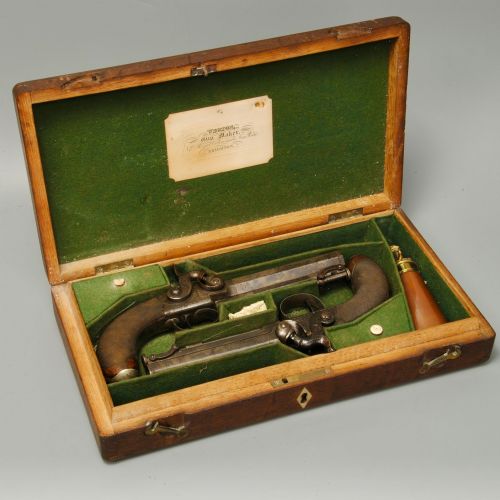
Cased sets often integrated fitted wooden boxes lined with velvet to secure the handgun alongside accessories such as bullet moulds, powder flasks, and cleaning rods. Metal parts frequently featured engraved scrollwork or maker inscriptions, while specific military pieces carried government or East India Company inspection stamps.
The inventory spans Victorian military pieces, American Civil War revolvers, and Ottoman Empire sidearms.
Factors influencing quality
Quality rests upon the crispness of the mechanical action, the legibility of maker signatures and proof marks, and the preservation of original metal finishes and stock wood. Examples retaining matching serial numbers across components or complete boxed sets with original accessories represent the upper tier of survivals.
The degree of hand-finishing, from simple military issue tooling to intricate engraving on officer and presentation pieces, dictates the standing of an individual firearm. Condition ranges from heavily service-worn sidearms to pristine cased pairs preserved with minimal operational wear.
Colt·Deane Adams And Deane·Mortimer·Auguste Francotte·A W Spires
The 19th Century Percussion Handgun Glossary
- Percussion cap
- A small metal cup containing a priming compound placed on the nipple of a firearm to ignite the main charge when struck by the hammer.
- Smoothbore
- A barrel without rifling grooves inside, designed to fire lead balls without imparting spin.
- Revolver
- A repeating handgun with a revolving cylinder containing multiple chambers for sequential firing.
- Flick bayonet
- A spring-loaded blade attached beneath the barrel that releases forward for close-quarters combat.
- Matching numbers
- Serial numbers corresponding across various component parts of a firearm, indicating factory assembly integrity.
19th Century Percussion Handgun: Frequently Asked Questions
How do I identify a military issue pistol?
Military firearms typically feature government inspection stamps, broad arrow marks, or issue designations stamped onto the metal frame or wood stock.
These pieces often display standardisation in design and simpler finishes compared to privately purchased civilian officer models.
What is the difference between a pocket pistol and a belt pistol?
Pocket pistols are shorter, lighter firearms designed for concealed carry and close-range self-defence during the Victorian era.
Belt pistols are larger military or civilian sidearms intended to be worn in a holster or attached to a belt during travel or service.
Why do some revolvers come in fitted boxes?
High-grade civilian and officer revolvers were frequently retailed in custom wooden cases lined with velvet to protect the weapon.
These boxed sets housed the handgun alongside essential loading and maintenance accessories such as flasks, moulds, and cleaning tools.
How should I care for an antique percussion handgun?
Keep the firearm in a stable environment away from high humidity and direct sunlight to protect the steel and wood components.
Apply a light microcrystalline wax or specialist oil to metal surfaces to prevent oxidation while leaving original patina undisturbed.