

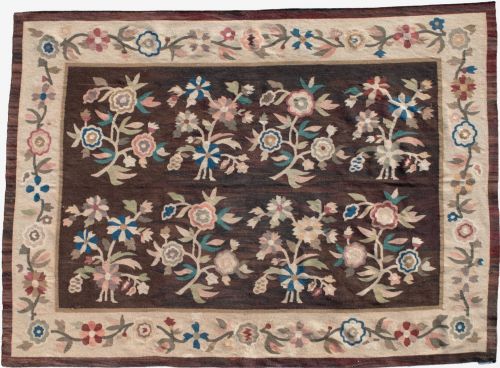


Vintage Bessarabian Flatweave
These vintage bessarabian flatweave pieces are traditional woven rugs bringing distinct floral motifs and folk character into your rooms.
Vintage Bessarabian Flatweave
When you search for vintage bessarabian flatweave, you are looking at flat-woven floor coverings originating from the historical region of Bessarabia, encompassing parts of modern Moldova and Ukraine. These pieces bring heavy regional tradition into a room through flat tapestry weaves that sit flat on the floor.
On this page, you are most likely to meet kilims and rugs dated across the late nineteenth and early twentieth centuries, specifically spanning from eighteen eighty to nineteen twenty. These items appear as individual rugs or occasionally as matched pairs, offering distinct folkloric character.
The objects take the form of kilim rugs and larger carpets featuring traditional regional designs rather than standard Persian or Anatolian geometry. They serve primarily as decorative floor coverings that ground a space with historic textile artistry.
What varies in quality
Quality in these flatweaves rests on the crispness of the traditional design execution and the handling of the wool. Finer examples display greater precision in the flat tapestry weave and a more sophisticated balance of floral motifs across the field.
The visual strength of the piece also dictates its standing, with superior items maintaining strong saturation and clear distinction between the regional motifs. Condition and structural integrity of the flat weave ultimately separate the standard examples from the finest survivals of the period.
Vintage Bessarabian Flatweave Retail Price Guide 2026
Typical asking prices for vintage bessarabian flatweave among the pieces listed under this phrase on Sellingantiques today, from the lower quarter to the upper quarter. They describe what is for sale here now, not the wider market.
Every woven flower on these rugs survived generations of cold winters and country floors just to sit in your modern living room.
The Vintage Bessarabian Flatweave Glossary
- Flatweave
- A textile produced without a pile by interlocking warp and weft threads together. This technique creates a thin, smooth rug that lies flat on the floor.
- Kilim
- A tapestry-woven carpet or rug made across southeastern Europe and the Near East. These pieces have no pile and rely entirely on the woven design.
- Warp
- The stationary longitudinal threads held under tension on a loom. The weft threads are passed over and under the warp to build the textile.
- Weft
- The transverse threads passed through the warp yarns to create the pattern and colour of the fabric. In these rugs, the weft completely covers the warp.
Vintage Bessarabian Flatweave: Frequently Asked Questions
Where were vintage bessarabian flatweave rugs made?
These rugs originate from the historical region of Bessarabia, spanning parts of modern Moldova and eastern Europe. They represent distinct local weaving traditions passed down through generations.
They reflect the domestic and cultural textile practices of Ukrainian and Moldovan folk communities from the late nineteenth and early twentieth centuries.
How do I care for a flatweave rug?
Protect your flatweave by using a quality underlay to prevent sliding and reduce friction against hard floors. Vacuum gently using suction only without a rotating brush.
Keep the textile out of direct, harsh sunlight to preserve the natural wool fibres and dyes over time. Rotate the rug periodically to ensure even wear.
Are these rugs reversible?
Most traditional kilims and flatweaves feature a very similar pattern on both sides because of the tapestry weaving technique. This structural characteristic means the rug can often be flipped.
However, you should check the specific backing and condition of each individual piece before reversing it on your floor.
What motifs appear on these rugs?
The surface designs frequently incorporate traditional regional floral patterns rooted in Ukrainian folk and Bessarabian styles. These botanical elements distinguish them from geometric Middle Eastern rugs.
The compositions focus on naturalistic flower arrangements and foliate sprays rendered in a distinct flat-woven aesthetic.