


Vintage Barometer Oak Casing
These vintage barometer oak casing pieces combine practical weather tracking with solid timber cabinetry from the Victorian, Edwardian, and mid twentieth-century periods.
Vintage Barometer Oak Casing
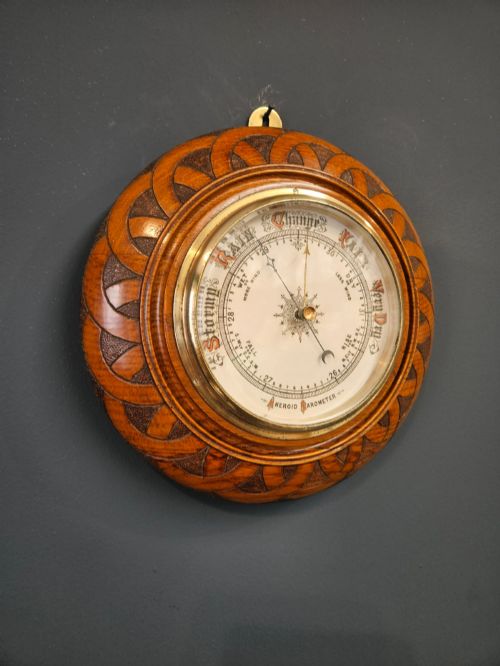
A vintage barometer oak casing brings together functional scientific instruments and robust domestic woodwork, spanning forms such as aneroid barometers, stick barometers, complex barographs, and complete weather stations. When you search for vintage barometer oak casing, you encounter instruments housed in timber frames that range from compact wall hangings to substantial desk and shop display models.
The pieces listed on this page originate across several distinct eras, including the Victorian, Edwardian, and 1930s British periods. Surviving examples demonstrate how households and businesses recorded atmospheric pressure using reliable timber enclosures.
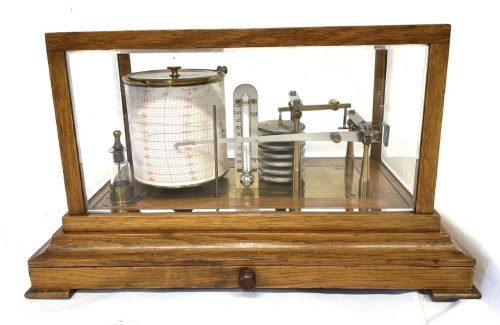
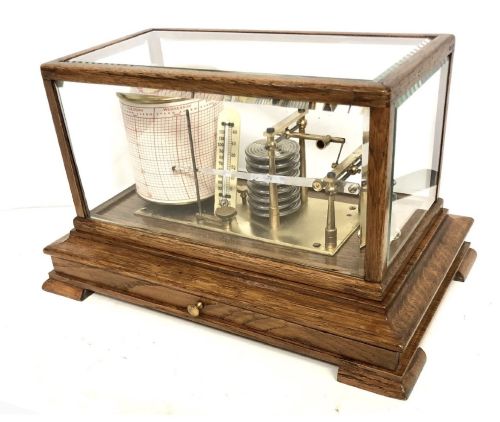
Most pieces on this page take the form of wall-mounted banjos or table-standing barographs featuring bevelled glass and dedicated chart drawers. Makers applied geometric designs, turning, and carving to the timber housings.
How they were made
Craftsmen utilised solid oak to build the protective cases, shaping the timber through turning, carving, and geometric joinery to frame the delicate internal mechanisms. Brass components, including bezels, levers, and instrument plates, provide structural contrast against the warm grain of the wood.
Makers set bevelled glass panes into the timber housings of barographs and display instruments to protect the paper charts and steel recording arms while allowing clear visibility. Paper charts and printed dials complete the functional display of atmospheric changes.
Listings feature Victorian and Edwardian oak barometer cases alongside scientific barographs housing brass mechanisms and paper charts.
What varies in quality
Quality separates standard domestic weather recorders from specialised scientific apparatus by makers such as Short & Mason or Negretti & Zambra. Superior examples incorporate complex multiday barograph movements with integrated thermometers and chart drawers rather than basic aneroid dials.
The refinement of the oak casing distinguishes finer pieces, showing in deep geometric carving, precise wood turning, and heavy bevelled glass panels. The precision of the brass mechanism and the clarity of the paper scale determine the overall standard of the instrument.
Short & Mason·Negretti & Zambra·J Hughes London·Jules Richard·Admiral Fitzroy·Dobbie Son And Hutton
The Vintage Barometer Oak Casing Glossary
- Barograph
- A self-recording barometer that graphs atmospheric pressure over time onto a rotating paper chart. These instruments typically sit inside a glass-covered timber case.
- Aneroid Barometer
- An instrument that measures air pressure through the expansion and contraction of a sealed metal capsule, without using liquid mercury.
- Stick Barometer
- A tall, vertical barometer design that displays atmospheric pressure via a mercury-filled glass tube mounted within a wooden trunk.
- Bevelled Glass
- Glass panes featuring an angled, polished edge, commonly set into the multiple glass panels of barograph cases.
- Weather Station
- A combined instrument housing multiple meteorological tools, such as a barometer, thermometer, and humidity gauge, within a single oak frame.
Vintage Barometer Oak Casing: Frequently Asked Questions
How do barographs work?
A series of stacked vacuum metal capsules expands or contracts with shifting air pressure, moving a connected steel arm across a rotating paper chart.
Clockwork mechanisms inside the drum rotate the paper cylinder once every week to record continuous weather patterns.
Where were these placed at home?
Homeowners typically hung wall-mounted barometer banjos in hallways or studies where guests could observe the weather and admire the timber cabinetry.
Table-standing barographs and weather stations sat securely on desks, sideboards, or library tables for easy daily reading.
How do I read paper charts?
The revolving drum holds a paper chart marked with pressure gradients and days of the week, allowing you to track rising or falling weather trends at a glance.
Needle traces record historical pressure data directly onto the grid for interpretation.
Can these instruments be calibrated?
Adjustment screws on the rear or internal mechanism allow users to align the dial pointer with known local barometric pressures.
Professional calibration ensures the steel linkages respond accurately to current atmospheric conditions.