

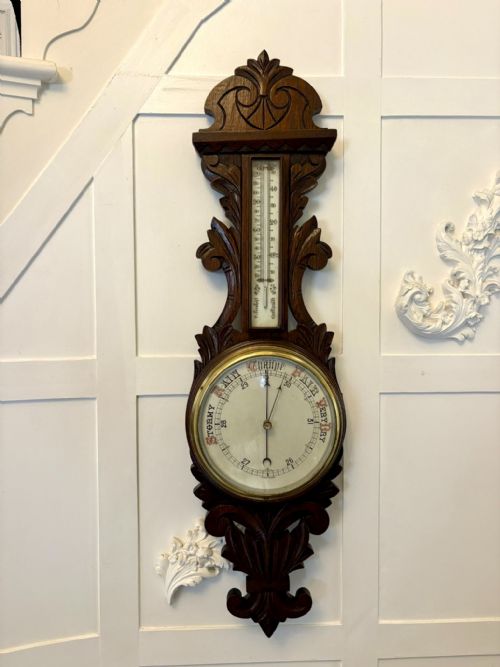


Traditional Oak Weather Instrument
These traditional oak weather instruments span the Victorian and Edwardian eras, offering reliable meteorological tracking housed in robust timber cases.
Traditional Oak Weather Instrument
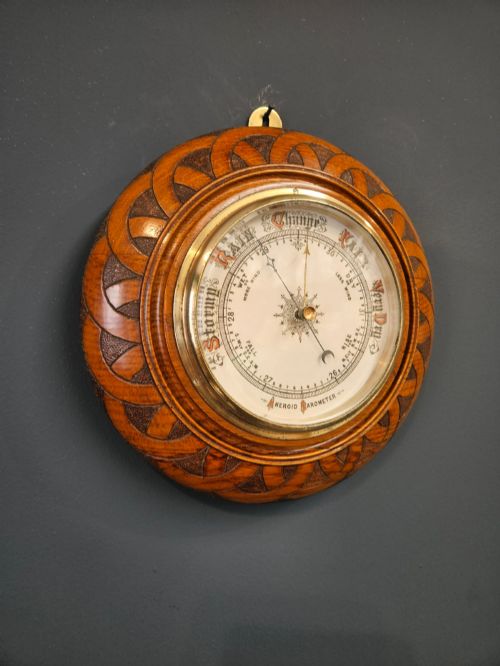
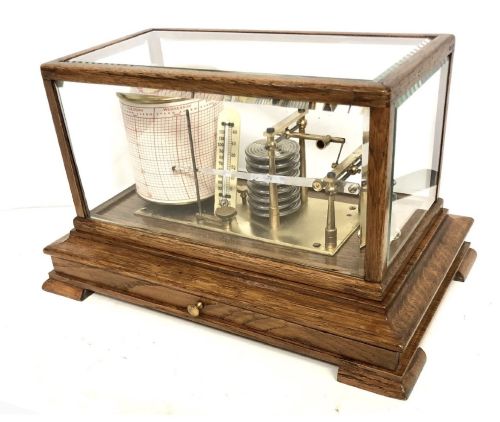
A traditional oak weather instrument brings domestic meteorological tracking into the home, drawing on scientific instruments from the Victorian and Edwardian periods. These pieces include wall barometers, barographs with chart drawers, and combined clock and barometer units.
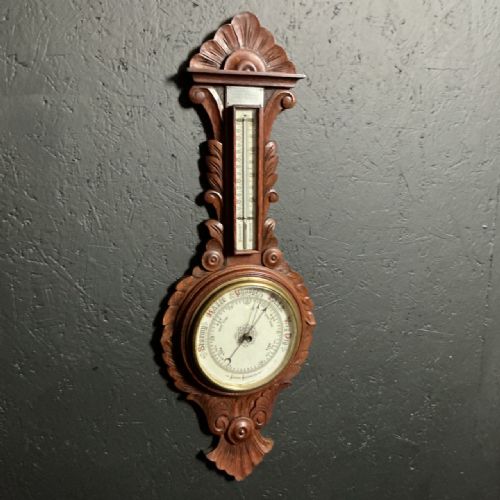
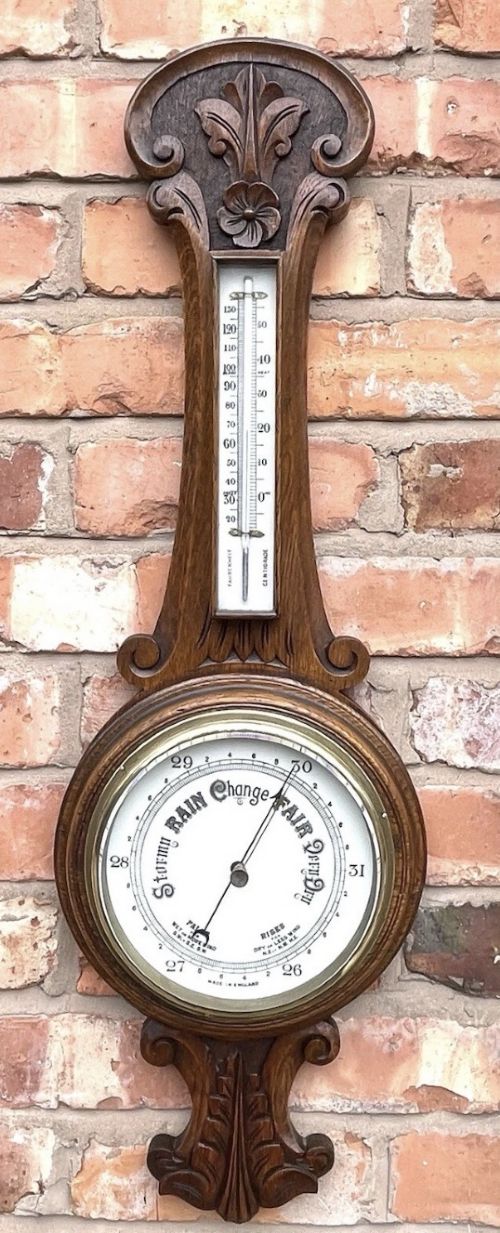
The selections encountered here most frequently take the form of carved oak banjo barometers featuring integrated thermometers and bevelled glass. Pieces from the Black Forest style and standard late Victorian production appear regularly alongside compact variants.
Makers such as Negretti & Zambra and Maple & Co represent the higher end of these domestic scientific instruments, utilising sturdy oak housings alongside walnut accents. Collectors also find simpler wall-mounted barometers dated between eighteen sixty and nineteen twenty.
Construction and materials
Cases rely heavily on solid oak and carved wood, sometimes incorporating walnut elements to frame the dials and chart compartments. These timbers are shaped through turning and carving techniques typical of late nineteenth and early twentieth century cabinetmaking.
Functional components integrate brass bezels, exposed metal mechanisms, and heavy bevelled glass to protect the delicate barometer dials and thermometer scales. Mercurial tubes and aneroid movements operate within these timber enclosures alongside paper chart drums in barograph variants.
Listings feature oak, carved wood, brass, glass, metal, and walnut across Victorian and Edwardian periods.
Assessing quality in traditional oak weather instruments
The standard of carving across the oak case distinguishes ordinary production from finer examples, particularly in Black Forest or Maple & Co pieces. Crisp detail in the woodwork and well-proportioned banjo shapes indicate superior craftsmanship.
The presence of supplementary instrumentation, such as integrated thermometers or functional chart drawers, adds complexity to the instrument. Maker signatures on the dial plate also elevate the standing of a piece within this category.
Negretti & Zambra·Maple & Co
The Traditional Oak Weather Instrument Glossary
- Banjo barometer
- A domestic weather glass housed in a vertical wooden case shaped loosely like a banjo, usually combining a thermometer with the main dial.
- Barograph
- A self-registering meteorological instrument that records atmospheric pressure over time onto a rotating paper chart.
- Aneroid barometer
- A device that measures air pressure through the expansion and contraction of a flexible metal box, operating without liquid mercury.
- Bevelled glass
- Heavy window glass featuring a polished, angled edge around the perimeter, fitted into the brass bezel of the instrument face.
- Mercurial barometer
- A traditional scientific instrument utilising a column of liquid mercury balanced against atmospheric pressure.
Traditional Oak Weather Instrument: Frequently Asked Questions
How do I read a traditional oak weather instrument?
The main dial displays atmospheric pressure changes measured in inches or millibars, which indicate upcoming shifts in meteorological conditions. Tapping the glass gently before reading helps settle the internal mechanical linkage.
Secondary dials or attached thermometers provide current ambient temperature readings to give a complete picture of domestic weather conditions.
Where should I hang a wall barometer?
Mount the instrument on an interior wall away from direct sunlight and sudden temperature fluctuations, such as active radiators or heating vents. Stable indoor environments prevent the wood case from warping and protect the internal brass mechanics.
Ensure the wall fixing is secure enough to bear the combined weight of the solid oak timber and heavy glass components.
What is the difference between an aneroid and a mercurial barometer?
An aneroid barometer uses an enclosed metal vacuum chamber that moves a needle via springs and levers, making it safer and easier to transport. These make up the majority of domestic wall instruments.
A mercurial barometer relies on a column of liquid mercury and requires careful handling, often representing more traditional scientific manufacture.
How do I care for the oak case?
Dust the carved woodwork regularly with a soft, dry cloth to prevent grime accumulation in the recesses of the Victorian or Edwardian carvings. Avoid using modern aerosol polishes that leave residues on the timber surface.
Applying a modest amount of beeswax periodically preserves the natural finish of the oak without harming the brass bezel or glass.