


Victorian Writing Companion
A victorian writing companion brings order to correspondence, housing inkwells, pens and stationery in disciplined wood and metal.
Victorian Writing Companion
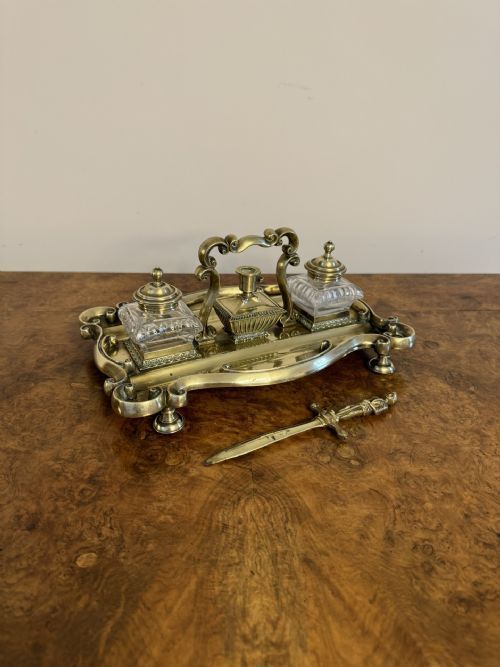
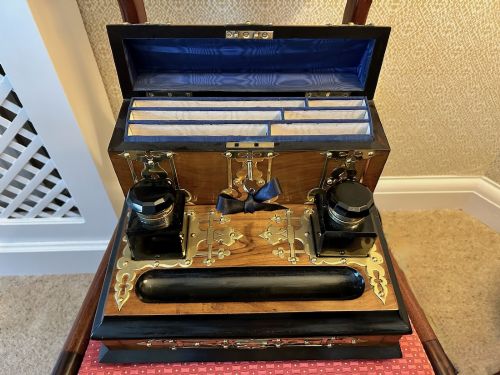
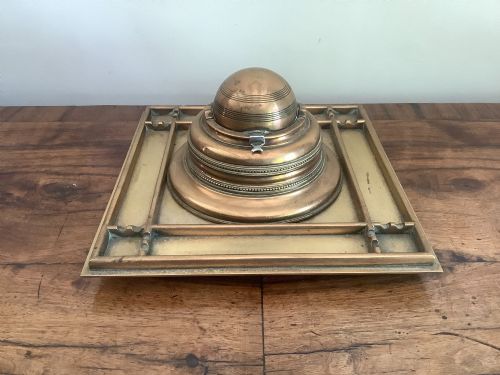
A victorian writing companion encompasses desk accessories, inkstands, stationery boxes and writing slopes designed for the nineteenth-century study. Buyers encounter portable boxes alongside heavy bureau stands intended to remain stationary upon a partner desk.
The selection relies heavily on Victorian and Edwardian examples, spanning the nineteenth and early twentieth centuries. Oak, walnut and coromandel predominate, frequently fitted with brass mounts and cut glass inkwells.
Common forms include double inkstands, stationery cabinets with adjustable dates, and fitted writing slopes with compartments for paper and nibs. These pieces reflect the formal correspondence habits of the period, executed in substantial timbers and metalwork.
Materials and construction
Cabinet makers utilised dense hardwoods such as oak, walnut, rosewood and coromandel, often embellished with brass mounts, ormolu, mother-of-pearl and tortoiseshell. Surface decoration ranges from intricate carving to inlaid brass and Chinoiserie motifs.
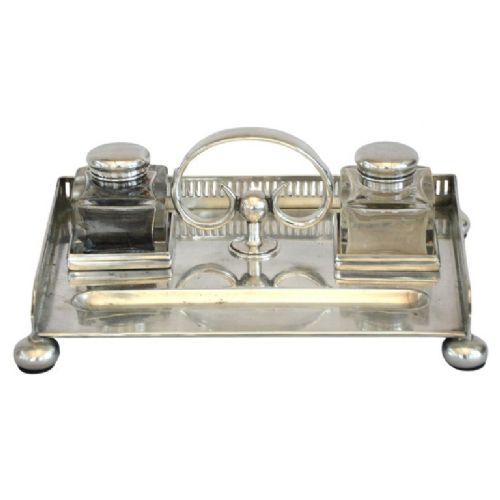
Glassmakers produced heavy cut glass inkwells designed to fit securely into fitted wooden or metal trays. Silver plating and solid brass provide the structural framework for inkstands and letter racks, while leather and velvet line the writing surfaces of portable slopes.
Some companions include chaff-cutter escapement clock movements or hidden secret drawers for stashing private correspondence.
Assessing the craftsmanship
Quality rests upon the selection of timber veneers and the precision of the brass or ormolu mounts. Finer pieces display carefully matched burr walnut or coromandel grain, whereas simpler versions utilise plain oak or mahogany.
The interior fittings dictate the standing of the piece, with complete sets retaining matching cut glass inkwells, original key escutcheons and functioning drawers. Desk sets featuring combined accessories, such as calendar mechanisms or clock inserts, represent more ambitious commissions.
Walker And Hall
The Victorian Writing Companion Glossary
- Inkstand
- A tray or stand holding one or more inkwells, pen rests and sometimes a sander or wafer box. These desk accessories formed the centrepiece of Victorian letter writing.
- Stationery cabinet
- An upright box with compartments, doors or slopes designed to hold writing paper and envelopes upright. They often incorporated letter racks and small drawers.
- Writing slope
- A portable box with a hinged sloping lid that opens to reveal a velvet or leather-lined writing surface and storage for stationery. Many include secret drawers beneath the pen tray.
- Ormolu
- Gilded bronze or brass mounts applied to furniture and desk accessories for decorative effect. The technique was widely utilised during the nineteenth century in various revival styles.
- Davenport
- A compact writing desk featuring a sloped writing surface above a pedestal of drawers. The style remained popular throughout the Victorian period for domestic correspondence.
Victorian Writing Companion: Frequently Asked Questions
What is a Victorian writing companion?
A Victorian writing companion is a desk accessory or fitted box designed to organise correspondence materials. These pieces include inkstands, stationery cabinets and writing slopes.
They provided a designated place for inkwells, pens and paper in nineteenth-century households and offices. The term spans portable boxes and substantial desk stands.
How do I date an inkstand?
Dating relies on timber choices, mounting styles and maker marks where present. Earlier nineteenth-century examples often feature rosewood, coromandel and intricate brass inlay.
Later Victorian pieces shift towards substantial oak and Arts and Crafts simplicity, while Edwardian versions frequently combine silver plating with cut glass.
Were these pieces used for travel?
Certain forms, such as portable writing slopes and pocket companions, were built for travel. They featured secure locking mechanisms and lidded inkwells to prevent spillage on the move.
Larger desk stands and stationery cabinets were intended to remain stationary on a library table or partner desk.
How do I care for wooden desk accessories?
Maintain the timber by applying appropriate wax polish sparingly to preserve the grain and finish. Avoid placing wooden desk sets in direct sunlight or near heat sources.
Glass inkwells and metal mounts benefit from gentle cleaning with a soft cloth to remove dust without damaging surrounding wood or leather.