


Victorian Wooden Music Box
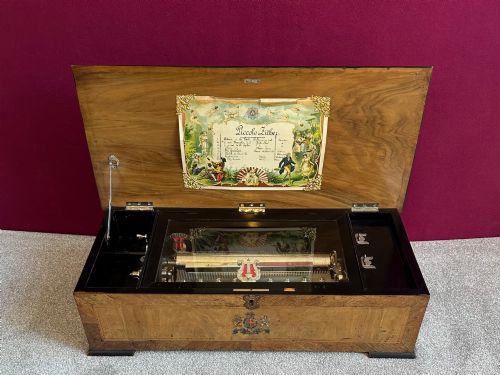
When you choose a victorian wooden music box, you bring home a mechanical cylinder or disc player housed in a polished timber case.
Victorian Wooden Music Box
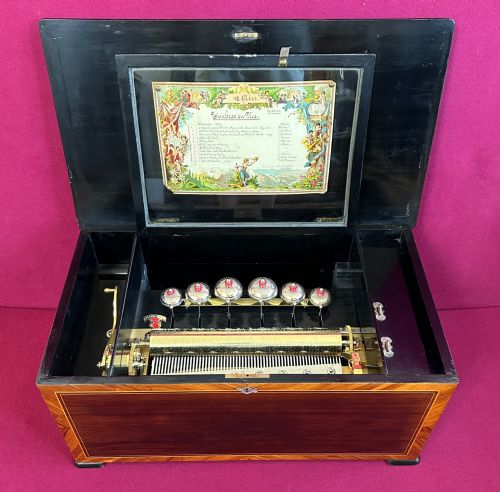
A victorian wooden music box is a mechanical instrument that plays pre-programmed tunes using a pinned metal cylinder or a flat disc rotated against a tuned steel comb. The most common examples on this page are mid-to-late nineteenth-century cylinder boxes housed in rectangular timber cases, alongside larger cabinet forms, tables, and occasional variants like musical fruit bowls or chairs.
The objects span periods from the eighteenth century through to the Edwardian era, though the nineteenth century dominates the selection. These pieces originate primarily from Swiss workshops or British retailers, combining precision metalwork with decorative cabinetry designed for domestic parlour entertainment.
How they were made
Maker workshops built the exterior casework using dense cabinet timbers such as rosewood, walnut, and ebonised wood, frequently embellishing the lids with boxwood stringing and floral marquetry inlay. Inside the box, a brass bedplate supports the revolving pinned cylinder, the spring-driven motor, and the steel comb with its individually tuned teeth.
Even the furniture joined in the tune, with surviving marquetry chairs hiding musical movements inside their wooden frames.
What varies in quality
The distinction between ordinary and superior pieces rests on the complexity of the musical arrangement and the craftsmanship of the case. High-end examples by notable makers feature multiple airs, brass bells, and intricate marquetry, whereas simpler pieces offer basic single-cylinder tunes in plain wooden boxes.
Acoustic performance and the original integrity of the brass and steel movement dictate the standing of a box. Fully restored works with original pins and combs command greater appreciation than those with replaced components or altered casework.
Langdorff And Fils·Nicole Freres·B A Bremond
The Victorian Wooden Music Box Glossary
- Cylinder
- A rotating metal barrel set with tiny pins that pluck the teeth of a steel comb to produce notes. This cylinder shifts laterally to play multiple distinct tunes, known as airs.
- Comb
- A flat piece of tuned steel with multiple cantilevered teeth that vibrate when struck by the pins on the cylinder. Each tooth corresponds to a specific musical note.
- Marquetry
- The art of applying pieces of veneer to a wooden structure to form decorative patterns and pictorial designs. This technique decorates the lids of many nineteenth-century cases.
- Airs
- The individual musical tunes or melodies that a box is pinned to play during a single rotation sequence. Multi-air boxes offer a varied repertoire.
- Bedplate
- The heavy brass plate that serves as the rigid foundation for the entire mechanical movement, holding the spring motor, cylinder, and comb in precise alignment.
Victorian Wooden Music Box: Frequently Asked Questions
What is a musical box cylinder?
The cylinder is the rotating metal barrel studded with thousands of tiny hand-placed pins. These pins pluck individual teeth on the steel comb to create the melody.
As the mechanism turns, the cylinder can shift along its axis to present a different set of pins, allowing the machine to play multiple distinct tunes.
How do you wind these music boxes?
Most nineteenth-century boxes utilise either a permanent winding handle attached to the side or a separate key inserted into the case. Winding tensions the internal mainspring that drives the gear train.
Care must be taken not to overwind the mechanism, stopping as soon as resistance is felt to protect the vintage spring.
What are box airs?
Airs refer to the individual musical compositions or tunes programmed onto the revolving cylinder. A standard domestic box might play six or twelve distinct airs.
A lever on the exterior of the case allows the listener to select a specific air or set the mechanism to repeat continuously.
Where were these boxes made?
The majority of mechanical musical movements originated in Swiss valleys, particularly around Geneva and Sainte-Croix, where specialised horological skills adapted into musical automation.
Cabinetmakers across Britain and Europe then housed these imported Swiss movements in local timber cases made from rosewood, walnut, or ebonised wood.
How should I care for a wooden music box?
Keep the box in a stable environment away from direct sunlight and sudden temperature shifts, which can warp the delicate timber veneer or affect the brass mechanism.
Wind the movement gently and avoid touching the pinned cylinder or steel comb with bare fingers, as natural oils can cause corrosion on the metal.