


Victorian Venetian Oil Painting
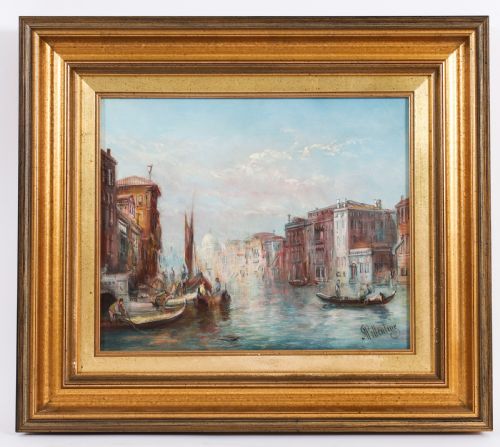
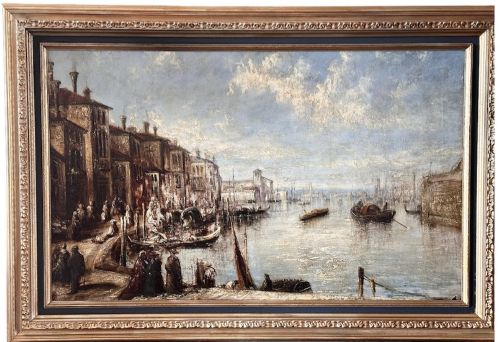
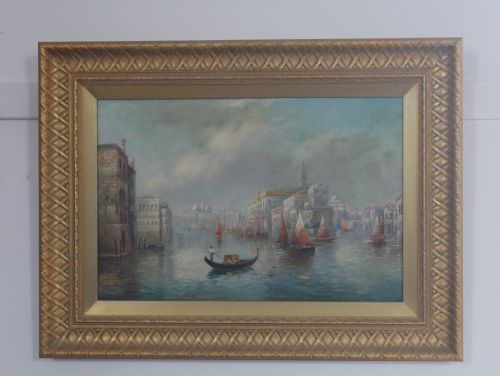
These Victorian venetian oil painting works capture the light and architecture of Italy on canvas, prized for their atmospheric townscapes.
Victorian Venetian Oil Painting
When you search for a Victorian venetian oil painting, you encounter 19th-century townscapes depicting iconic locations such as the Grand Canal, the Doge's Palace, the Lagoon, and Santa Maria della Salute. These works record the bustling waterways and historic palazzos through the lens of nineteenth-century romanticism and fine art.
The most common form on this page is the framed canvas townscape, produced across the Victorian era by artists drawn to the distinct architecture and light of Venice. Subjects frequently centre on major landmarks like the Mocenigo Palace, the Dogana, and San Simeone Piccolo.
How They Were Made
The works utilise oil on canvas as the primary medium, applied to support structures made of wood. Many examples retain their original giltwood, gilded wood, or gilt wood frames embellished with gold leaf.
Artists built up the oil paint on canvas to render detailed townscapes, capturing the reflective water of the Venetian canals and the ornate stonework of historic buildings. The physical construction relies on traditional stretched canvas housed within decorative wooden framing.
Alfred Pollentine painted so many Venetian canals you can almost hear the gondoliers arguing about the traffic near the Dogana.
What Varies In Quality
The distinction in these paintings lies in the fidelity of the architectural draughtsmanship and the handling of atmospheric light across the lagoon. Works by established named artists display a sharper command of perspective and detail in complex structures like the Doge's Palace.
Framing also influences the piece, with original giltwood surrounds maintaining historical integrity compared to later replacements. The nuance in the oil application determines how successfully the canvas conveys the depth and movement of the water.
Alfred Pollentine·Francis Moltino·Jane Vivian·William Raymond Dommersen
The Victorian Venetian Oil Painting Glossary
- Oil on Canvas
- Pigment mixed with a drying oil applied to a woven fabric stretched across a wooden frame. This combination allows for rich colour blending and durability.
- Giltwood
- Wood carved and covered with a thin layer of gold leaf or metallic powder. It provides decorative framing characteristic of the period.
- Townscape
- An artistic representation of a city's physical environment and buildings. In these works, the focus rests on Venetian canals and palazzos.
- Lagoon
- The stretch of water enclosed by land surrounding Venice. It forms the subject matter for numerous coastal and waterway scenes.
Victorian Venetian Oil Painting: Frequently Asked Questions
Where should I hang a Venetian oil painting?
These townscapes suit living rooms or studies where adequate wall space allows the canvas to be viewed without crowding. Natural light enhances the giltwood frames and the oil pigments.
Keep the painting away from direct sunlight and heat sources to protect both the canvas and the wooden support from warping or fading over time.
How do I clean a 19th-century oil painting?
Dust the surface very gently with a soft, dry brush to remove loose particles. Avoid using water, cloths, or cleaning solutions on the paint layer.
Professional conservation is recommended for deeper cleaning or varnish removal to prevent damaging the original oil on canvas.
Are these paintings signed by the artist?
Many works from this period bear signatures or attributions to painters who specialised in Venetian scenes. Signatures often appear in the lower corners of the canvas.
Documentation and framing style can also help connect a painting to a specific nineteenth-century hand.
What frames typically accompany these paintings?
Giltwood and gilded wood frames finished with gold leaf are standard for this period. These ornate wooden surrounds complement the romanticism of the townscapes.
Original frames often show age-related wear that corresponds to the nineteenth-century origin of the canvas.