
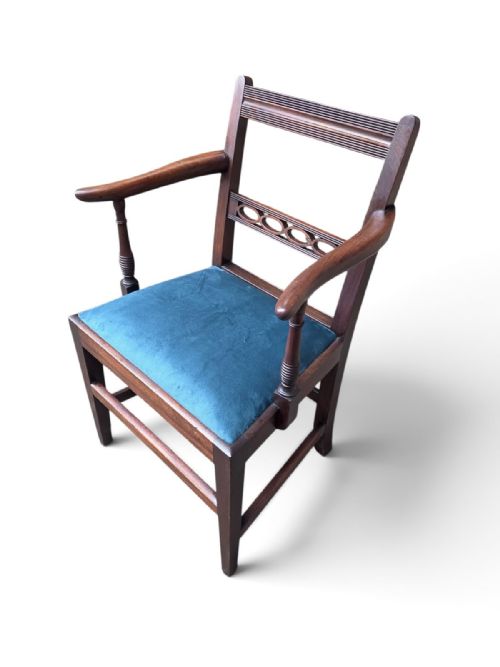
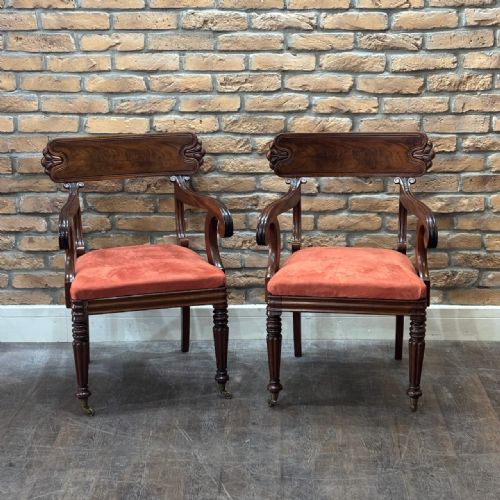


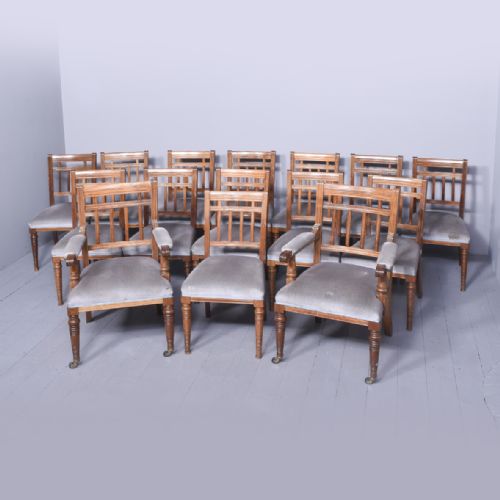
Victorian Velvet Carver Chair
A victorian velvet carver chair brings substantial timber frames and deep upholstery together for a commanding seat at a desk or table.
Victorian Velvet Carver Chair
When you search for a victorian velvet carver chair, you enter a field of robust nineteenth-century seating designed with open arms for comfort and social standing. The pieces encountered here span from the middle of the Victorian era through to the turn of the twentieth century, taking forms such as desk chairs, elbow chairs, and open armchairs. Walnut and mahogany provide the primary wooden structures, often shaped into high backs or balloon backs.
Makers and workshops across Britain adapted historical revival tastes for these armchairs, incorporating Gothic, Louis XV, and Hepplewhite influences alongside Art Nouveau lines. Regional pieces appear from Scotland alongside London workshops, showing varied interpretations of the form. Dining chairs and desk seats in this category frequently feature carved decoration on the timber framework.
How they were made
Cabinetmakers constructed these frames using dense hardwoods like mahogany, walnut, rosewood, and oak, often shaped with hand-carved details or wood inlay. Brass fittings and castors sometimes supported the legs, while joinery relied on traditional mortise and tenon techniques to bear the weight of the open arms.
Upholstery departments applied velvet over coiled springs and stuffing to build up the seat and back pad. Timber surfaces received polished finishes to highlight the natural grain of the timber.
A chairman once presided over a royal music hall from one of these very elbow chairs.
What varies in quality
The distinction between standard production seating and superior examples lies in the depth and sharpness of the carved wood decoration on the arms and crest rail. Timber selection also dictates grade, with figured walnut or dense mahogany commanding greater attention than plain utility woods.
Construction integrity separates fine workshops from basic output, seen in the rigidity of the arm joints and the proportion of the frame. The quality of the original timber framing and the execution of revival styles determine the standing of each piece.
J & T Scott·Jenks & Wood
The Victorian Velvet Carver Chair Glossary
- Carver chair
- An armchair, typically with open arms, designed for the head of a dining table or for use at a desk. These pieces match the standard dining chairs of a set but provide armrests.
- Balloon back
- A rounded, oval-shaped chair back resembling a balloon, popular in mid-nineteenth-century seating design. This curved wooden frame supports an upholstered central panel.
- Elbow chair
- An alternative term for an armchair with low armrests, often used in morning rooms or studies. The compact arms allow the sitter to draw close to a table.
- Gothic Revival
- An architectural and decorative style drawing inspiration from medieval forms, featuring pointed arches and heavy tracery. This aesthetic appeared frequently in nineteenth-century oak seating.
- Louis Quinze Style
- A French revival design movement characterised by asymmetric curves, cabriole legs, and scrollwork. Walnut armchairs often adopted these flowing contours around nineteen hundred.
Victorian Velvet Carver Chair: Frequently Asked Questions
How do I use a carver chair today?
These armchairs suit studies, bedrooms, and dining tables where a substantial seat is required. Their open arms allow them to function comfortably at a desk.
Position them away from direct heat sources to protect the wooden frame and velvet upholstery from fading.
What wood types should I expect?
The listings show frames built primarily from mahogany, walnut, rosewood, and oak. Some examples incorporate timber inlay.
These dense woods provide the structural strength needed to support the open arms and heavy upholstery.
How do I date a Victorian chair?
Dating relies on the stylistic cues of the timber frame, such as heavy Gothic revival carving or later Art Nouveau lines. Reference points include the reigning periods and revival movements recorded in the design.
Securing a precise year depends on maker marks or documented workshop attributions where available.
Are these chairs suitable for daily sitting?
Nineteenth-century armchairs were built for daily domestic use with sturdy hardwood frames. Modern placement benefits from checking the internal webbing and padding condition.
Regular care of the wooden surfaces keeps the polish stable under normal household conditions.