




Victorian Turned Column Whatnot
These Victorian turned column whatnots are tiered display stands that bring multi-level timber shelving and architectural supports into nineteenth-century rooms.
Victorian Turned Column Whatnot
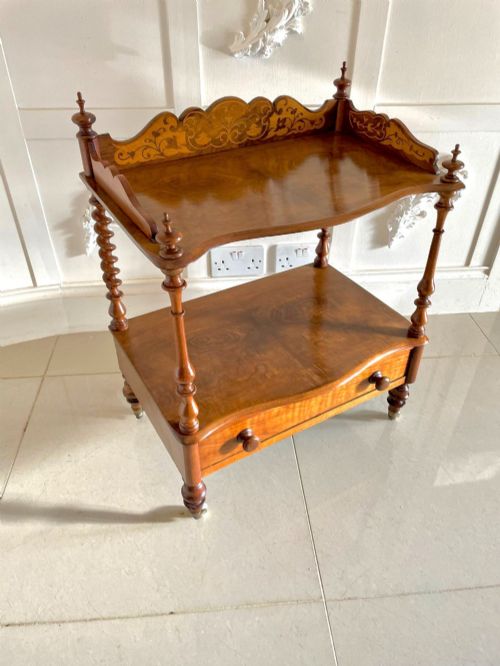
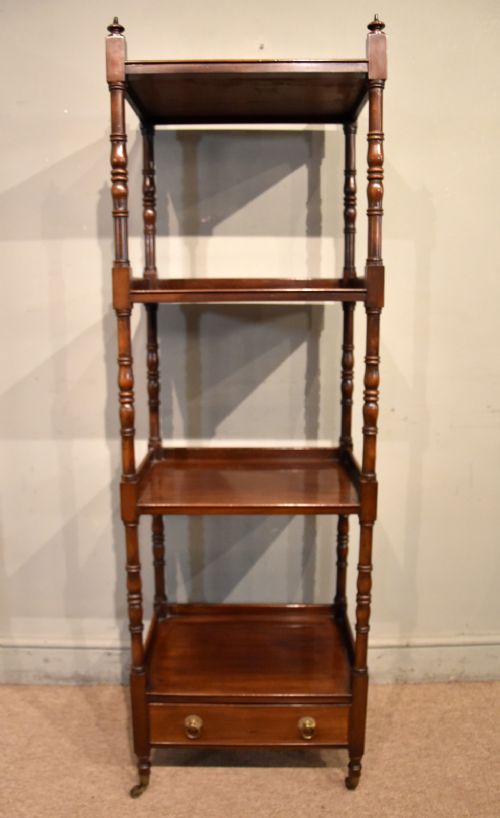
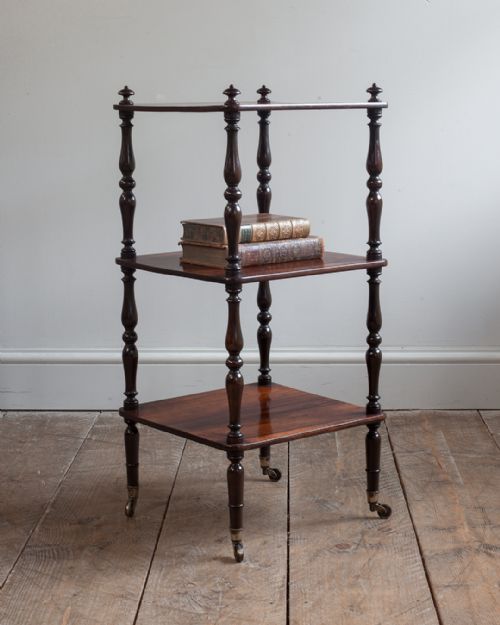
A Victorian turned column whatnot provides tiered open shelving supported by vertical wooden turnings, designed to hold books, ornaments or small display objects. You will most frequently encounter multi-tier examples constructed from mahogany, walnut or rosewood across this selection.
The form spans three or four distinct tiers, sometimes incorporating corner designs or freestanding rectangular shapes. Makers utilised specific structural variations like spiral supports and raised finials to add visual height to the piece.
Originating primarily within nineteenth-century British parlours and drawing rooms, these items served as practical storage for everyday volumes alongside decorative display surfaces. The surviving pieces bridge the gap between heavy library furniture and lighter occasional tables.
Materials and construction methods
Cabinet makers relied heavily on dense hardwoods such as mahogany and rosewood, alongside figured veneers like burr walnut and birdseye maple for primary surfaces. These timbers provided the structural integrity required to support multiple stacked shelves without sagging.
Vertical supports were shaped on a lathe to create turned columns, sometimes featuring spiral twists or slender spindles. Finer examples integrated subtle details such as boxwood inlay to accent the timber borders of each tier.
Victorian Turned Column Whatnot Retail Price Guide 2026
Typical asking prices for victorian turned column whatnot among the pieces listed under this phrase on Sellingantiques today, from the lower quarter to the upper quarter. They describe what is for sale here now, not the wider market.
Listings feature woods spanning mahogany, rosewood and burr walnut, alongside occasional maple and boxwood inlay.
Quality differences across the range
The distinction between standard utility pieces and finer examples rests in the choice of timber figure and the crispness of the turnings. Dense burr veneers and rich rosewood demand superior raw material selection compared to plain mahogany.
Construction refinement shows in how cleanly the columns join the tiers and whether decorative elements like finials and boxwood stringing remain intact. Greater attention to secondary details elevates an everyday shelf into a refined drawing room item.
The Victorian Turned Column Whatnot Glossary
- Whatnot
- A set of open shelves for displaying ornaments, books or curiosities, developed in the eighteenth century and widely produced through the Victorian era.
- Étagère
- A piece of furniture consisting of a set of open shelves for displaying small objects, synonymous with the whatnot in many nineteenth-century contexts.
- Burr walnut
- A highly prized wood veneer taken from the growth excrescences of walnut trees, valued for its swirling, organic patterns.
- Finial
- A relatively small decorative ornament that terminates the top of a turned column, post or furniture corner.
- Boxwood inlay
- Narrow strips of pale boxwood inserted into contrasting darker timber surfaces to create geometric or linear borders.
Victorian Turned Column Whatnot: Frequently Asked Questions
What rooms suit a whatnot?
These multi-tier stands fit naturally into sitting rooms, hallways or studies where vertical display space matters more than broad floor area. Their open shelves allow them to sit against walls or in corners without dominating the visual weight of the room.
They function effectively for holding stacks of books, small ceramics or framed photographs. The narrow footprint makes them practical for transitional spaces where a heavy bookcase would feel too large.
How do I date a whatnot?
Dating relies on identifying the primary timber, structural form and secondary decorative flourishes such as inlay or turning style. Mid-nineteenth-century pieces often favour rosewood and figured walnut, while later variants move toward Edwardian satinwood or simpler mahogany frameworks.
Changes in edge moulding and the presence of makers' marks or retailer stamps can narrow down the decade of production. Comparing the tier count and column turning against dated archive examples helps place the item within the broader Victorian timeline.
Were whatnots used for books?
While often associated with ornamental display, these tiered stands frequently served as convenient holders for everyday reading material in nineteenth-century drawing rooms. The lower shelves accommodated heavier volumes, while upper tiers held lighter pamphlets or decorative items.
Their open construction meant books were kept close to hand rather than locked away behind heavy glass-fronted library bookcases. This dual purpose of storage and display defined their popularity across the period.
Are corner whatnots different?
Corner whatnots are specifically engineered with triangular shelves designed to fit directly into ninety-degree room angles. This configuration maximises unused spatial pockets while maintaining the stacked multi-tier storage characteristic of the standard rectangular forms.
They utilise the same turned column supports and timber varieties as freestanding versions. Their distinctive shape makes them particularly useful for smaller Victorian parlours where wall space is at a premium.