


Victorian Trumpet Sewing Table
A Victorian trumpet sewing table is an ingenious nineteenth-century parlour piece designed to hold needlework while doubling as a games or occasional table.
Victorian Trumpet Sewing Table
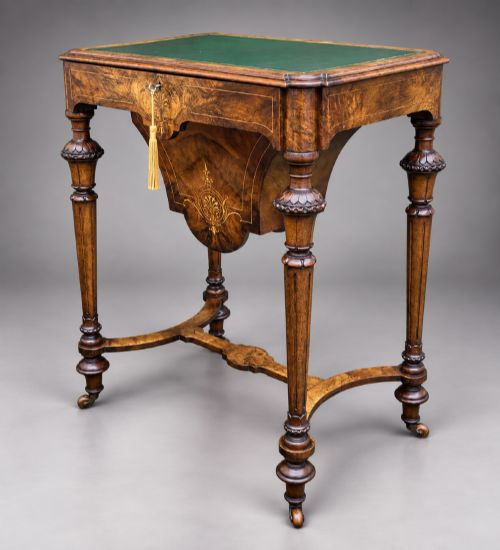
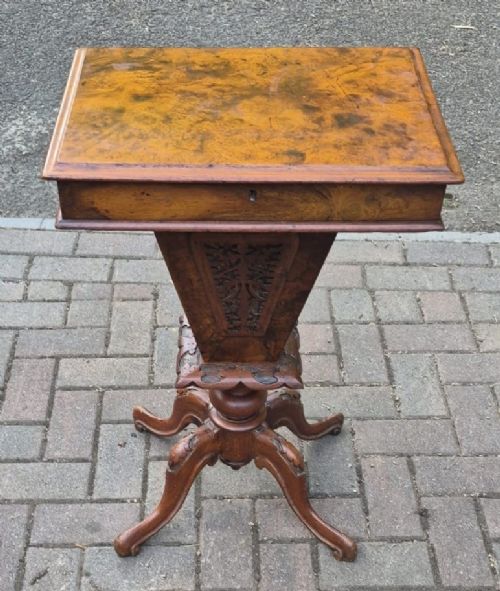
A Victorian trumpet sewing table centres on a distinctive octagonal or circular body that flares outwards from a slender stem towards a wide base, resting on a tripod support. The interiors typically reveal fitted compartments designed for sewing implements, wools and threads.
Most examples seen here date from the mid to late nineteenth century, spanning decades from eighteen-fifty to eighteen-ninety. Burr walnut is the dominant timber, accompanied by rosewood, mahogany, arbutus and yew wood.
Beyond basic work tables, many incorporate chess or checkers boards on the lid, functioning as versatile games tables alongside their primary use for needlework. Occasional and side table variants also appear frequently across the period.
Materials and construction
Cabinetmakers utilised choice veneers such as burr walnut and rosewood applied over solid carcases, creating rich grain patterns across the trumpet-shaped bodies and hinged lids. Marquetry, wood inlay and boxwood details often adorn the top surfaces.
The flared bodies require precise joinery to taper outwards from the central pillar towards the rim. Turned wooden stems connect the body to sturdy tripod feet, often carved with scrolling details.
Many tables hide miniature velvet pin cushions and tiny wooden spool holders beneath their lids, ready for Victorian embroidery.
Judging quality in work tables
The choice of timber veneer sets the baseline for quality, with richly figured burr walnut and intricate marquetry commanding attention over plain mahogany or simple walnut boards. Finely executed boxwood inlay and complex Tunbridge ware additions indicate superior cabinetmaking.
Interior organisation dictates functional merit, distinguishing simple hollow boxes from elaborately fitted trays with lidded compartments for sewing tools. The stability of the tripod base and the crispness of any carved wooden details complete the assessment.
The Victorian Trumpet Sewing Table Glossary
- Trumpet table
- A nineteenth-century occasional table featuring a flared, cone-shaped body resembling a musical instrument. This form provides deep storage beneath a hinged lid.
- Burr walnut
- A prized timber harvested from walnut tree growths, displaying swirling, knotty grain patterns. Cabinetmakers sliced it into thin veneers for decorative table tops.
- Marquetry
- The art of applying decorative veneer pieces of various woods to form geometric or floral patterns. It appears frequently on the lids of mid-century work tables.
- Tunbridge ware
- A specialised form of mosaic woodwork originating in Kent, using tiny blocks of naturally coloured wood to create pictorial designs. It decorates specific sewing table lids.
- Work box
- A portable or table-mounted container for storing sewing equipment, threads and needlecraft supplies. In this context, it refers to the compartment housed within the flared table body.
Victorian Trumpet Sewing Table: Frequently Asked Questions
What is a trumpet sewing table?
A trumpet sewing table is a nineteenth-century occasional table featuring a distinctive flared body supported by a central pillar and tripod feet. The hinged lid opens to reveal fitted compartments for storing threads, needles and sewing paraphernalia.
These pieces served ladies in the parlour for needlework and related crafts. Many double as games tables by incorporating inlaid chess boards on the reverse of the lid.
How do I date a Victorian work table?
Dating relies on timber choices, construction methods and decorative styles recorded across the nineteenth century. Earlier pieces from eighteen-fifty often utilise dense mahogany or rosewood, while burr walnut gains popularity into the eighteen-sixties and eighteen-seventies.
Inlay styles also shift over time, moving from simple stringing to complex marquetry and Tunbridge ware mosaics by eighteen-eighty. Examining the interior fittings and joinery helps narrow down the decade of production.
How were they used in Victorian homes?
Victorian households placed these tables in drawing rooms and parlours as functional furniture that maintained a decorative appearance. Ladies kept their ongoing needlework, lace-making or embroidery stored neatly out of sight within the flared body.
When guests visited, the lid closed to provide a sturdy surface for lamps, books or chess games. Their compact tripod footprint allowed easy movement around the room as needed.
What woods were used for sewing tables?
Cabinetmakers primarily selected rich hardwoods such as walnut, burr walnut, rosewood and mahogany for these tables. Burr walnut provides highly figured, decorative surfaces that suited fashionable nineteenth-century interiors.
Accents of boxwood and various contrasting timbers appear within floral marquetry and geometric inlay work. Regional timbers such as Irish yew and arbutus also feature in specific Killarney ware examples.