
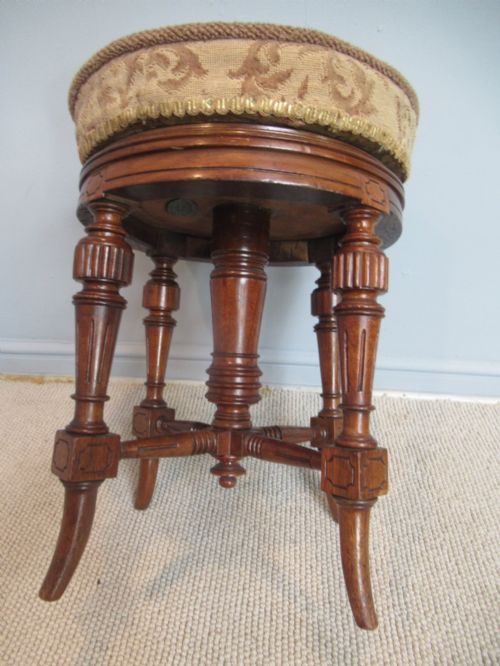

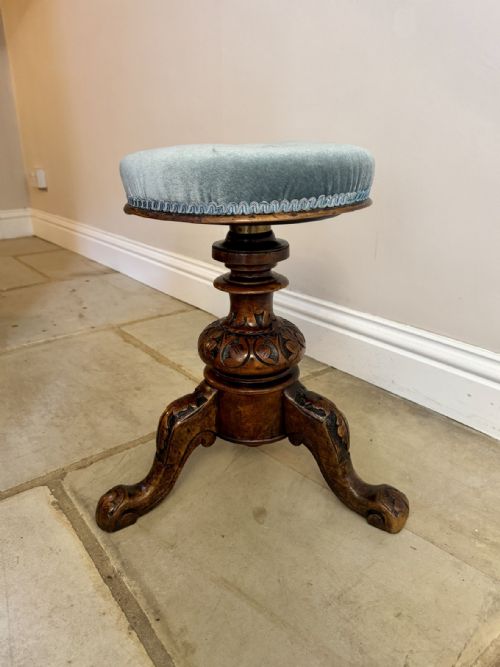
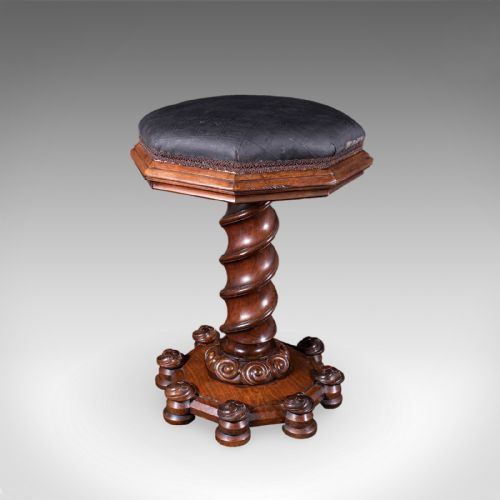


Victorian Swivel Piano Stool
A victorian swivel piano stool is a sturdy revolving seat built to adjust for posture at the keyboard during practice.
Victorian Swivel Piano Stool
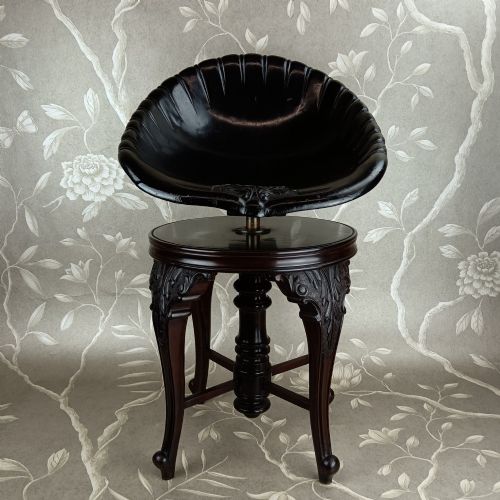
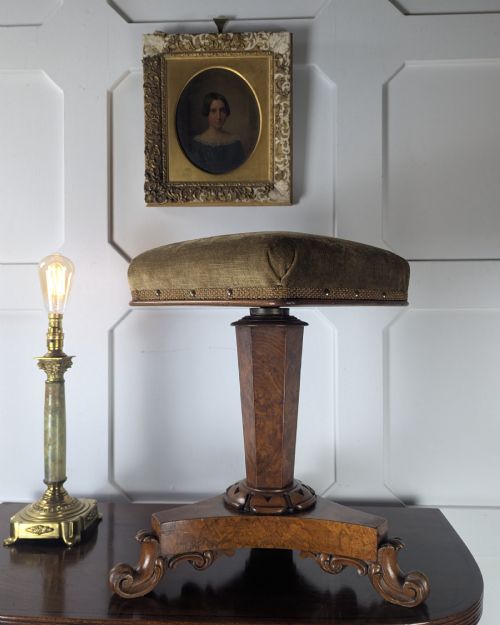
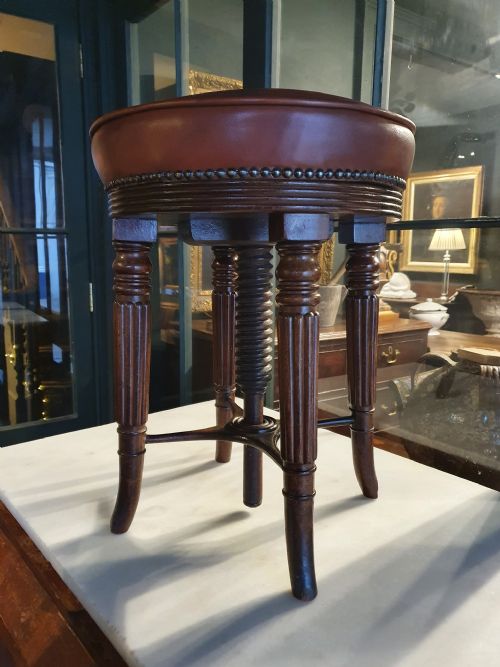
A victorian swivel piano stool typically takes the form of a circular or square top supported by a central wooden screw mechanism that raises and lowers the seat. Most examples found here date from the nineteenth century, spanning periods from William IV through late Victorian decades.
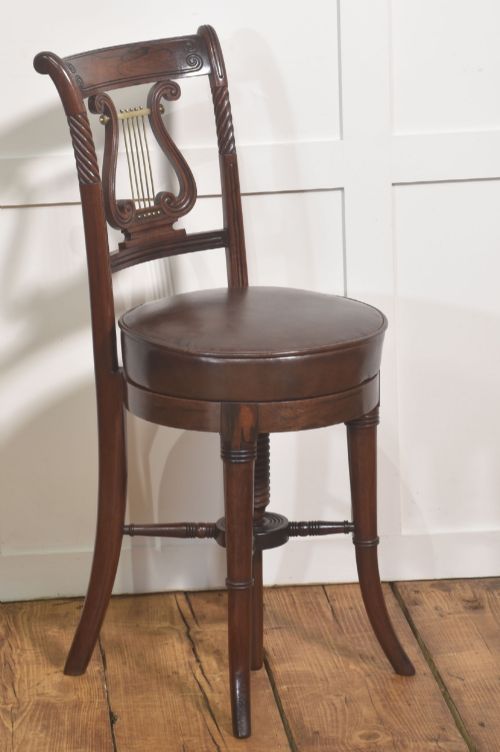
Makers produced these seating pieces in various timbers and upholstered tops to match parlour and music room decor. Alongside standard piano seats, the selection includes related music chairs, harpist chairs, and dressing table stools with the same revolving action.
Materials and construction
Carpenters utilised dense hardwoods such as mahogany, walnut, and rosewood for the frames, turning the central pillars and carving the tripod or four-legged bases. Some specialised pieces incorporated cast iron and metal components for industrial revolving mechanisms.
Seats were traditionally upholstered over stuffing using fabric, leather, velvet, or papier-mâché for decorative tops. Adjustable heights relied on threaded wooden screws or metal screw shafts hidden beneath the cushion.
Musicians relied on these revolving seats to spin effortlessly toward the sheet music cabinet without dragging the legs across the carpet.
Gradations of craftsmanship
Quality separates through the integrity of the timber framing and the smooth operation of the internal swivel screw. Finer examples display crisply carved woodwork and stable joinery on the base.
The choice of primary wood and secondary detailing dictates distinction, with figured walnut, rosewood, and signed maker stamps elevating certain pieces above utilitarian workshop output.
Jennens and Bettridge·Gillows·James Shoolbred·Thonet·Howe
The Victorian Swivel Piano Stool Glossary
- Swivel
- A mechanism allowing the upper seat to rotate fully around the central support column. This action let musicians turn slightly to reach sheet music cabinets.
- Rise and fall
- An alternative description for an adjustable height stool utilising a screw mechanism. Turning the seat clockwise or anticlockwise alters the vertical position.
- Papier-mâché
- A composite material made from paper pulp mixed with glue and resin, pressed into moulds and lacquered. Jennens and Bettridge utilised this technique for decorative music stool tops.
- Patent music chair
- A specialised seat featuring mechanical adjustments for height or backrest angle protected by a nineteenth-century registration. These often incorporated leather upholstery.
- Trriple-pod base
- A support structure with three curving legs radiating from the central pillar. It ensured stability on uneven nineteenth-century carpets.
Victorian Swivel Piano Stool: Frequently Asked Questions
How do I adjust the height?
Most stools adjust by simply turning the padded seat clockwise to lower it or anticlockwise to raise it on the internal wooden screw.
Heavier models may require holding the base steady while rotating the top to engage the threaded metal or wooden shaft.
Were these only used for pianos?
While primarily designed for keyboard practice, makers also produced similar revolving seats for harpists, organists, and dressing tables.
The adjustable height and compact footprint made them versatile for various tasks in the nineteenth-century home.
How do I identify a William IV piece?
William IV examples typically exhibit robust mahogany or walnut timbers with heavy carved pedestals and bold scrolling feet.
They date from the 1830s and display transitional styling between Regency classicism and early Victorian ornamentation.
Is the upholstery original?
Original fabric or leather is occasionally preserved, but many pieces have undergone reupholstery to suit modern domestic interiors.
Inspect the tacking underneath and the wear on the padding to determine if the covering dates to the nineteenth century.