


Victorian Snake Ring
Victorian snake ring designs combine coiled serpent forms with gemstones to symbolise eternal love.
Victorian snake ring
A victorian snake ring takes the form of a coiled serpent wrapping around the finger, carrying deep romantic symbolism. These pieces date from the nineteenth century into the Edwardian era, reflecting a fascination with nature and eternity popular during Queen Victoria's reign.
Materials and construction
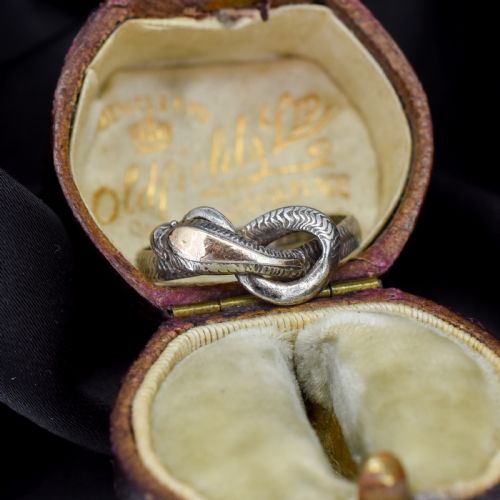
Goldsmiths utilised 18ct gold, 15ct gold, yellow gold and silver to shape the winding bodies of the serpents. Metalwork techniques involved casting and hand-finishing the scales and coiling tails to create a convincing serpentine texture.
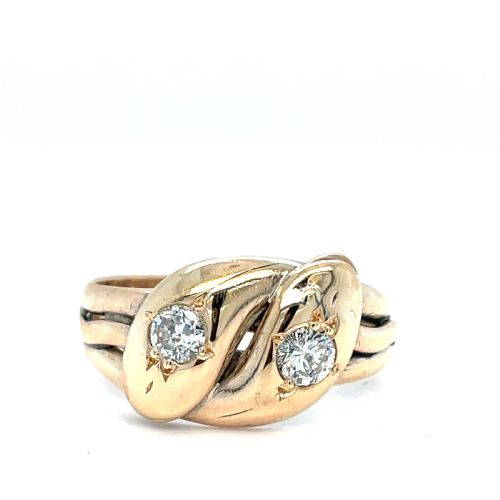
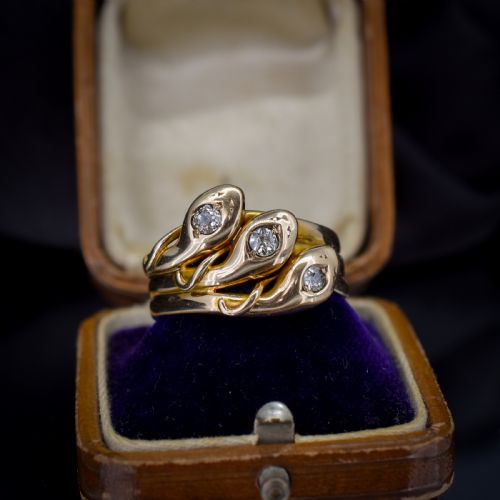
Gemstones including old cut diamonds, rose-cut diamonds, sapphires, rubies and garnets were flush-set or star-set into the heads. Hallmarks stamped inside the bands often record assay offices such as Chester and Birmingham alongside specific dates.
Retail Price Guide 2026
Typical UK retail prices for victorian snake ring, calculated from the Sellingantiques database of over a million retail prices indexed since 2003. This retail price guide relies exclusively on Sellingantiques data; no external sources or auction records are used, so the figures do not describe the wider market.
Some Victorian serpents double up as twin-headed love knots, keeping two watchful diamond eyes on the wearer.
Judging quality in serpent jewellery
Quality rests in the crispness of the chased scale engraving and the weight of the gold band. Finer examples display meticulous detail along the spine and head, whereas simpler versions show softer definition in the metalwork.
The selection and setting of the gemstones further distinguish the tier of a piece. Larger old cut diamonds or matched sapphires set into the eyes elevate the execution compared to smaller or plain metal variations.
The Victorian Snake Ring Glossary
- Old cut diamond
- A hand-faceted diamond cut before modern machinery, featuring a smaller table and higher crown that produces a soft candlelight sparkle.
- Rose-cut diamond
- A gemstone cut with a flat base and a domed crown of triangular facets resembling an unopened rosebud.
- Assay office
- An official body that tested precious metals and stamped hallmarks to guarantee the purity of gold or silver.
- Coiled serpent
- A decorative motif where the body of a snake wraps in loops around the finger, symbolising eternity in nineteenth-century jewellery.
Frequently Asked Questions
What do snake rings mean?
Serpent motifs in nineteenth-century jewellery symbolised eternal love, wisdom and rebirth. Prince Albert famously presented Queen Victoria with an emerald-set snake engagement ring, popularising the design.
Because of this royal association, these rings became widespread tokens of affection and commitment throughout the Victorian period.
How do I date a snake ring?
Dating relies heavily upon official hallmarks stamped inside the band, which can reveal assay office marks and specific year letters. Stylistic clues such as gemstone cuts also help narrow the period.
Old cut diamonds and specific gold purities like 15ct point firmly to nineteenth-century manufacturing before twentieth-century standardisation.
Are these rings comfortable to wear?
Most antique serpent bands sit smoothly against the finger because the coiled tail and head taper naturally. Heavier examples provide a solid feel without catching easily on clothing.
Wearers should nonetheless remove them during manual tasks to protect the delicate scale engraving and gemstone settings.
What gold purity should I expect?
Victorian and Edwardian pieces commonly utilise 18ct gold or 15ct gold, alongside occasional silver or lower gold standards. British hallmarking laws ensured these precious metals met strict provincial thresholds.
Yellow gold dominates the surviving examples, often glowing with a rich warm hue developed over decades.