

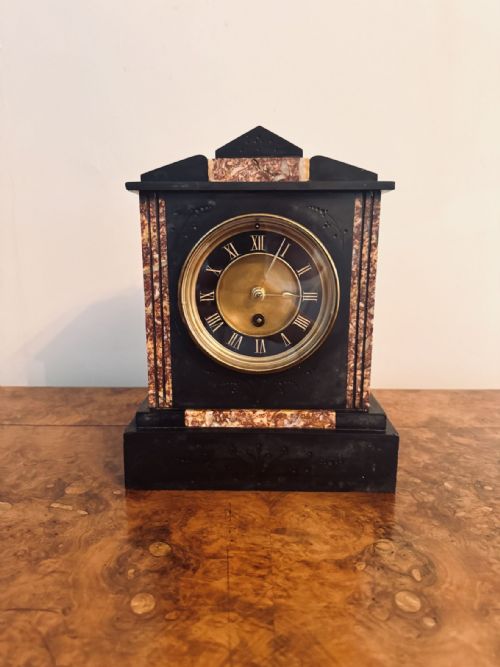


Victorian Slate Timepiece
These Victorian slate timepiece examples bring architectural presence and mechanical weight to a mantelpiece, offering enduring Victorian engineering housed in solid stone.
Victorian Slate Timepiece
When you search for a Victorian slate timepiece, you encounter heavy architectural and classical mantel clocks fashioned from substantial stone. These pieces draw upon nineteenth-century design, ranging from straightforward drumhead models to elaborate architectural compositions.
The objects on this page primarily date from the middle to the late nineteenth century, spanning periods marked by classical revivalism and Egyptian revival aesthetics. Most examples integrate contrasting marble alongside the dark slate body to create striking visual depth.
Mantel clocks dominate this category, functioning both as reliable timekeepers and as decorative centerpieces for domestic interiors. Their robust proportions reflect the Victorian preference for substantial, imposing furnishings that command attention in a room.
Materials and construction
Makers constructed these timepieces using dense black slate and polished marble as the primary structural materials. This combination provided both the necessary heft for mechanical stability and a smooth canvas for decorative incising.
Craftsmen frequently mounted bronze, brass, and glass elements onto the stone bodies to accent the dials and bezels. Enamel dials protected behind glass faceplates display Roman or Arabic numerals, housing intricate eight-day movements driven by precision engineering.
Victorian Slate Timepiece Retail Price Guide 2026
Typical asking prices for victorian slate timepiece among the pieces listed under this phrase on Sellingantiques today, from the lower quarter to the upper quarter. They describe what is for sale here now, not the wider market.
Materials recorded across the inventory include slate, black marble, bronze, brass, glass, and enamel.
Evaluating quality and execution
Quality in these timepieces rests upon the sophistication of the architectural detailing and the integration of secondary materials like bronze mounts. Finer examples display crisp moulding, harmonious marble inlays, and sculptural ornamentation such as Egyptian revival motifs.
The distinction between standard production and exceptional work also lies in the movement and dial execution. Signed French movements and finely painted enamel dials elevate a piece far above simpler, unmarked factory iterations.
Philippes Paris·Achille Brocot
The Victorian Slate Timepiece Glossary
- Slate
- A fine-grained metamorphic rock that takes a smooth polish, forming the heavy dark body of these mantel clocks. It provided Victorian makers with a stable, stone alternative to timber cases.
- Drumhead clock
- A timepiece featuring a circular clock case mounted atop a rectangular or stepped stone base. This distinct silhouette appears frequently among nineteenth-century domestic clocks.
- Egyptian Revival
- A nineteenth-century decorative style incorporating motifs from ancient Egyptian architecture and iconography. On these clocks, such details appear as bronze mounts or specialised incised patterns.
- Movement
- The internal mechanical assembly of gears, springs, and escapements that drives the clock hands. Many period examples utilise robust eight-day French mechanisms.
Victorian Slate Timepiece: Frequently Asked Questions
What is a Victorian slate timepiece?
It is a heavy domestic mantel clock constructed primarily from polished slate, often accented with marble and bronze. These pieces date from the nineteenth century and reflect various revival styles.
They served both as functional timekeepers and as prominent decorative ornaments in Victorian homes, notable for their substantial weight and architectural forms.
How do I wind these clocks?
Most models utilise an eight-day mechanical movement accessed through the glazed front bezel. A dedicated winding key fits into arbors on the enamel dial to tension the mainspring.
Careful, measured turns ensure the movement remains properly tensioned without damaging the internal mechanism or over-winding the spring.
Where should I place a slate clock?
These clocks require a very sturdy, level surface due to their considerable weight. A mantelpiece, heavy sideboard, or deep shelf provides adequate support.
Placing the clock on a stable foundation ensures the pendulum hangs plumb and the mechanical beat remains even and reliable.
How do I identify the period?
Dating relies on stylistic clues such as architectural proportions, bronze mount designs, and the presence of specific revival motifs. Inscribed maker marks on the movement backplate also help establish origin.
Materials like black slate paired with contrasting marble point directly to mid-to-late nineteenth-century manufacturing trends.