



Victorian Silver Plate Teapot
These victorian silver plate teapot examples bring heavy metal craftsmanship and period elegance straight to the tea table.
Victorian Silver Plate Teapot
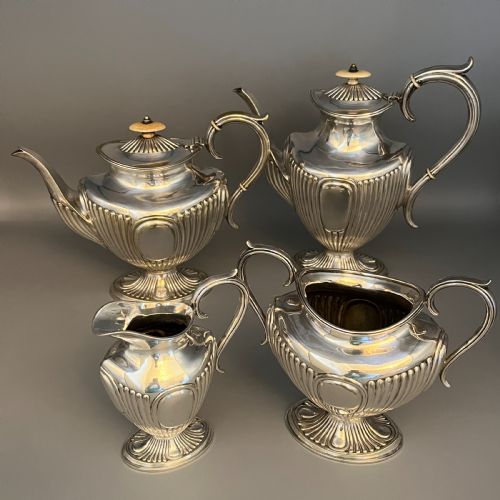
A victorian silver plate teapot stands as a centrepiece of nineteenth century hospitality, combining functional brewing with heavy decorative styling. Buyers find single teapots alongside larger four piece tea sets, coffee pots, and kettles on stands.
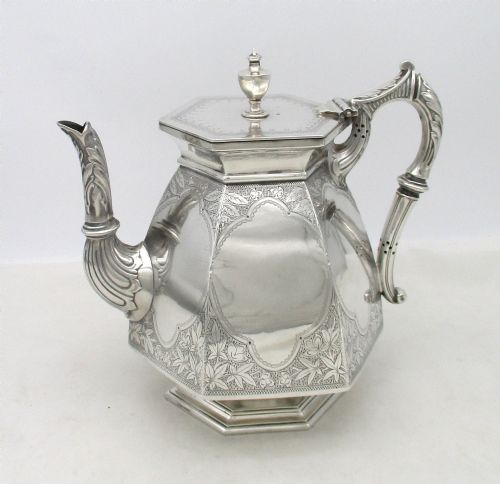
The pieces on this page span from the mid nineteenth century into the Edwardian era, taking forms such as lobed oval bodies, ornate Rococo Revival shapes, and linear Aesthetic Movement designs.
Origins trace through English workshops of the period, offering domestic teaware that ranges from simple family pots to large decorative services.
How they were made
Construction relies on a base metal core, frequently electroplated nickel silver or standard metal, coated in a layer of silver to give the appearance of solid bullion. Workshops also utilised EPNS as the electroplating technique became widespread.
Handles and insulators incorporated ebonised wood or bone to prevent heat transfer during use, whilst stands often accompanied larger spirit kettles with burners.
Victorian Silver Plate Teapot Retail Price Guide 2026
Typical asking prices for victorian silver plate teapot among the pieces listed under this phrase on Sellingantiques today, from the lower quarter to the upper quarter. They describe what is for sale here now, not the wider market.
Listings on this site feature nineteenth century and early twentieth century periods, utilising silver plate, ebonised wood, and bone.
What varies in quality
Quality rests upon the depth of the plating and the crispness of the chased or engraved decoration across the body. Pieces displaying heavier gauge metal and balanced proportions hold their form better through decades of daily use.
Makers' marks and crests indicate workshops of higher standing, distinguishing standard commercial production from bespoke or registered designs.
Boardman Glossop And Co·Elkington And Co·Thomas Bradbury
The Victorian Silver Plate Teapot Glossary
- Silver Plate
- A base metal coated with a thin layer of silver through chemical or electrical processes. This method made elaborate teaware accessible to a wider Victorian household.
- Electroplated Nickel Silver
- An alloy of copper, nickel, and zinc coated with silver via electrolysis. This technique replaced older Sheffield plating methods in the nineteenth century.
- EPNS
- An abbreviation commonly stamped on nineteenth century and Edwardian metalware to denote electroplated nickel silver. It appears on tea sets and coffee pots across the period.
- Aesthetic Movement
- A late nineteenth century design style prioritising visual beauty over narrative meaning, often featuring stylised motifs. Pieces in this style move away from heavy floral revivalism.
- Rococo Revival
- A nineteenth century decorative style drawing on eighteenth century French motifs with scrolls, asymmetrical curves, and floral repoussé work. Teapots in this taste feature deeply embossed surfaces.
Victorian Silver Plate Teapot: Frequently Asked Questions
How do I clean my silver plate teapot?
Use a soft cloth and a gentle silver polish formulated for plated items to remove tarnish without wearing through the thin silver layer to the base metal underneath.
Avoid abrasive pastes and harsh scrubbing brushes that can scratch the surface or damage ebonised wood insulators.
Can I still use these teapots for brewing tea?
Many buyers test the interior for cleanliness and structural integrity before using these pots for serving hot water or tea during gatherings.
Running hot water through the spout first helps check for any historical leaks or interior residue from past decades.
What is the difference between a teapot and a spirit kettle?
A standard teapot holds brewed tea for pouring directly into cups at the table during afternoon tea service.
A spirit kettle rests on a metal stand with a small burner beneath it, designed to keep water hot throughout a longer meal or gathering.
How can I tell a Victorian pot from an Edwardian one?
Victorian examples often lean towards ornate Rococo Revival or Aesthetic Movement decoration with heavy embossing, whilst Edwardian pieces frequently adopt cleaner, simpler outlines.
Maker stamps and registry marks combined with stylistic clues help narrow down the decade of production.