

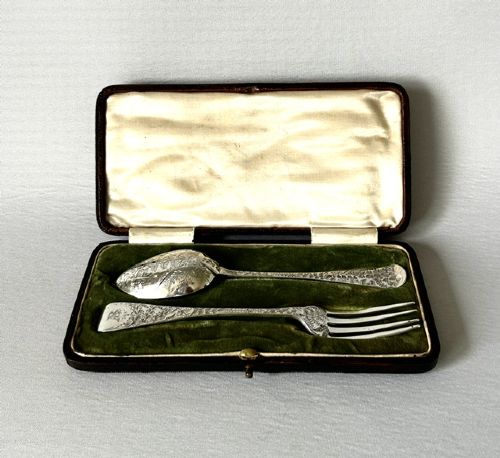
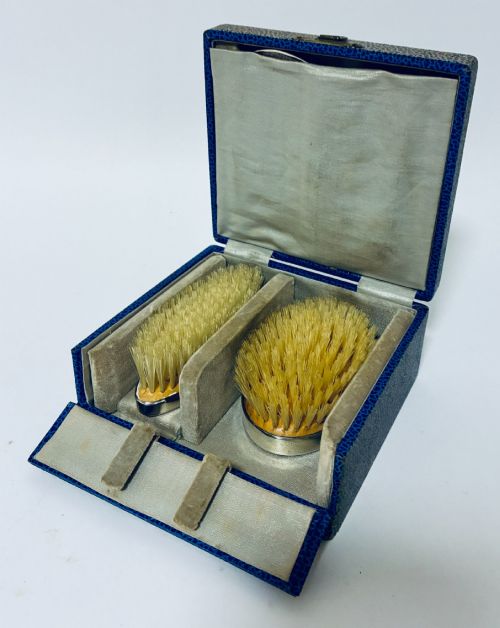


Victorian Silver Christening Set
A Victorian silver christening set is a cherished heirloom gift comprising matched spoons, forks, or cups housed in a fitted case.
Victorian Silver Christening Set
A victorian silver christening set typically comprises a matched fork, spoon, or knife, and sometimes expands to include a napkin ring, mug, or tea cup and saucer. These functional eating implements were traditionally presented to infants to mark a baptism or birth.
Buyers most frequently encounter complete three or four-piece groupings housed within their original fitted presentation boxes. These sets date principally from the Victorian and Edwardian eras, spanning the mid nineteenth century into the early twentieth century.
How they were made
Silversmiths utilised solid sterling silver or silver plate for the implements, hammering and casting the metal into traditional fork and spoon configurations. Handles frequently incorporate decorative elements such as mother-of-pearl or natural bristle details.
The protective presentation cases are constructed from wood or sturdy cardbases lined internally with silk, velvet, or satin. Exteriors are wrapped in leather, faux leather, or textured leatherette to secure the silverware safely.
Victorian Silver Christening Set Retail Price Guide 2026
Typical asking prices for victorian silver christening set among the pieces listed under this phrase on Sellingantiques today, from the lower quarter to the upper quarter. They describe what is for sale here now, not the wider market.
Some infant sets include tiny apostle spoons featuring miniature carved saints at the handle terminals to watch over the child.
What varies in quality
The distinction between standard production and superior craftsmanship rests upon the weight of the silver and the crispness of the chasing or engraving. Maker reputation also influences distinction, with pieces bearing marks from prominent silversmiths commanding greater interest.
The preservation of the original fitted case significantly elevates the appeal of a set. Cases retaining intact silk linings and unblemished leather or leatherette exteriors indicate careful historical preservation.
Walter and John Barnard·John Round·Thomas Harwood and Co·John Aldwinckle and Thomas Slater·Chawner and Co·Martin Hall and Co·Aaron Hadfield·Walker and Hall·Frederick Elkington·William Hutton
The Victorian Silver Christening Set Glossary
- Sterling silver
- A silver alloy containing 92.5 percent pure silver and 7.5 percent other metals, usually copper, ensuring durability for functional tableware.
- Hallmark
- An official stamp applied by an assay office indicating the purity of the metal, the year of manufacture, and the silversmith's mark.
- Chasing
- A metalsmithing technique where the silversmith hammers designs into the front surface of the metal to create raised ornamentation without removing material.
- Leatherette
- A synthetic material designed to imitate leather, commonly utilised on the exterior of late nineteenth and early twentieth century presentation cases.
- Gilt
- Silver that has been coated with a thin layer of gold on its surface, creating a warm golden tone across the interior of bowls or spoons.
Victorian Silver Christening Set: Frequently Asked Questions
What items are in a christening set?
A standard set generally contains a fork and a spoon, while larger configurations add a matching knife, napkin ring, or tea cup.
These items were fashioned specifically for a child's hands and daily use during formal meals.
Are these sets safe to use?
Sterling silver is non-toxic and entirely safe for regular dining when properly cleaned and polished with appropriate silver care products.
Vintage cases, however, are delicate and best reserved for safe storage rather than active travel.
How do I date a silver set?
Dating relies upon the official hallmarks stamped directly onto the metal surface of each fork, spoon, or cup.
Assay office symbols and date letters reveal the exact year the item was submitted for testing and certification.
Why are some sets gold plated?
Gilt finishes, where a layer of gold coats the silver, were applied to prevent tarnishing and protect the metal from acidic foods.
This technique adds a decorative dual-tone appearance to the bowls of spoons and the interiors of cups.