


Silver Christening Set
A silver christening set marks a traditional gift of heritage, pairing delicate spoons, forks, knives or egg cups inside custom fitted presentation cases.
Silver Christening Set
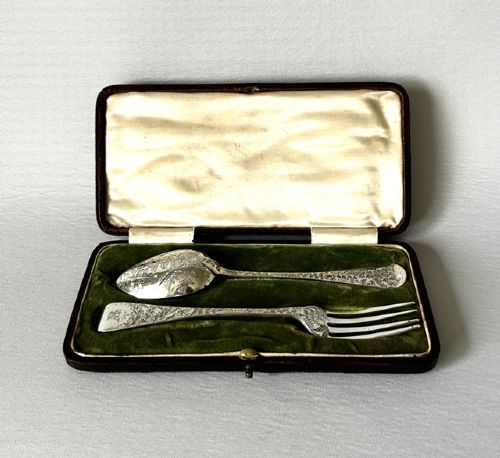
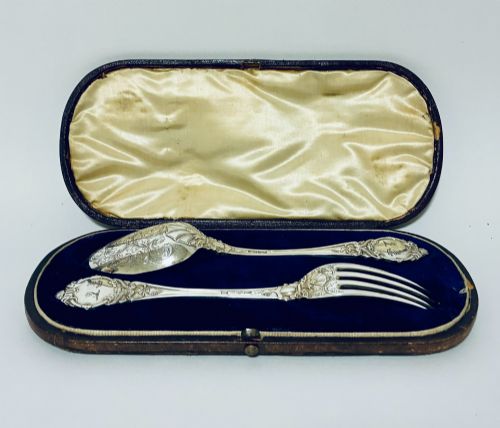
A silver christening set comprises matching implements intended for a child, most frequently encountered in Victorian, Edwardian and Georgian iterations preserved within original cases lined with silk or velvet. These groups range from simple fork and spoon pairs to larger three or four piece configurations incorporating knives, napkin rings, porringers or egg cups.
The phrase denotes both modest two piece flatware combinations and elaborate boxed ensembles bearing hallmarks from major silversmithing centres like London, Birmingham and Sheffield. Buyers encounter items spanning from the mid nineteenth century through to the mid twentieth century, reflecting shifting domestic traditions of infant gift giving.
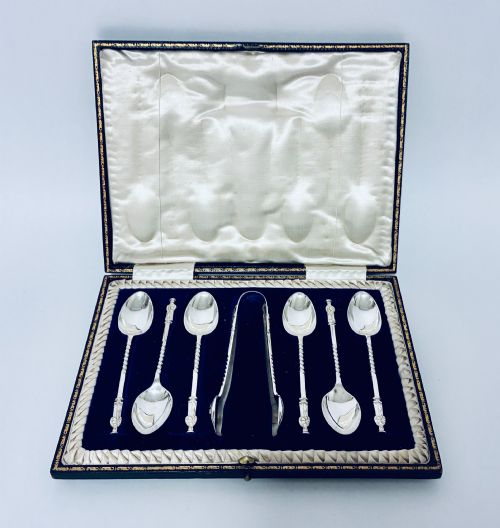
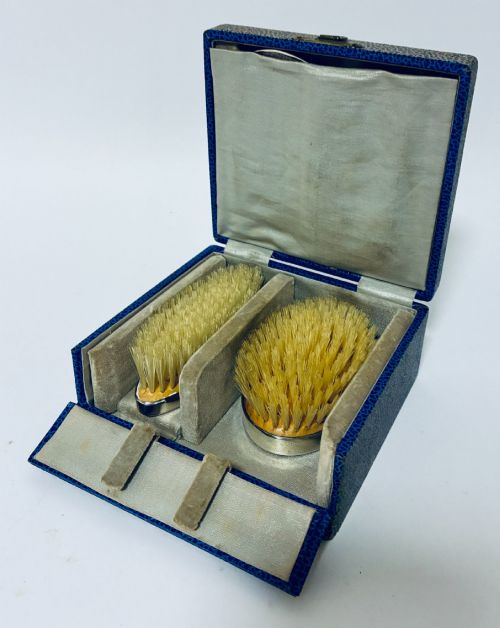
Many survivors retain their protective leather, leatherette or faux leather outer boxes, which safeguards the soft metal from wear over generations. The core forms remain remarkably consistent across periods, prioritising smaller proportions suited to a child's hands alongside decorative motifs like Apostle figures or nursery themes.
Factors of distinction
Quality rests significantly upon the completeness of the original ensemble and the preservation of its fitted case, with intact sets showing matching date letters and maker's marks across every component. Complete documentation through crisp hallmarks adds considerable substance to a piece.
The reputation of the silversmith and the intricacy of the decorative work dictate the upper tier of execution, distinguishing standard commercial production from specialised output by renowned workshops. Heavier gauge silver, crisp chasing and distinctive patterns like Albany or dedicated nursery rhyme motifs elevate specific groupings above simpler utilitarian equivalents.
Listings feature items spanning from the mid nineteenth century through to the mid twentieth century, executed in sterling silver and silver plate.
Tiffany & Co·Walter & John Barnard·John Round·Thomas Harwood and Co·John Aldwinckle & Thomas Slater·Chawner & Co·Francis Higgins II·Goldsmiths & Silversmiths·Sanders & Mackenzie·Wm Adams Ltd
The Silver Christening Set Glossary
- Hallmark
- Official marks stamped on precious metals indicating the standard of silver, the assay office, the maker and the year of production. These stamps provide the definitive timeline for dating antique items.
- Porringer
- A small, shallow bowl with one or two flat horizontal handles, frequently included in larger nursery or infant dining assemblies. They were traditionally used for porridges or soft foods.
- Pusher
- A short, broad flatware utensil with a curved end designed to help a small child push food onto a spoon or fork. This form appears frequently in twentieth century infant collections.
- Apostle Spoon
- A spoon featuring the cast figure of an apostle or saint on the terminal of the handle. Sets often comprise a selection of these figures alongside matching sugar tongs.
- Silver Gilt
- Silver that has been coated with a thin layer of gold on its surface. This technique provides a contrasting golden interior to bowls, cups and porringers.
Silver Christening Set: Frequently Asked Questions
What pieces belong in a christening set?
Standard configurations usually include a matching fork and spoon, sometimes expanding to incorporate a hollowware item like an egg cup, napkin ring or small knife.
Larger groupings occasionally feature porringers or sugar tongs, all scaled down to infant dimensions and housed together in a fitted presentation case.
How do I date a silver set?
Dating relies primarily upon the official hallmarks stamped directly onto the metal components, which record the specific assay office and year cycle.
Stylistic cues such as Victorian ornamentation, Edwardian delicacy or Arts and Crafts planished surfaces also help narrow the production era.
Are original boxes important?
Original cases lined with silk or velvet protect the softer silver items from surface scratches and complete the historical context of the presentation.
While loose pieces remain collectible, surviving boxes marked with retailer details add notable provenance and appeal for display.
Were these sets meant for daily use?
Most ensembles served primarily as commemorative presentation gifts rather than everyday tableware, which explains why many survive in pristine condition.
They were traditionally kept in their velvet lined boxes as family heirlooms to mark a milestone birth or baptism.