
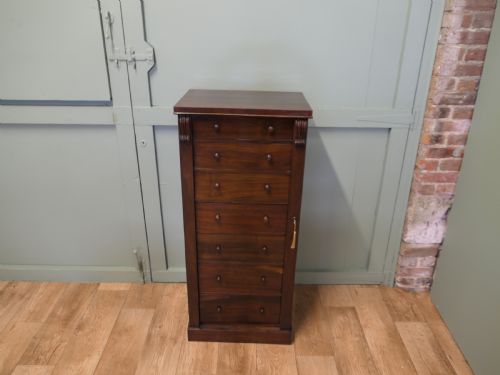
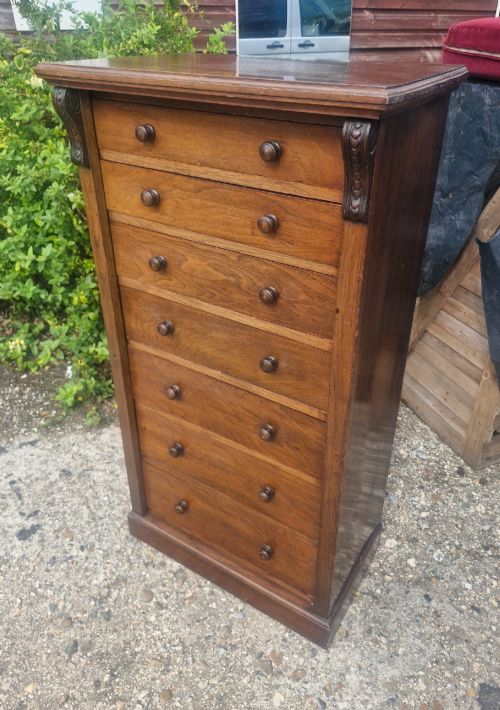
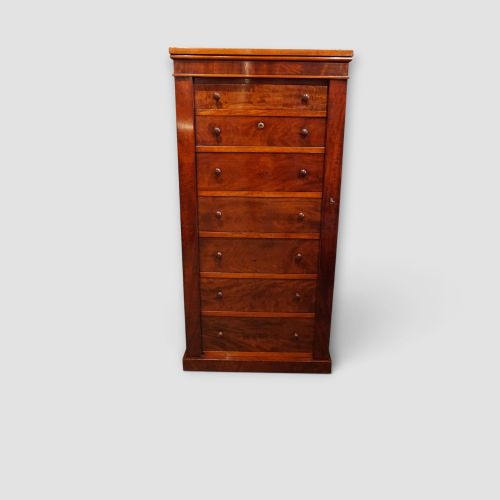
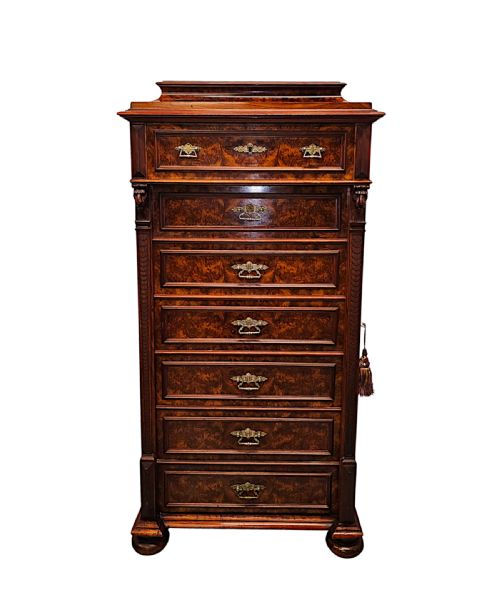
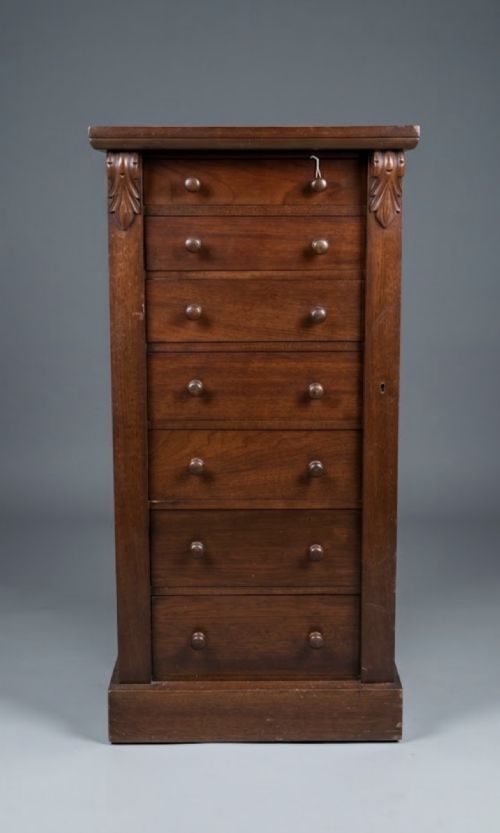
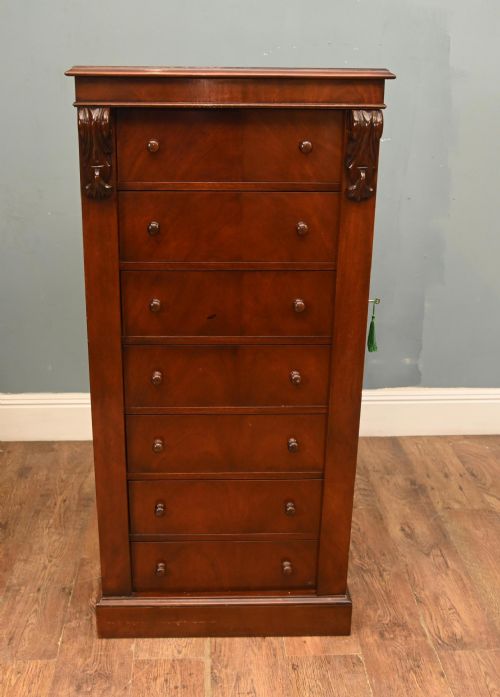


Victorian Seven Drawer Chest
A victorian seven drawer chest stands tall and narrow, offering ample storage in a compact footprint that suits smaller rooms.
Victorian Seven Drawer Chest
A victorian seven drawer chest typically takes the form of a tall, narrow piece designed to maximise vertical space without occupying a large floor area. These pieces frequently appear under various historical labels, including Wellington chests and semainiers, reflecting their origins in the nineteenth century.
Buyers seeking this form will encounter numerous examples dating from the Victorian era alongside pieces from adjacent periods such as the Regency and William IV years. Mahogany and walnut dominate the selection, often showcasing striking grain patterns like flame mahogany veneer and burr walnut.
The distinctive layout provides seven internal tiers behind a hinged locking flap or traditional drawer construction. This configuration makes the form practical for modern interiors where floor space remains at a premium while vertical capacity is required.
How they were made
Cabinet makers utilised dense hardwoods such as mahogany, walnut, and oak for the primary structures, often applying figured veneers like flame mahogany or burr walnut to the drawer fronts. Secondary timbers such as pine appear in concealed areas like drawer linings and carcase backs.
Construction relied on precise joinery to ensure the tall, narrow frames maintained structural integrity over decades of use. Brass hardware, including drop handles and locking mechanisms, was integrated to secure the drawers and complement the polished timber surfaces.
Legend connects the name of the Wellington chest to the Iron Duke himself, though no records prove he ever folded a single sock inside one.
What varies in quality
The selection of timber grain heavily dictates visual appeal, with highly figured burr walnut and matched flame mahogany veneers sitting at the upper tier of craftsmanship. Plain pine or standard solid timbers occupy a simpler, more utilitarian tier.
Mechanisms such as the locking flap on Wellington chests demonstrate the level of care taken during construction, where a smoothly operating secret lock secures all seven drawers simultaneously. Precision in the dovetail joinery and the condition of the original polished finish further separate standard items from finer examples.
The Victorian Seven Drawer Chest Glossary
- Wellington chest
- A tall, narrow chest of drawers, traditionally with seven drawers secured by a hinged vertical locking flap on one side. This form gained popularity in the nineteenth century.
- Semainier
- A tall chest of seven drawers designed originally to hold a different outfit for each day of the week. The term shares its French roots with the word for weekly.
- Flame mahogany veneer
- A decorative wood slicing that displays a flickering, flame-like pattern created by the grain of the mahogany tree. Cabinet makers applied this to prominent surfaces for visual impact.
- Burr walnut
- Timber taken from the wart-like growth on a walnut tree, yielding a dense cluster of swirling knots and rings. It was highly prized for luxury nineteenth-century furniture.
- Secret lock
- A concealed locking mechanism designed to secure the primary locking bar or flap of a tall chest. It protects the contents of all drawers behind a single barrier.
Victorian Seven Drawer Chest: Frequently Asked Questions
What is a seven drawer chest?
A seven drawer chest is a tall, narrow storage unit designed to hold numerous items within a compact footprint.
These pieces often feature a locking side flap or a stack of slender drawers suited for bedrooms and studies.
How do I use a Wellington chest?
A Wellington chest is operated by unlocking the hinged vertical side flap, which swings open to release the individual drawers.
Once opened, each of the seven drawers can be pulled out independently for daily storage.
What woods were used for these chests?
Cabinet makers built these chests using hardwoods such as mahogany, walnut, oak, and rosewood.
Many examples feature decorative veneers like flame mahogany or burr walnut applied over solid carcases.
How do I tell Victorian pieces apart?
Victorian pieces show distinct stylistic traits linked to the nineteenth century, including specific wood selections and construction methods.
Comparing timber types, hardware styles, and internal joinery helps identify pieces from different decades within the era.