


Victorian Secretary Desk Chest
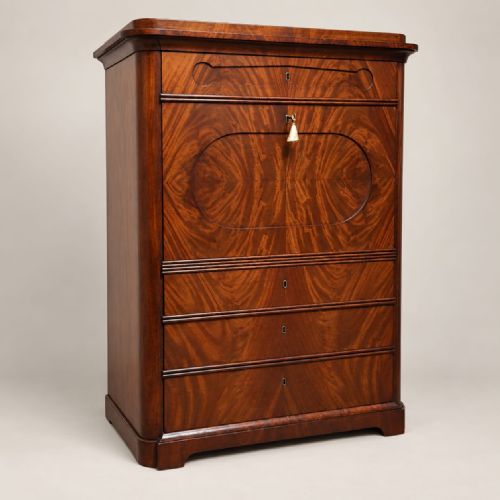
These pieces known as victorian secretary desk chest combine cabinetwork and writing surfaces, offering drawers alongside a fitted fall front.
Victorian Secretary Desk Chest
When you search for a victorian secretary desk chest, you find hybrid forms designed for domestic writing and storage. These pieces combine the upright drawer capacity of a tall chest with a writing compartment.
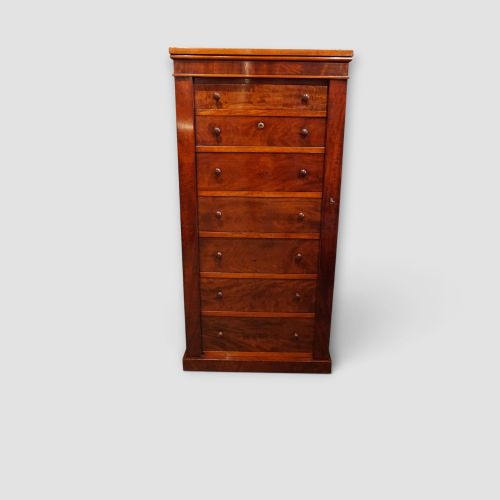
The versions met on this page include mahogany bureaux, burr walnut writing cabinets, and narrow Wellington chests with locking flaps. Pine examples and glazed bookcase variants also appear among the selection.
Origins span the nineteenth century, taking in Victorian and Georgian periods alongside Biedermeier and rustic farmhouse interpretations. The furniture ranges from compact desk chests to large glazed storage combinations.
How they were made
Joiners built these carcass structures using solid pine for internal framing and secondary drawer linings. Mahogany, walnut, and burr walnut provided the primary timber faces, frequently enhanced with flame mahogany veneer.
Surface detailing relied on brass hardware for handles and locks, alongside satinwood stringing in select cabinets. Fitted interiors incorporated baize writing slopes inside fall fronts, complemented by glass in bookcase upper sections.
Tall Wellington chests lock their entire vertical stack with a single hinged wooden flap secured by one tiny key.
What varies in quality
The distinction between standard and superior pieces rests on timber selection and veneer matching. Flame mahogany and burr walnut figured surfaces demonstrate greater joinery ambition than plain pine builds.
Internal organisation dictates refinement, separating simple writing slopes from complex tiered pigeonholes and secret compartments. Wellington chest locking mechanisms and tightly fitted secretaire drawers further mark out accomplished workshop execution.
Druce & Co.
The Victorian Secretary Desk Chest Glossary
- Secretaire
- A piece of furniture containing a drawer or flap that drops down to form a writing desk. It conceals internal compartments and small drawers.
- Wellington chest
- A tall, narrow chest of drawers secured by a hinged locking stile on one side. This wooden bar fastens over the drawer edges with a padlock.
- Baize
- A coarse woolen material resembling felt, traditionally used to line writing surfaces and slope panels. It provides a flat, soft texture for writing.
- Biedermeier
- A Central European style dating from the nineteenth century emphasising clean lines and utilitarian comfort. It favors domestic timbers over heavy ornamentation.
- Escritoire
- A small writing cabinet or desk. The term is often used interchangeably with bureau or secretary.
Victorian Secretary Desk Chest: Frequently Asked Questions
How do you open the writing flap?
Writing flaps on these chests usually lower on pivoting brass hinges once the exterior lock is released. Some designs utilise internal side levers or pull-out support lopers that slide out from the frame to bear the weight.
Care should be taken to ensure support lopers are extended before lowering heavy fall fronts to protect the pivot joints from undue strain.
How do you tell a Georgian piece from a Victorian one?
Georgian examples often display restrained proportions and lighter timber framing such as walnut and satinwood stringing. Their internal drawer arrangements tend to favor architectural pigeonhole layouts with classical detailing.
Victorian pieces frequently utilise denser mahogany or burr walnut veneers with heavier moulded cornices. They embrace varied mechanical formats like the side-locking Wellington mechanism.
Where should I place one in my home?
These pieces suit home studies, living rooms, or hallways where vertical storage and a surface for writing are both required. Their enclosed compartments keep stationery and paperwork out of sight when not in use.
Placement should avoid direct sunlight and intense heat sources to protect timber veneers from drying out and cracking over time.