
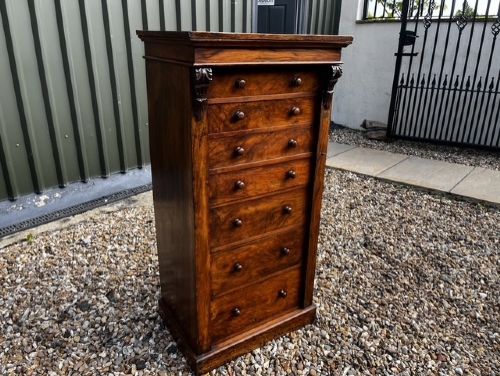


Victorian Secretaire Tallboy
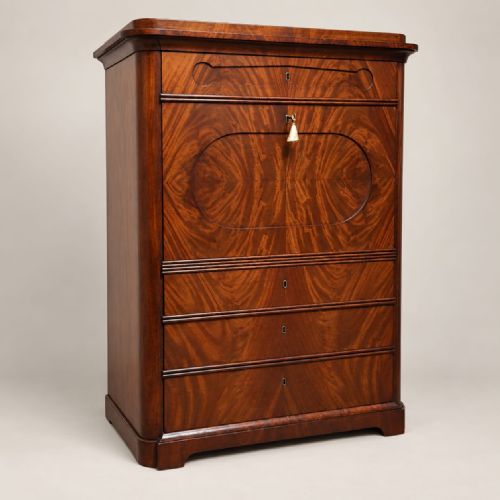
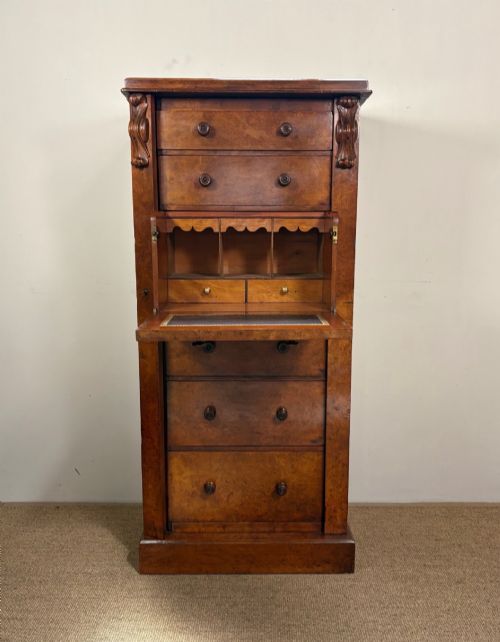
A victorian secretaire tallboy combines upright storage with a fitted writing drawer, offering a practical workspace within a commanding cabinet.
Victorian Secretaire Tallboy
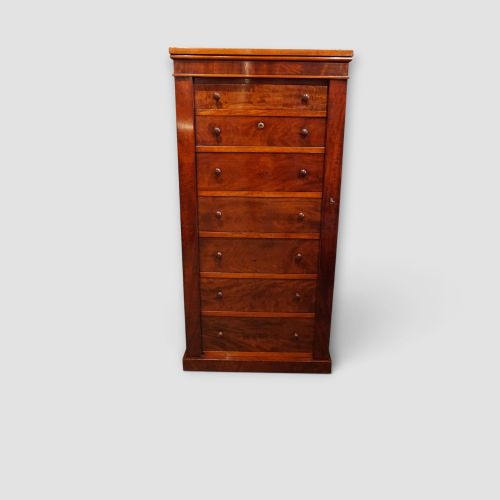
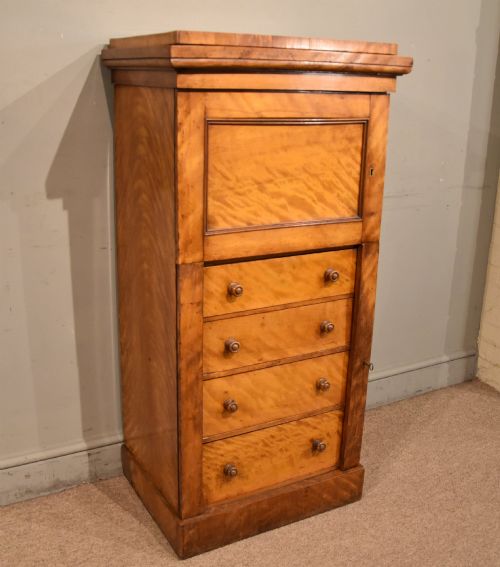
The term victorian secretaire tallboy covers tall, multi-drawer furniture pieces incorporating a dedicated writing section amongst the chest drawers. Examples frequently take the form of tall Wellington chests, campaign cabinets, and upright bureau variations dating from the nineteenth century.
Most entries found here stem from the Victorian era, spanning decades from eighteen fifty to eighteen ninety, alongside occasional Regency and later nineteenth-century interpretations. These tall proportions suit rooms needing vertical storage combined with a surface for correspondence.
Forms vary from mahogany Wellington chests with locking side flaps to camphorwood and teak military campaign chests built in sections. Walnut, flame mahogany veneer, burr walnut, and rosewood appear widely across the selection.
Materials and Construction
Cabinetmakers utilised solid timbers alongside decorative veneers like flame mahogany, amboyna, and burr walnut applied to secondary woods such as pine. Brass mounts, recessed handles, and corner brackets reinforce campaign and military pieces designed for travel.
Interiors often feature fitted writing drawers lined with leather surfaces, pigeonholes, and small subsidiary compartments for stationery. Locking mechanisms, including side-locking bars on Wellington chests and brass drop-front supports, secure the writing compartments.
Military campaign chests travelled across oceans with British officers, hiding secret compartments within their sturdy teak frames.
Assessing Quality and Execution
The refinement of the internal writing drawer distinguishes finer pieces, showing thoughtful arrangement of small drawers and concealed compartments. Superior examples employ choice veneers with matched grain patterns across the drawer fronts and side panels.
Hardware choice indicates tier, with solid brass fittings, robust locking mechanisms, and secret drawers demonstrating higher workshop standards. The precision of the joinery in the locking side flap or drop-front writing surface dictates the structural integrity of the tall frame.
Druce And Co
The Victorian Secretaire Tallboy Glossary
- Secretaire
- A desk or chest of drawers containing a fitted writing drawer with a drop-front or pull-out surface. This built-in compartment allows the furniture to serve dual purposes for storage and correspondence.
- Wellington chest
- A tall, narrow chest of drawers secured by a hinged locking flap on one side that fastens over the drawer edges. The design originates from the early nineteenth century and maximises vertical capacity.
- Campaign chest
- Portable furniture built in two or more sectional parts with recessed brass handles and corner brackets. British officers used these sturdy chests during military movements across the empire.
- Veneer
- A thin layer of figured wood applied over a stable secondary timber body. Craftsmen used veneers of mahogany, walnut, and rosewood to create decorative surfaces on drawer fronts.
- Abattant
- A vertical cabinet or chest featuring a drop-front writing flap that conceals pigeonholes and small drawers. When closed, the piece presents the appearance of a standard tall chest.
Victorian Secretaire Tallboy: Frequently Asked Questions
How do I use a secretaire drawer?
Pull out the designated drawer and lower its front flap to reveal the writing surface and pigeonholes.
Close and lock the flap when finished to conceal the desk interior and secure your papers.
What is the difference between a tallboy and a Wellington chest?
A traditional tallboy comprises two stacked chest sections, whereas a Wellington chest is a single tall column secured by a locking side flap.
Both offer generous vertical storage suitable for rooms with limited floor space.
Are campaign pieces heavier than standard chests?
Campaign chests are often heavier due to dense tropical hardwoods like teak and camphorwood, combined with solid brass corner reinforcement.
However, their division into separate stacking sections makes them easier to transport.
How do I care for nineteenth-century wood surfaces?
Maintain polished mahogany and walnut by dusting with a soft cloth and applying traditional wax sparingly to nourish the timber.
Keep these tall cabinets away from direct sunlight and heat sources to prevent veneer splitting.