
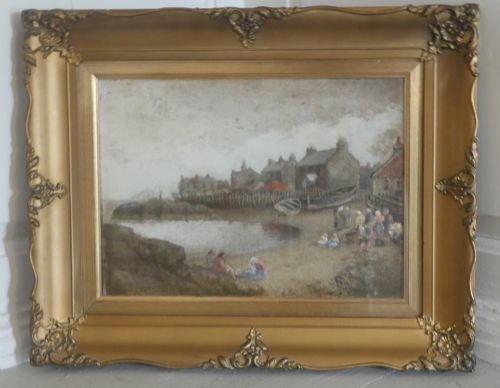



Victorian Seaside Landscape
These Victorian seaside landscape works capture nineteenth-century coastal life through oil and watercolour, bringing historic shorelines and harbours directly into your home.
Victorian Seaside Landscape
A victorian seaside landscape depicts coastal scenes, sandy beaches, fishing harbours, and chalk cliffs through the lens of nineteenth-century artists. You will most frequently encounter framed watercolours and oil paintings on canvas that record British coastal locations from Cornwall to Scotland.
These works typically portray everyday coastal activities, including fisher folk hauling catches, children playing by the shore, and pleasure piers. The visual record spans topographical views and impressionistic interpretations created during the Victorian period and slightly beyond.
How they were made
Artists painted these scenes using oil paint on canvas or board, alongside delicate watercolour on paper. Many surviving works retain their original gilt wood frames, which complement the maritime subject matter.
Makers applied pigments with varying brushwork, from the tight realism of nineteenth-century realists to the looser strokes characteristic of later impressionist interpretations.
Materials documented across these listings include oil on canvas, paper, gilt wood, wood, watercolour, glass, and oil paint.
What varies in quality
The sophistication of atmospheric lighting and the precision of topographical detail separate standard decorative pictures from accomplished artistic records. Superior examples demonstrate a strong command of coastal light, water movement, and human proportion.
Condition of the paper or canvas, together with the integrity of the original gilt wood frame, influences the desirability of each piece. Works bearing clear signatures and documented locations carry stronger historical provenance.
Edward Mills·William Banks Fortescue·John Bedloe Goddard·Sir Thomas Newenham Dean·William Raymond Dommersen·Alfred Henry Vickers·James George Bingley·Robert Macaulay Stevenson·William Greaves·James Kinnear·William Shayer·George Marks·Henry Valter·John Duvall
The Victorian Seaside Landscape Glossary
- Watercolour painting
- A work executed with water-soluble pigments on paper. This medium allows for translucent washes that suit atmospheric marine conditions.
- Oil on canvas
- A painting method utilising pigment suspended in drying oil applied to stretched fabric. It provides rich colour saturation and durable textures.
- Gilt wood
- Timber frames finished with a thin layer of gold leaf or metallic gilt. These ornate surrounds frequently house nineteenth-century art.
- Topographical art
- Representations depicting specific real-world locations with geographical accuracy. These scenes often document identifiable coastal landmarks and towns.
- Impressionism
- An artistic approach focusing on light and its changing qualities rather than minute detail. This style appears in later nineteenth-century and early twentieth-century coastal works.
Victorian Seaside Landscape: Frequently Asked Questions
How do I hang a watercolour safely?
Keep watercolours away from direct sunlight to prevent the pigments and paper from fading over time. Position them on interior walls where room temperature and humidity remain relatively stable.
Ensure the frame uses conservation-grade backing and proper glazing to protect the delicate paper surface from atmospheric moisture.
What subjects appear in these paintings?
Artists recorded busy fishing harbours, quiet chalk cliffs, sandy beaches with children playing, and nineteenth-century pleasure piers. Many works document specific British coastal towns and Scottish lochs.
Human figures such as fisher folk and families feature prominently alongside coastal vessels and architectural landmarks.
How do I identify the period?
Examine the costume of the figures, the style of the framing, and any signatures or dates inscribed on the front or reverse. Nineteenth-century works often employ specific realism or early impressionist techniques.
Paper watercolours from this era frequently exhibit watermark evidence and period mount boards that help confirm their age.
Are these works signed by artists?
Many pieces carry visible signatures, initials, or studio inscriptions left by the original painter. Some works include contemporary labels or inscriptions on the reverse detailing the exact coastal location.
Unsigned examples still reveal their period through material composition, canvas types, and stylistic handling typical of nineteenth-century schools.