
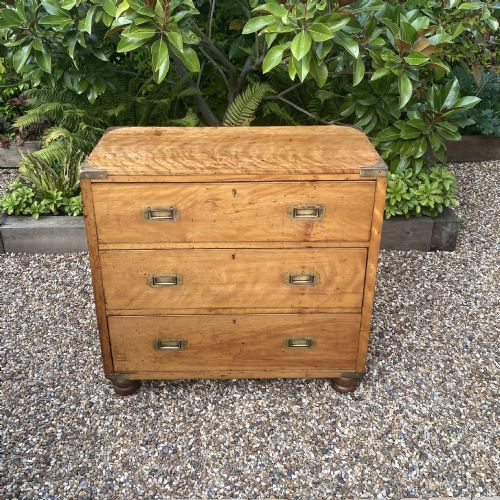
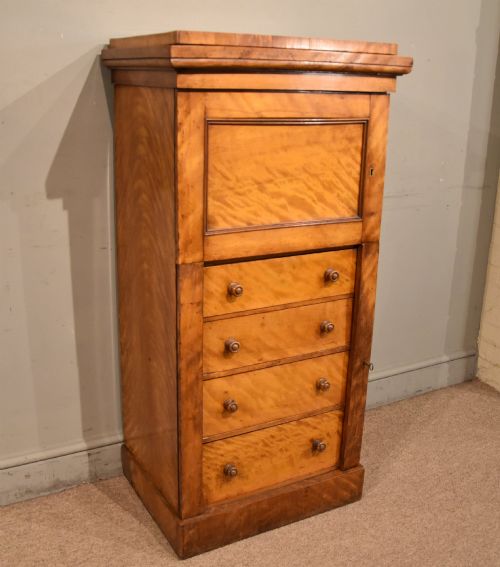

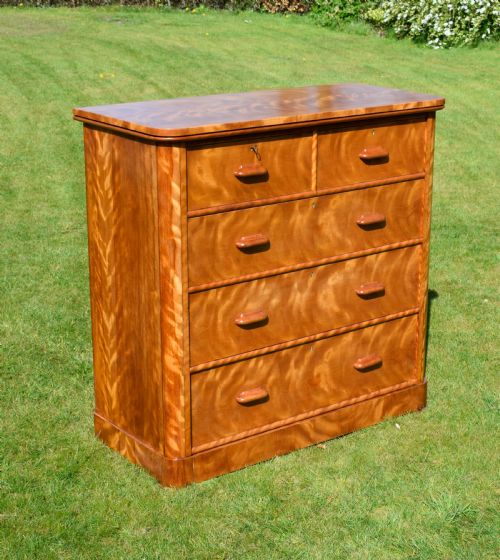


Victorian Satin Birch Chest
A victorian satin birch chest brings a luminous, pale amber grain to a room, offering both practical storage and striking nineteenth-century cabinet work.
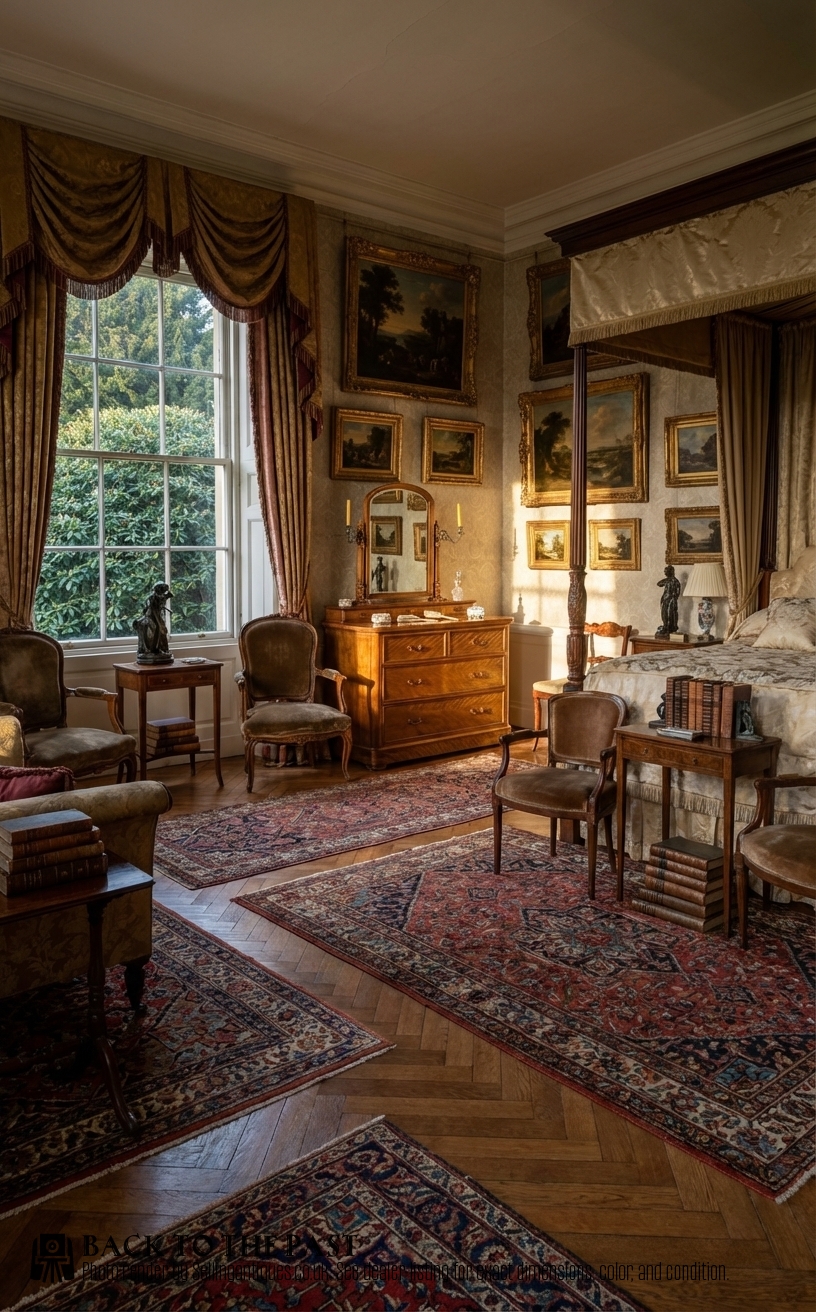
Victorian Satin Birch Chest
A victorian satin birch chest most commonly appears as a sturdy chest of drawers, though the grouping also encompasses Wellington chests, linen presses, bedside tables, and dressing chests. These pieces span the nineteenth century, with specific examples dated across the eighteen-sixties, seventies, eighties, and nineties.
Buyers encounter various configurations, from simple low chests to larger statement pieces featuring cupboards, candle sconces, or barley twist columns. The timber provides a distinctive pale, shimmering surface that sets these items apart from darker mahogany or walnut alternatives of the same era.
Materials and construction
Cabinet makers built these pieces primarily using satin birch veneer or solid satin birch, frequently supported by secondary woods such as pine and mahogany within the drawer linings and carcass frames. Metal fittings such as brass handles and hinges appeared alongside turned wooden bun handles and original glass details.
Construction methods relied on traditional joinery, creating robust housings for multiple drawers. Workshops applied stencilled details on specific dressing table chests, while others incorporated decorative structural elements like column turnings.
Listings demonstrate that satin birch was frequently paired with secondary woods like pine and mahogany, alongside brass and glass hardware.
Qualities that distinguish the range
The standard of a piece rests heavily on the intensity and figure of the satin birch timber, where highly figured grain commands greater attention. Cabinet work executed by documented London firms displays superior proportion and finer execution in decorative turns and drawer construction.
Proportion and utility also divide the selection, as larger linen presses or tall Wellington chests demand complex internal engineering. Pieces retaining original knob handles, brass mounts, and integrated cupboards demonstrate greater integrity than those altered over time.
Holland & Sons·Heal & Son·Druce & Co·Edwards and Roberts
The Victorian Satin Birch Chest Glossary
- Satin birch
- A timber derived from the North American birch species, characterised by a natural sheen and light golden colour that resembles satinwood. Craftsmen utilised it extensively for high-end Victorian furniture.
- Wellington chest
- A tall, slender chest of drawers secured by a hinged locking side bar that fastens with a key. This design originated in the nineteenth century for efficient paper and linen storage.
- Linen press
- A tall piece combining upper cupboard doors enclosing sliding trays with lower drawer storage for textiles. These items formed a central component of Victorian bedroom suites.
- Barley twist
- A decorative turning technique resembling a spiralling rope, frequently utilised on columns flanking drawer banks. This style added architectural depth to nineteenth-century case pieces.
Victorian Satin Birch Chest: Frequently Asked Questions
How do I care for satin birch?
Keep these items away from direct sunlight and steady heat sources to protect the pale timber veneer from drying or fading.
Apply a traditional wax polish occasionally and buff gently with a soft cloth to maintain the natural sheen.
Where were these chests placed?
Victorian households positioned these pieces primarily in bedrooms, dressing rooms, and occasionally grand hallways for linen and apparel storage.
Smaller bedside tables and dressing chests sat beside sleeping quarters to hold personal items and lighting.
Are all satin birch pieces solid wood?
Cabinet makers frequently applied fine veneers of satin birch over secondary timbers such as pine or mahogany to create stable, expansive drawer fronts and carcass panels.
Solid construction appeared alongside veneered surfaces depending on the specific furniture form and workshop.
How do I spot a later nineteenth-century piece?
Items produced towards the end of the century often incorporated stencilled decoration and alternative hardware alongside traditional drawer framing.
Construction details and secondary woods help confirm the manufacturing period within the Victorian era.