
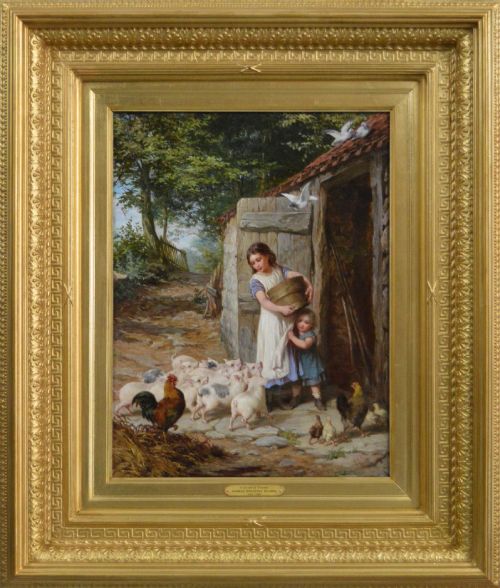


Victorian Rural Farm Painting
A victorian rural farm painting captures the quiet rhythm of nineteenth-century agricultural life through pastoral scenes of livestock, labour, and homesteads.
Victorian Rural Farm Painting
A victorian rural farm painting portrays the working countryside, featuring farmyards, heavy horses, cattle, and agricultural labourers at rest or toil. These works document a lost rural landscape through the lens of nineteenth-century pastoral realism and British impressionism.
Most examples found here utilise traditional media such as oil on canvas or watercolour pigment on paper, housed within period wooden and giltwood frames. The subjects range from expansive farming landscapes to intimate genre scenes of milkmaids and farm animals.
Materials and Technique
Painters applied oil paint or watercolour pigment onto prepared canvas and paper surfaces to build up detailed textures of foliage, animal coats, and rustic architecture. Artists frequently worked en plein air or developed studio compositions from preliminary field sketches.
Finished works were typically mounted within carved wood and gold leaf frames that complemented the visual weight and tonal depth of the composition.
Distinguishing Quality
Quality rests upon the artist's ability to render anatomical accuracy in animals and human figures, alongside a sophisticated handling of natural light across open fields and farmyards. Superior compositions balance the dynamic movement of plough teams with the tranquil atmosphere of rural pastures.
The sophistication of the palette and the subtlety of brushwork separate standard decorative works from fine examples executed by accomplished nineteenth-century practitioners.
George Augustus Holmes·James William Booth·Samuel Joseph Clark·Charles Vickers·John Linnell·Adrian Jones·John Frederick Herring Jnr·Frederick William Jackson·Thomas Mackay·George Cole·Georgina Lara·A Davis·Robert Gallon·William Greaves·Charles James Adams·Thomas Henry Thomas
The Victorian Rural Farm Painting Glossary
- Genre Realism
- A style of painting depicting scenes from everyday life, focusing here on agricultural workers and farmyard activities with naturalistic detail.
- Giltwood
- Wood that has been coated with gold leaf or a gold-coloured finish, commonly used for nineteenth-century picture frames.
- Pastoral Realism
- An artistic approach that portrays rural subjects and agricultural scenes without romanticised idealisation.
- Watercolour Pigment
- Finely ground colour suspended in a water-soluble binder, applied to paper to create translucent washes and fine details.
Victorian Rural Farm Painting: Frequently Asked Questions
What subjects appear in these paintings?
These works depict agricultural life, including farmyards, plough teams, resting labourers, and livestock such as horses, cattle, pigs, and sheep.
Artists also recorded specific rural structures like mills, farmsteads, and Surrey or Welsh landscapes.
Are these works painted on canvas or paper?
The selection includes both oil paintings executed on canvas and watercolours created on paper.
Frames typically consist of wood, often finished with giltwood or gold leaf.
How do I date a rural farm painting?
Dating relies on stylistic markers from the nineteenth and early twentieth centuries, moving from traditional British realism to early impressionism.
Signatures, artist biographical dates, and original framing materials also help establish the period.
How should I care for a Victorian painting?
Keep works out of direct sunlight to prevent fading in watercolour pigments and discolouration in oil varnishes.
Maintain stable indoor humidity levels to protect both the canvas support and the wooden gilt frame.