



Victorian Farm Artwork
Victorian farm artwork captures the agrarian life of the nineteenth century through oil paint and watercolour on canvas, paper and wood.
Victorian Farm Artwork
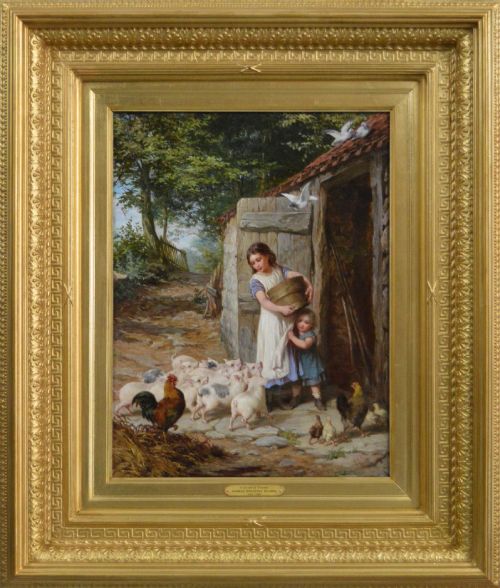
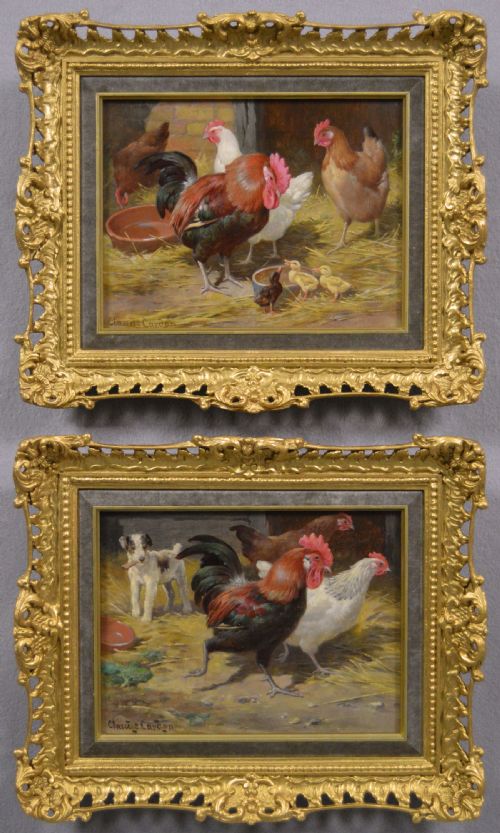
Victorian farm artwork depicts rural scenes, agricultural landscapes, livestock and farmyard animals from the nineteenth and early twentieth centuries. When searching for Victorian farm artwork, buyers encounter framed oil paintings and watercolours portraying cattle, horses, sheep, poultry and farm workers.
The subjects range from detailed portraits of prized shorthorn bulls and working shire horses to bustling farmyard scenes with pigs, ducks and figures tending to livestock. British and continental artists recorded these pastoral settings during periods spanning the mid-nineteenth century to the early twentieth century.
Most pieces on this page are oil paintings on canvas or paper watercolours, often housed in period giltwood frames. These works reflect a widespread artistic interest in realism and pastoral life during the Victorian and Edwardian eras.
Materials and technique
Artists applied oil paint to stretched canvas or wooden panels, building up layers of pigment to capture the textures of animal coats, feathers and rustic landscapes. Watercolours on paper provide a lighter medium for rural views and pastoral watercolours.
Many surviving pieces retain their original or period giltwood frames, which complement the tonal depth of the oil paintings. Gold leaf accents often highlight the ornate mouldings of these frames.
Listings span the nineteenth and early twentieth centuries, utilising oil paint, canvas, watercolour and giltwood.
What separates the work
Anatomical precision and liveliness in depicting animals distinguish finer paintings from simpler decorative works. Master painters rendered the musculature of shire horses and the fleece of sheep with careful observation and individual character.
Compositional complexity also marks the upper tier, where artists successfully balanced multiple figures, animals and atmospheric rural backgrounds within a single canvas.
George Augustus Holmes·Claude Cardon·Franz van Severdonck·James William Booth·John Frederick Herring Jnr·Samuel Joseph Clark·Charles Vickers·Percival Glenfern·John Linnell·Pierre Emmanuel Dielmans·Thomas Sidney Cooper·Edgar Hunt·Frederick William Jackson·Henry Birtles·Thomas Mackay·Georgina Lara·William Greaves·Robert Gallon·Louis Marie Dominique Robbe·Charles Hunt Jnr·Charles James Adams
The Victorian Farm Artwork Glossary
- Oil on Canvas
- A traditional painting method utilising pigments suspended in drying oils applied to a woven fabric support. This combination allowed artists to achieve rich colours and subtle blending.
- Giltwood
- Wood carved and coated with a thin layer of gold leaf or metallic powder. It provides decorative framing for nineteenth-century paintings.
- Etching
- A printmaking technique where lines are incised into a metal plate with acid before being inked and pressed onto paper. Herbert Dicksee utilised this method for detailed animal subjects.
- Watercolour
- A painting method where fine pigments are suspended in a water-soluble binder and applied to paper. It creates transparent washes of colour suited to pastoral landscapes.
- British School
- A designation for artists trained or working within Britain whose styles share regional characteristics of a given period. It encompasses various Victorian realists and landscape painters.
Victorian Farm Artwork: Frequently Asked Questions
What subjects appear in Victorian farm artwork?
These works display farmyard animals such as cattle, sheep, horses and poultry alongside figures engaged in rural labour. Landscapes and cottage scenes also feature prominently.
Artists documented dairy farming, ploughing teams and resting livestock within British and European pastoral settings.
How do I care for an antique oil painting?
Keep paintings away from direct sunlight and steady humidity levels to protect the canvas and oil paint. Avoid touching the painted surface directly.
Dust the canvas and frame gently with a dry, soft brush when necessary without using liquid cleaners.
How can I tell the period of a farm painting?
Examining the canvas preparation, framing style and artist signatures helps date the work. Victorian pieces often reflect mid-to-late nineteenth-century realism and pastoral themes.
Biographical details of recorded makers provide exact dates for active painting periods.