


Victorian Ruby Overlay Glass
Victorian ruby overlay glass combines deep red glass with clear crystal, offering rich colour and brilliant contrast that collectors prize for display.
Victorian Ruby Overlay Glass
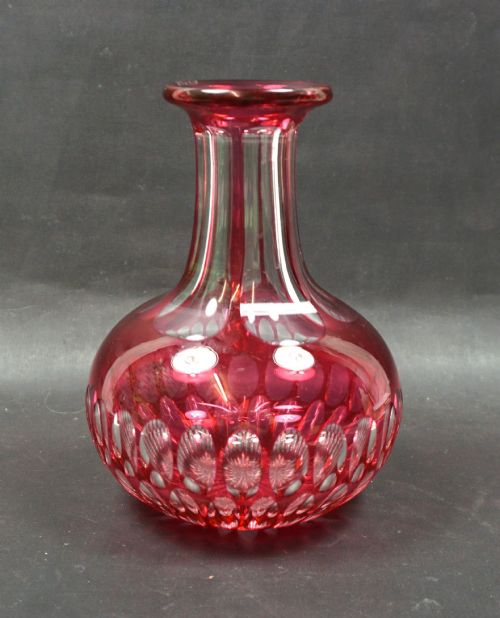
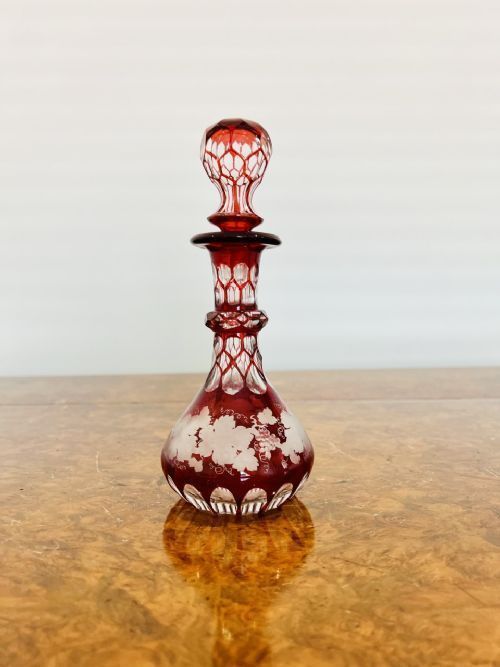
Victorian ruby overlay glass encompasses decorative and functional objects formed by casing a layer of red glass over clear crystal. When searching for victorian ruby overlay glass, buyers encounter tablewares and dressing table accessories produced in the nineteenth century, including decanters, vases, and scent bottles.
The pieces on this page span English and Bohemian workshops from the mid to late nineteenth century. Forms range from pairs of engraved champagne coupes and hanging bells to ovoid vases and spirit bottles.
How they were made
Makers produced these items by fusing a thin casing of ruby or cranberry glass over a primary body of clear lead crystal or glass. Artisans then cut through the outer red layer on a wheel to expose the clear crystal beneath, creating contrasting patterns and panels.
Many examples receive further ornamentation through hand gilding or detailed wheel engraving depicting motifs such as fruiting vines and birds. Silver tops and mercury glass finishes appear on specific dressing table pieces.
Certain hanging bells ring with surprising clarity across the room, proving that Victorian glassmakers balanced utility with theatrical charm.
What varies in quality
Quality rests upon the depth of the ruby casing and the crispness of the wheel cutting through the red layer into the crystal. Superior items display sharp facet edges and precise alignment where the overlaid colour contrasts cleanly with the clear ground.
The intricacy of surface decoration further distinguishes finer examples, particularly where hand engraving depicts detailed botanical or animal motifs alongside applied gold leaf. Weight and clarity in the underlying crystal also indicate superior manufacture.
The Victorian Ruby Overlay Glass Glossary
- Ruby Glass
- A rich red glass coloured with gold chloride during production. It forms the distinctive outer layer on many nineteenth-century overlay items.
- Cranberry Glass
- A lighter pinkish-red glass variant frequently utilised in English and Bohemian overlay tablewares and scent bottles. This tone is common among decanters and lily vases.
- Overlay Glass
- A technique involving two or more distinct layers of glass fused together before being cut or etched. The outer coloured layer is selectively removed to reveal the contrasting glass beneath.
- Lead Crystal
- A heavy, clear glass containing metallic oxides that increase brilliance and refractive index. It provides the clear foundation beneath the ruby casing.
- Mercury Glass
- A double-walled blown glass object silvered on the interior with a liquid mercury amalgam. It appears in specific nineteenth-century scent bottles.
Victorian Ruby Overlay Glass: Frequently Asked Questions
What is victorian ruby overlay glass?
Victorian ruby overlay glass consists of nineteenth-century decorative items made with a layer of red glass fused over clear crystal. Artisans cut through the outer red stratum to create patterns.
These pieces include decanters, scent bottles, and vases produced in English and Bohemian workshops during the period.
How do I clean my decanter?
Clean these delicate items gently by hand using warm water and mild soap. Avoid abrasive materials that might scratch the surface or damage applied gilding.
Take particular care around silver tops and engraved sections to preserve the historical integrity of the piece.
Are these pieces English or Bohemian?
The inventory includes items from both English makers and Bohemian workshops of the nineteenth century. English pieces frequently feature cranberry glass decanters and lily vases.
Bohemian production is often represented by richly cut ovoid vases and gilded hanging bells from the same era.