

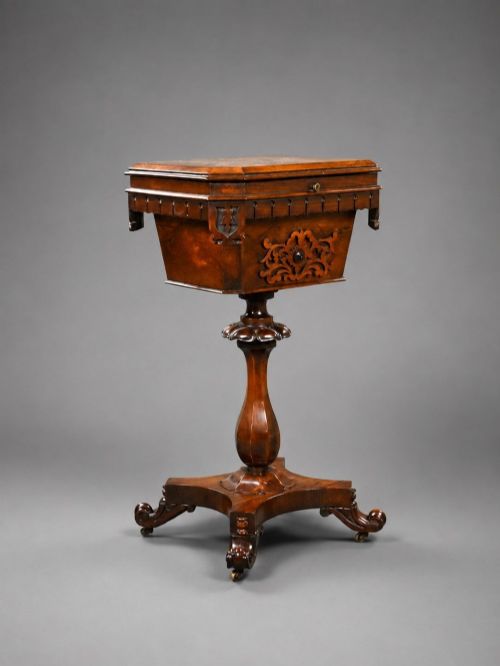

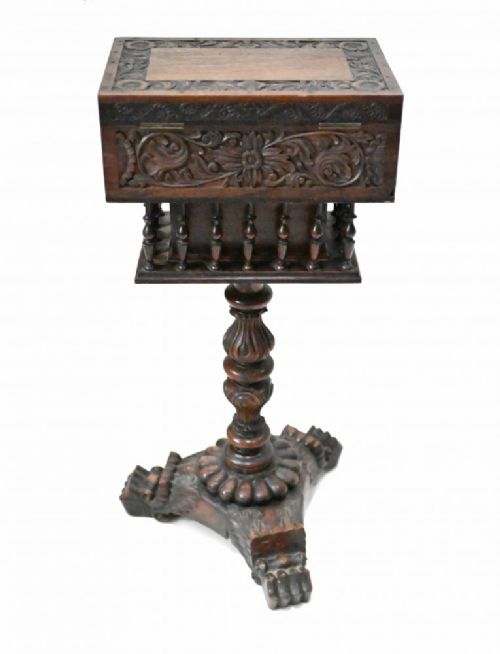


Victorian Rosewood Tea Chest
A Victorian rosewood tea chest is a substantial timber container made to hold expensive dry leaves, prized for its deep grain and fine joinery.
Victorian Rosewood Tea Chest
A victorian rosewood tea chest is a domestic receptacle designed to store and preserve high-value tea leaves during the nineteenth century. The selection on this page centres on sturdy sarcophagus shapes, box forms, and occasional tea poy tables originating across the Victorian, Regency, and William IV periods.
Buyers encounter pieces ranging from plain polished rosewood boxes to elaborate examples featuring Tunbridge Ware mosaic inlay or brass stringing. Most specimens incorporate interior compartments with fitted lids intended to keep green and black tea blends separate and airtight.
How they were made
Maker construction relies on dense rosewood timber veneers applied to solid secondary woods, shaped into sarcophagus, domed, or rectangular boxes. Cabinetmakers utilised brass for hinges, escutcheons, and interior mixing bowls, while bone or boxwood provided contrast for stringing and keyhole surrounds.
Specialised workshops produced intricate mosaic patterns using tiny coloured wood blocks for Tunbridge Ware panels, characteristic of makers such as Henry Hollamby. Other variants employ complex marquetry and mixed wood inlay to decorate the primary surfaces.
Victorian Rosewood Tea Chest Retail Price Guide 2026
Typical asking prices for victorian rosewood tea chest among the pieces listed under this phrase on Sellingantiques today, from the lower quarter to the upper quarter. They describe what is for sale here now, not the wider market.
Some containers include secret hidden drawers operated by releasing concealed wooden spring latches tucked beneath the internal canisters.
What varies in quality
Quality differentiates through the precision of the timber matching and the complexity of the exterior decoration. Superior pieces display continuous grain alignment across the lid and sides alongside intricate brass inlay or intact mosaic work.
Internal architecture dictates value, with top-tier examples retaining original fitted glass mixing bowls, secondary canisters, and working locks with matching keys. Lesser examples show simpler box construction with replaced interiors and absent compartments.
Henry Hollamby
The Victorian Rosewood Tea Chest Glossary
- Sarcophagus shape
- A distinctive box profile featuring a steep sloping lid and curved sides that mimics monumental stone tombs. This form dominated high-end cabinet making during the Regency and Victorian eras.
- Tea poy
- A pedestal-supported tea container standing on a pillar and base, often functioning as a small side table in the drawing room. These pieces provide greater height and presence than standard tabletop caddies.
- Tunbridge Ware
- A type of decorative woodwork characterised by mosaic designs built from thousands of tiny tinted wood squares. These geometric or pictorial panels adorn the lids and panels of select containers.
- Marquetry
- The art of applying thin decorative veneer pieces to a structural surface to create pictorial or abstract patterns. Makers combined rosewood, boxwood, and holly to achieve tonal contrast.
Victorian Rosewood Tea Chest: Frequently Asked Questions
What was inside a tea chest?
These containers held two or three fitted interior canisters or caddies designed to keep different tea leaves fresh, alongside a central glass mixing bowl.
Leaf tea was exceptionally expensive in the nineteenth century, so the entire chest remained locked by the master of the house to control consumption.
How do I date a rosewood chest?
Dating relies on exterior silhouette, hardware style, and secondary woods, with sarcophagus shapes and brass inlay pointing toward the Regency and early Victorian periods.
Later Victorian examples often incorporate French polish finishes and lighter rosewood veneers, while William IV pieces display heavy classical proportions.
Where were these chests placed?
Owners typically positioned tea containers on side tables in the drawing room or dining room where hospitality was performed.
Guests would watch the lady of the house measure and blend the loose leaves before hot water was added to the porcelain pot.
Are the interior mixing bowls original?
Many surviving chests retain their blown or cut glass mixing bowls, though these fragile elements were frequently replaced over decades of domestic use.
Original bowls fit precisely into the circular wooden aperture and show matching period wear to the underside base.