
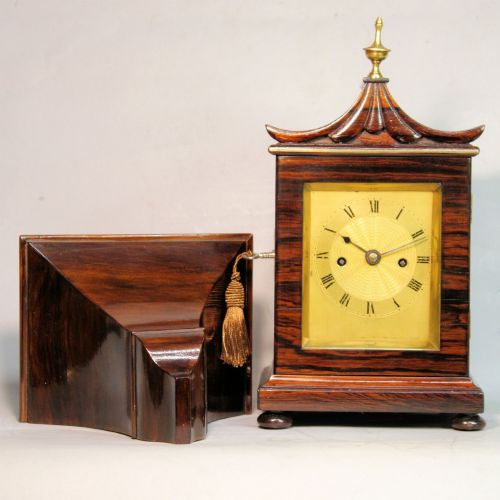


Victorian Rosewood Mantel Clock
These Victorian rosewood mantel clocks bring striking timepieces of rich timber and brass detail into a room.
Victorian Rosewood Mantel Clock
A victorian rosewood mantel clock is a domestic timekeeping device housed in timber from the Dalbergia genus, commonly encountered in nineteenth-century forms. These objects appear in styles ranging from French portico designs to English library and bracket clocks.
The pieces on this page span the nineteenth century, with specific examples dated across the eighteen-fifties, sixties, seventies, and eighties. Buyers regularly encounter both British and French origins alongside occasional American wall and mantel variants.
Forms include dome-topped cases, shaped French bodies, and elaborate portico architectures. Enamel dials, silvered metal, and glass panels frequently accompany the timber framing.
How they were made
Maker workshops constructed these bodies using solid rosewood and rosewood veneer over secondary timbers. Surface ornamentation often incorporates lemonwood inlay, brass mounts, and ormolu details.
Interiors house mechanical movements such as single and twin fusee mechanisms, eight-day trains, and platform escapements. Dials feature white enamel or silvered metal surfaces protected behind glass bezels.
Object types include bracket clocks, wall clocks, portico timepieces, and library clocks spanning the eighteen-hundreds to nineteen-hundreds.
What varies in quality
The refinement of the rosewood grain and the precision of any lemonwood or marquetry inlay dictate visual distinction. Elaborate ormolu mounts and cast brass elements separate standard timepieces from more ambitious portico and bracket forms.
Internal mechanical complexity, from simple timepieces to quarter-striking twin fusee movements, defines the standard of production. Signed dials by noted makers add archival weight to the physical construction.
Arnold and Frodsham·Paul Garnier·Walker and Hall·L Donne Birchin Lane·Robert Bryson Edinburgh
The Victorian Rosewood Mantel Clock Glossary
- Fusee
- A conical pulley used in clock movements to maintain even tension on the chain as the mainspring unwinds. This mechanism improves timekeeping accuracy across the power reserve.
- Portico clock
- A clock architecture supported by four columns, resembling a classical portico. These cases frequently display rich wood veneers and metal mounts.
- Bracket clock
- A portable table clock originally designed to sit on a wall bracket. Many examples feature substantial carrying handles and architectural timber cases.
- Ormolu
- Gilded bronze ornamentation applied to furniture and clock cases. This material provides bright metallic contrast against dark rosewood surfaces.
- Platform escapement
- A self-contained escapement assembly mounted on a small platform. It allows clocks without pendulums to maintain accurate time in portable formats.
Victorian Rosewood Mantel Clock: Frequently Asked Questions
What is a fusee movement?
A fusee is a conical pulley designed to equalise the declining power of a mainspring as it unwinds. This keeps the driving force consistent for the escapement.
Clocks with fusee movements often indicate English workshop origin and higher mechanical ambition during the nineteenth century.
How do I identify a portico clock?
Portico clocks feature a distinct architectural case supported by four vertical pillars surrounding the central dial. They draw heavily on neoclassical design principles.
Makers frequently enhanced these timber and veneer structures with ormolu mounts and delicate lemonwood inlay.
Where should I place a mantel clock?
These clocks belong on stable horizontal surfaces such as mantelpieces, sideboards, or library tables where vibration is minimal. Keeping them away from direct sunlight protects the rosewood finish.
Ensure the surface is level to allow the pendulum or platform escapement to beat evenly.
How do French and English styles differ?
English examples on this page often lean towards bracket, library, and fusee configurations with restrained wood surfaces. French pieces frequently present portico, shaped, and marquetry-inlaid bodies.
Both traditions utilise glass panels and enamel dials to showcase the interior mechanics.