
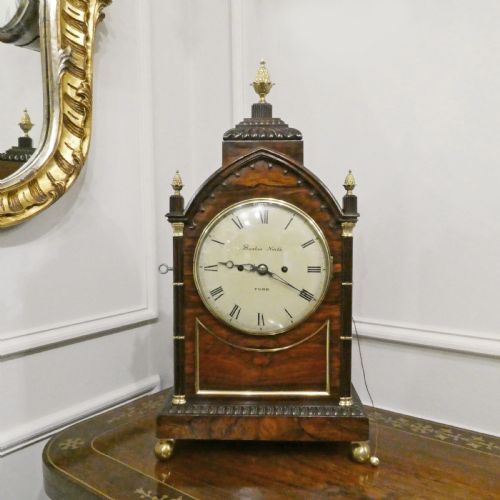
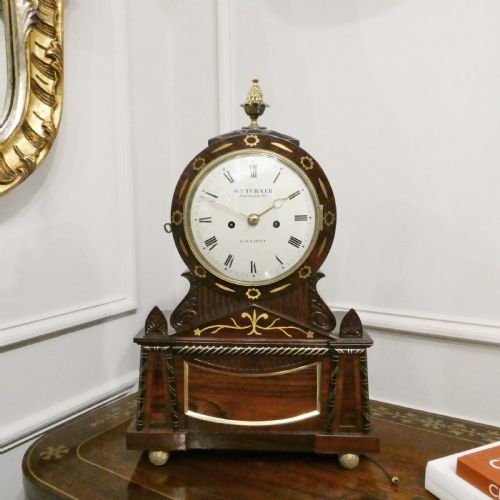
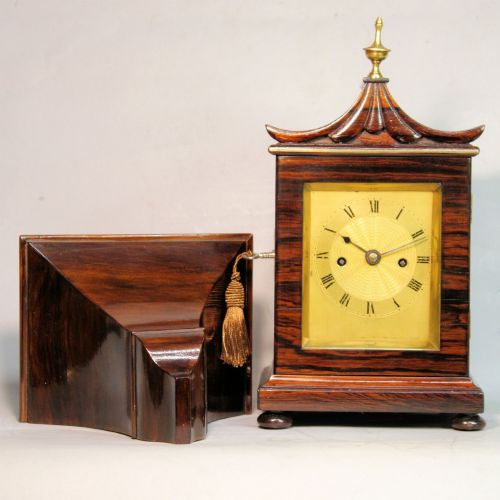


English Rosewood Bracket Clock
An english rosewood bracket clock brings nineteenth-century precision and rich timber grain to a mantel or wall.
English Rosewood Bracket Clock
An english rosewood bracket clock is a portable timepiece housed in a rich dark timber case, often designed to sit on a bracket or table. Buyers seeking this phrase encounter mantel clocks, library clocks, and table clocks spanning the Georgian, Regency, William IV, and Victorian periods.
The examples on this page predominantly feature nineteenth-century construction with rosewood cases, incorporating brass, gilt brass, and glass elements. Forms range from small library clocks to large brass-inlaid Regency pieces and miniature fusee timepieces with optional wall brackets.
How they were made
Cabinet makers constructed the clock cases primarily from rosewood, frequently applying brass inlay or ebonised wood details to enhance the dark timber. Movement makers integrated fusee mechanisms and silvered metal dials within glass-fronted or five-glass enclosures.
Workshops utilised materials such as mother-of-pearl and gilt brass for dial decoration and bezel surrounds. Platform escapements and striking trains appeared in library and mantel formats during the mid nineteenth century.
Some miniature clocks come with an optional wall bracket, proving that Victorian makers knew how to downsize grand furniture for compact spaces.
What varies in quality
Quality rests in the crispness of the brass inlay, the depth of the rosewood grain, and the execution of the clock movement by named makers. Precision in the silvered metal dial and the clarity of the glass panels distinguish finer workshop output.
Proportion and scale alter the character of the clock, ranging from miniature library timepieces to large Regency examples. The integration of specialised escapements and signed dial plates marks the distinction between standard production and masterwork items.
Barber and North of York·Turner of London·George Orpwood·Seller of Reading·Arnold and Frodsham·Plumbly and Tupman
The English Rosewood Bracket Clock Glossary
- Bracket clock
- A portable spring-driven clock originally designed to rest upon a matching wall bracket or table. These cases often incorporate carrying handles and glazed side panels.
- Fusee
- A conical pulley connected to the mainspring by a chain or cord, designed to equalize the driving force as the spring unwinds. This mechanism ensures more consistent timekeeping throughout the running period.
- Library clock
- A compact mantel or table clock intended for domestic study use, frequently featuring multiple glass panels for viewing the movement. They appear in nineteenth-century English domestic interiors.
- Platform escapement
- A self-contained escapement unit mounted on a small platform within the clock, common in later nineteenth-century timepieces. It allows portable clocks to keep accurate time without requiring strict vertical leveling.
- Silvered metal
- A brass or copper dial plate treated with a silver compound to produce a matte white metallic finish. Engraved numerals and maker signatures stand out clearly against this treated surface.
English Rosewood Bracket Clock: Frequently Asked Questions
What is a fusee movement?
A fusee movement uses a conical pulley and chain to maintain steady power as the mainspring relaxes. This mechanical device improves accuracy across the running duration of the clock.
Such movements represent traditional high-grade English horology found in nineteenth-century bracket and library clocks.
Where should I place a library clock?
Library clocks suit small tables, desks, or mantelpieces where their compact rosewood cases and glass panels remain visible. They add traditional timekeeping presence to domestic rooms without dominating the space.
Ensure the surface is stable and free from excessive vibration to protect the delicate internal escapement.
How do I date an english rosewood bracket clock?
Dating relies on stylistic markers from periods such as the Georgian, Regency, William IV, and Victorian eras. Brass inlay patterns, dial configurations, and case proportions shift across these decades.
Signatures inscribed on the silvered metal dials often link the piece directly to recorded nineteenth-century makers.
What are five-glass clocks?
Five-glass clocks feature glazed panels on the top, sides, and front, allowing light to illuminate the movement from multiple angles. This design became popular for library and mantel timepieces during the nineteenth century.
The transparent housing showcases both the dial and the internal brass mechanics simultaneously.