


Victorian Recording Barometer
These victorian recording barometer pieces track atmospheric pressure mechanically over time, offering a tangible link to nineteenth-century meteorological observation.
Victorian Recording Barometer
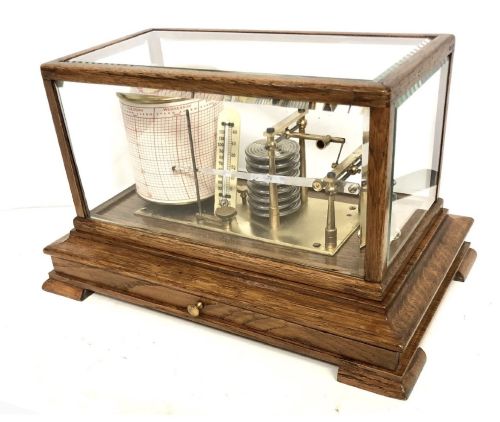
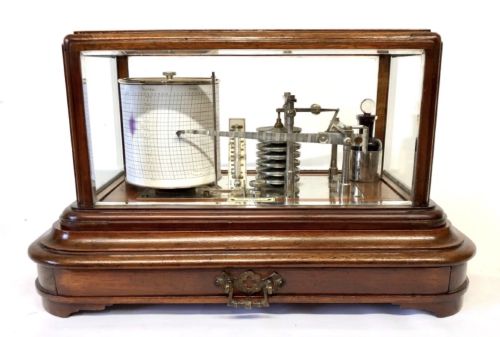
A victorian recording barometer, commonly encountered as a barograph, houses a mechanical weather-recording mechanism beneath glass panels. These scientific instruments translate atmospheric changes into ink traces on paper charts.
The selection here encompasses various housing styles, from mahogany and oak cabinet designs to wall-mounted configurations and combined weather stations featuring integrated thermometers or barometers.
Most examples originate from the Victorian period through to the Edwardian era, spanning the nineteenth and early twentieth centuries with robust cabinet construction.
Materials and construction
Cabinet makers utilised dense timbers such as mahogany, oak, and walnut to enclose the delicate brass and steel internal movements. Bevelled glass panels often protect the clockwork drums and lever arms from dust.
Paper charts receive the continuous ink trace generated by the barometer linkage, while brass components ensure smooth mechanical operation without corrosion.
Distinctions in quality
Quality rests upon the precision of the brass mechanism and the joinery of the timber case, alongside the presence of maker signatures. Fine examples display crisp engraving on instrument scales and heavy bevelled glass fitting tightly within dovetailed or mitred frames.
The integration of ancillary instruments like thermometers or barometer dials elevates the sophistication of the piece, distinguishing standard utility pieces from high-grade scientific apparatus.
GAUPP & CO HONGKONG & SINGAPORE·NEGRETTI & ZAMBRA LONDON·SHORT & MASON LONDON·BAINES HARROGATE·Robson of Newcastle·Antoine Redier·Callaghan & Co of London·RICHARD FRERES·JH Steward London
The Victorian Recording Barometer Glossary
- Barograph
- A self-recording barometer that graphs atmospheric pressure onto a rotating paper chart over a weekly period. This mechanical device relies on stacked vacuum chambers.
- Aneroid barometer
- An instrument measuring air pressure by the expansion and contraction of an elastic metal box, operating without liquid mercury. This forms the sensing heart of the recording mechanism.
- Bevelled glass
- Glass panes with angled edges fitted into the cabinet frame to offer clear viewing angles of the internal machinery. This detail indicates superior cabinet craftsmanship.
- Chart drawer
- A small compartment built beneath the main instrument platform to store replacement paper records. It keeps consumables close at hand.
Victorian Recording Barometer: Frequently Asked Questions
How do I change the chart paper?
Lift the glass cover and gently release the pen arm using the small lever. Slide the old paper chart off the rotating drum and secure a fresh one in its place.
Ensure the pen nib rests lightly on the new paper before closing the case and winding the clockwork movement.
Where should I place a barograph?
Position the instrument on a stable, level surface away from direct sunlight, radiators, and heavy vibrations. A quiet hallway or study provides a consistent environment.
Avoid areas with high humidity to protect the brass mechanisms and wooden cabinet from gradual deterioration.
How do I date these instruments?
Examine the style of the timber cabinetry, the maker signature, and any patent details stamped on the brass bedplate. Edwardian pieces often show lighter oak tones, while Victorian examples lean toward rich mahogany and walnut.
Archival records of known instrument makers help narrow down the decade of production.
Do these instruments require calibration?
Periodic adjustment against a reliable local weather source ensures accurate pressure readings. A small adjustment screw on the mechanism allows fine-tuning of the pen arm position.
Changes in altitude and long-term metal fatigue in the vacuum chambers make occasional recalibration standard practice.