


Victorian Pet Portrait
These Victorian pet portrait works capture the character of cherished dogs and cats, offering an intimate glimpse into nineteenth-century domestic life.
Victorian Pet Portrait
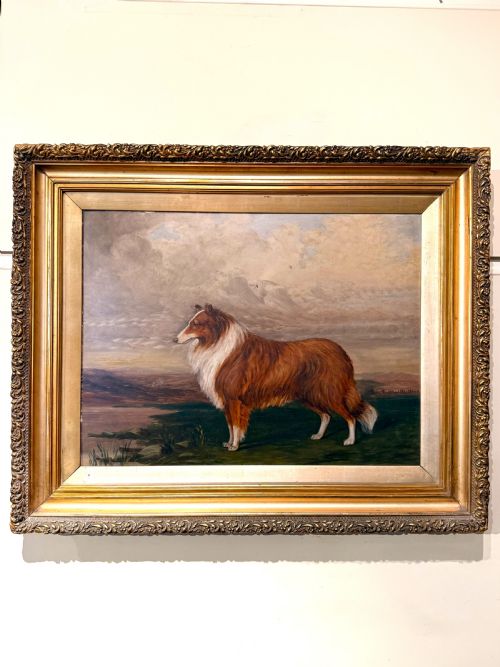
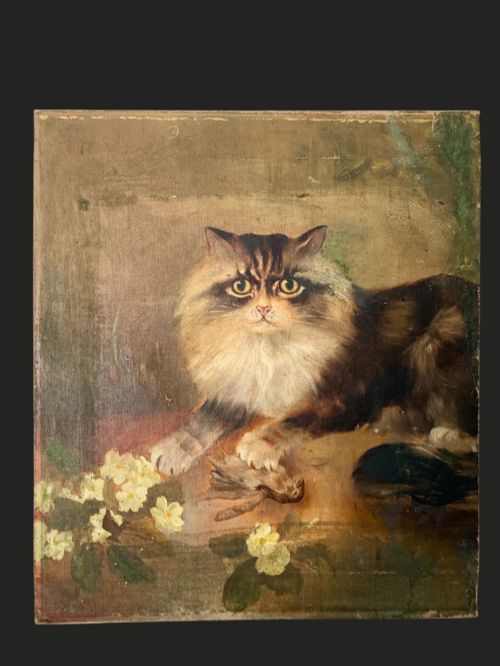
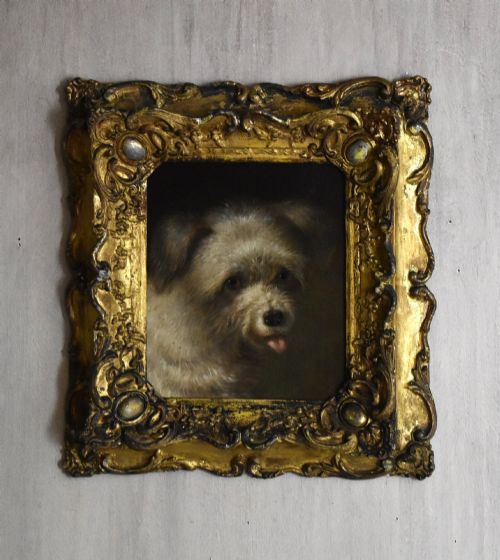
A Victorian pet portrait depicts domestic animals, most frequently dogs and cats, rendered by nineteenth-century artists working in oil, canvas, and board. These works range from naive school studies to detailed realism.
The subjects include individual prize-winning animals, spaniels, terriers, and groups of kittens, often shown within domestic interiors or rural settings. Framed textiles and prints also appear alongside original paintings.
Most pieces date from the nineteenth century, extending into the early twentieth century, reflecting a strong period interest in the personality and companionship of household animals.
Materials and Technique
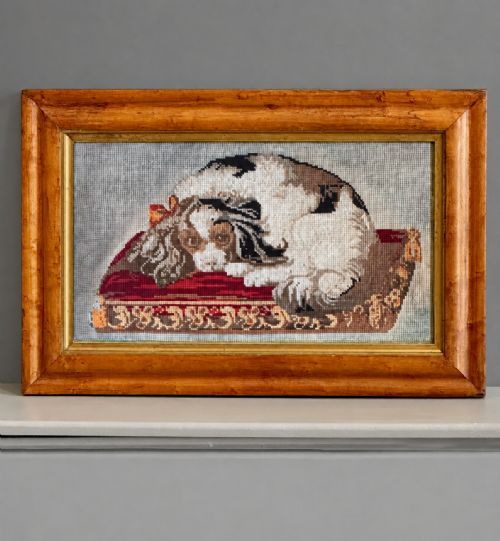
Artists painted primarily in oil on canvas or wood board, utilising layered pigments to build depth in fur textures and animal expressions. Needlework Berlin wool work employs coloured threads on canvas to form detailed animal figures.
Frames are constructed from wood, often finished with gesso and gold leaf or built from burr maple. These surrounds complement the domestic character of the paintings and needleworks.
Several kittens caught mid-mischief share wall space with prized greyhound racing champions.
The Measure of Quality
Quality rests in the anatomical accuracy of the animal, the handling of light in the coat, and the expressiveness of the eyes. Works by recorded artists demonstrate a surer command of form than provincial naive school pieces.
The preservation of the original surface, the depth of the oil pigments, and the integrity of the period frame contribute to the standing of an individual piece.
Martin Theodore Ward·William Barraud·Agnes Augusta Talboys·John Henry Dell·Valentine Thomas Garland·Philip Eustace Stretton·Charles Burton Barber·Francisco José Domingo y Marqués·Samuel John Carter·Jules Le Roy
The Victorian Pet Portrait Glossary
- Naive school
- An art style characterised by a childlike simplicity of perspective and line, often produced by self-taught provincial painters. These works offer charm through direct observation rather than academic precision.
- Berlin work
- A type of nineteenth-century needlework stitched in wool on canvas from printed pattern charts. It frequently depicts popular domestic animals in vibrant colours.
- Gesso
- A plaster-like mixture applied to wooden frames as a base for gilding or painting. It provides a smooth surface for decorative mouldings.
- Chromolithograph
- A multicoloured print produced through a lithographic process using several stones or plates. This technique allowed faithful reproduction of oil paintings in the Victorian period.
Victorian Pet Portrait: Frequently Asked Questions
How do I identify a Victorian pet portrait?
Look for nineteenth-century canvas or board supports, typical subject matter such as spaniels or kittens, and period framing materials like burr maple or gesso.
Artist signatures, stylistic traits associated with the naive school or realism, and nineteenth-century pigments further confirm the era.
What animals appear in these portraits?
Dogs and cats form the vast majority of the subjects, ranging from named champions to pet rabbits and terrier studies.
Artists frequently depicted King Charles spaniels, terriers, greyhounds, and groups of playful kittens.
Are these works always painted in oil?
Oil paint on canvas or wood board is the predominant medium found in these listings, capturing texture and light in the animals' coats.
Needlework textiles and chromolithograph prints also represent the category.
How were these portraits displayed originally?
Victorian owners hung these framed paintings within domestic interiors to celebrate the specific character of their household animals.
The inclusion of original burr maple and gesso frames indicates their intended prominent place in nineteenth-century homes.